Best Accounting Software for UK Freelancers (2026): Xero, FreeAgent, QuickBooks, Sage and Zoho Compared
Best Accounting Software for UK Freelancers (2026): Xero, FreeAgent, QuickBooks, Sage and Zoho Compared
Last updated: October 2026
This guide is written for freelancers and contractors. For a comparison focused specifically on self-employed sole traders — including MTD ITSA pricing at the £10/month level and the September 2026 Xero price rise — see our best accounting software for UK sole traders (2026).
⚠️ Xero price update: Xero UK increased subscription prices on 1 September 2026. Ignite rose from £16 to £18/mo, Grow from £37 to £39/mo, Comprehensive from £50 to £55/mo, and Ultimate from £65 to £70/mo (all ex. VAT). Prices in this article reflect the new September 2026 rates. See Xero's pricing update page.
From 6 April 2026, sole traders and freelancers earning above £50,000 a year must keep digital records and submit quarterly updates to HMRC under Making Tax Digital for Income Tax. That threshold drops to £30,000 in April 2027, and to £20,000 in April 2028. If you are still running your books in a spreadsheet — or not running them properly at all — the window to sort this without a last-minute scramble is closing. The right accounting software will file your quarterly MTD submissions automatically, keep your Self Assessment ready year-round, and cost you considerably less than a bookkeeper charging by the hour.
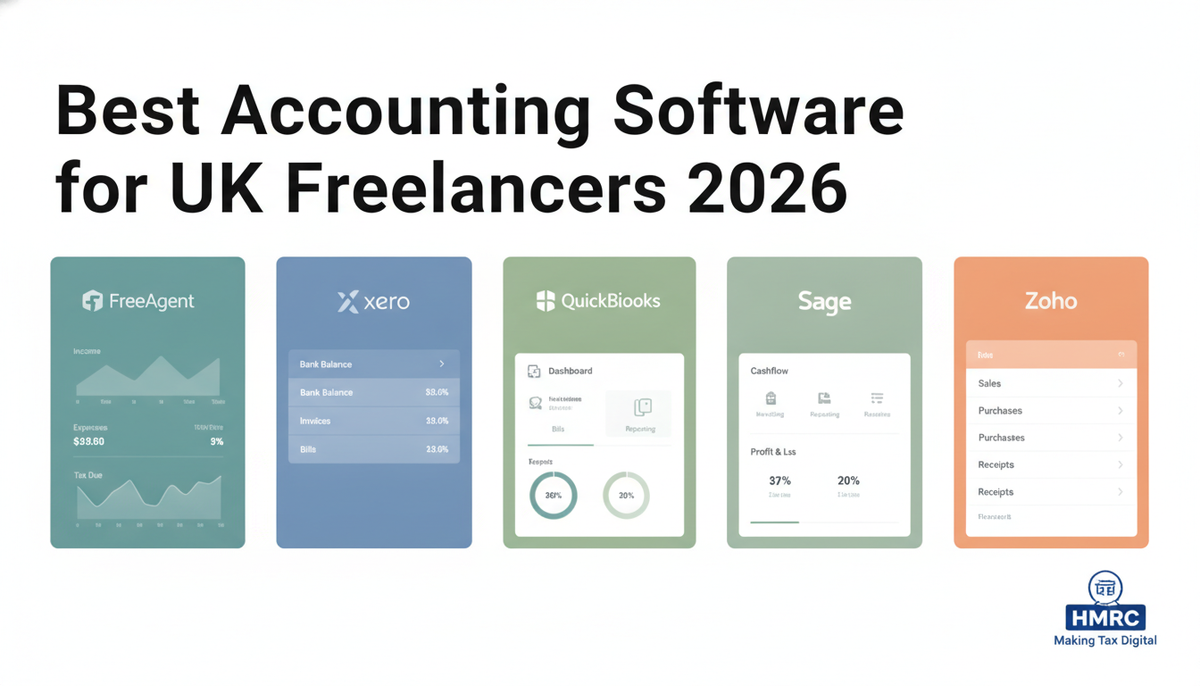
This guide compares the five strongest contenders for UK freelancers and sole traders in 2026: FreeAgent, Xero, QuickBooks, Sage and Zoho Books. Each has a genuine case for different circumstances. We have checked current UK pricing directly from vendor sites (June 2026), examined real-user feedback from AccountingWEB and Trustpilot, and mapped the compliance picture against HMRC's recognised software list. All prices are quoted excluding VAT unless stated.
Not sure which plan Xero you actually need? Compare Ignite vs Grow before you commit.
Read the Xero plan comparison →
TL;DR — three picks for three budgets
- Free with your bank: FreeAgent — NatWest, RBS, Ulster Bank or Mettle customers get the full platform at no cost. HMRC-recognised, MTD-ready, and built specifically for sole traders.
- Cheapest paid MTD option: QuickBooks Sole Trader Plus at £10/month — the lowest price from a mainstream provider for non-VAT freelancers needing quarterly MTD submissions.
- Best for growth: Xero Ignite at £20/month — strongest app ecosystem, accountant-preferred, and the cleanest path from sole trader to limited company without a painful migration.
Quick Comparison: UK Freelancer Accounting Software 2026
Prices below are monthly list price, excluding VAT. Most providers run introductory discounts of 50–90% for the first three to twelve months — check vendor sites for current offers before committing.
| Tool | Best For | Price (£/mo, ex VAT) | MTD ITSA | Payroll incl. | Free Trial |
|---|---|---|---|---|---|
| FreeAgent | NatWest/RBS/Mettle customers, freelancers & contractors | Free (qualifying bank) or £19 | ✅ | ✅ | 30 days |
| Xero Ignite | Growing freelancers, accountant ecosystem | £18 | ✅ | ❌ Add-on | 30 days |
| QuickBooks Sole Trader Plus | Budget-conscious non-VAT freelancers | £10 | ✅ | ❌ Add-on | 30 days |
| Sage Sole Trader | Non-VAT freelancers wanting a free or ultra-cheap start | Free or £7 | ✅ | ❌ | 30 days |
| Zoho Books Free | Micro-businesses and startups under £35k turnover | Free (or £12 Standard) | ✅ | ❌ | 14 days |
Sources: freeagent.com/pricing, xero.com/uk/pricing, quickbooks.intuit.com/uk, sage.com/en-gb, zoho.com/uk/books/pricing — all checked June 2026.
FreeAgent: The Best Deal in the Market If Your Bank Qualifies
FreeAgent was built in Edinburgh specifically for the UK freelancer and contractor market, and it shows. Self Assessment filing, real-time tax estimates that update as you log income, time tracking, project management — it is all included on every plan, with no feature gating. The product is now owned by NatWest Group, which is both a strength (distribution, longevity) and a limitation (if you want entirely independent software).
The headline story is the free tier. If you hold a business current account with NatWest, Royal Bank of Scotland, Ulster Bank, or Mettle — and make at least one transaction per month on Mettle — you get the full FreeAgent platform at no cost, for as long as you hold the account. No stripped-down version, no hidden upsells. Approximately 40% of FreeAgent's 200,000+ UK users access it this way, according to the company's own figures.
For everyone else, the standalone pricing for a sole trader is £19/month (or £190/year), with a 50% introductory discount for the first six months. That makes the actual entry cost £9.50/month for the first half-year before settling at the full rate. One add-on is worth noting: Smart Capture Unlimited, which removes the 10-receipt-per-month limit on OCR scanning, costs an additional £5/month. Busy freelancers processing more than a handful of expenses monthly will almost certainly need it.
FreeAgent pricing summary (June 2026)
| Plan | Monthly (full) | Annual | Intro rate (6 months) |
|---|---|---|---|
| Sole Trader | £19/mo | £190/yr | £9.50/mo |
| Landlord | £10/mo | £100/yr | £5/mo |
| Limited Company | £33/mo | £330/yr | £16.50/mo |
| NatWest/RBS/Ulster/Mettle | Free | Free | Free |
Source: freeagent.com/pricing, June 2026. All prices exclude 20% VAT.
Key features: Invoicing, expense tracking with OCR, Open Banking feeds, payroll (included on all plans), project and time tracking, real-time tax estimates, MTD for VAT, MTD for Income Tax, direct Self Assessment filing. FreeAgent is one of the few platforms that files your SA return directly without needing a separate tool.
Pros: UK-built and designed for sole traders from day one. Payroll included at no extra cost. Arguably the clearest tax timeline display of any product in this comparison. Free for a very large portion of UK freelancers via the NatWest banking tie-in. Direct SA filing eliminates a key admin bottleneck.
Cons: At £19/month standalone, it is the most expensive option in this guide for sole traders who do not qualify for the bank deal. QuickBooks Sole Trader Plus at £10/month offers comparable core functionality at nearly half the price for non-NatWest users. The interface, while well-designed, can feel more complex than necessary for a sole trader with simple income. Smart Capture add-on is an extra cost that feels like it should be bundled.
Best for: Freelancers and contractors who bank with NatWest, RBS, Ulster Bank or Mettle (for whom it is simply the best deal in the market), and sole traders who want direct Self Assessment filing and built-in project tracking. Read our full FreeAgent review for a detailed breakdown.
Xero: The Strongest Platform for Freelancers With Growth Plans
Xero is not the cheapest option here, and it was not designed exclusively for sole traders. What it offers instead is depth: the largest app marketplace of any UK accounting platform (over 1,000 integrations), the most thorough adoption among UK accountants and bookkeepers, and a clear upgrade path from a simple sole trader account all the way to a multi-director limited company without ever changing software. If you plan to grow, hire staff, or incorporate, starting on Xero avoids an expensive and disruptive migration later.
Xero restructured its UK pricing in 2024, adding a budget Simple tier and renaming its plans. The current UK range for freelancers runs from £7/month (Simple — non-VAT only, with significant restrictions) through to £55/month (Comprehensive, which adds multi-currency and analytics). For most growing sole traders, Xero Ignite at £20/month is the most sensible entry point: it includes MTD for Income Tax, unlimited bank reconciliation, and basic invoicing and expenses, while the cheaper Simple plan excludes expense claims and mileage tracking entirely.
One limit worth flagging on Ignite: 20 invoices and 5 bills per month. For a freelancer invoicing a handful of clients this is usually fine. For anyone approaching 20 invoices monthly, the Grow plan at £39/month removes these caps entirely. The decision tree is straightforward: check your current invoice volume before committing.
Xero pricing summary (June 2026)
| Plan | Price (ex VAT) | Invoice limit | VAT returns |
|---|---|---|---|
| Simple | £7/mo | 5/mo | ❌ Non-VAT only |
| Ignite | £18/mo | 20/mo | ✅ |
| Grow | £39/mo | Unlimited | ✅ |
| Comprehensive | £55/mo | Unlimited | ✅ + multi-currency |
Source: xero.com/uk/pricing, June 2026. All prices exclude 20% VAT. Payroll add-on: +£6/mo for up to 5 employees.
Key features: MTD for VAT and Income Tax, Open Banking feeds, invoicing with payment links, expense claims and mileage tracking (Ignite and above), project tracking (Grow and above), Hubspot and Stripe integrations, Xero AI-assisted bank categorisation. For freelancers using Dext for receipt capture, the Dext and Xero integration is one of the most polished in the market, with automatic coding and sync.
Pros: By far the deepest ecosystem of any platform in this comparison — receipts from Dext, cashflow forecasting from Float, payroll from the native add-on. Accountants almost universally prefer Xero over the alternatives, which matters if you ever hand off your year-end. MTD ITSA was recognised by HMRC well ahead of the April 2026 deadline. Stronger reporting than FreeAgent at equivalent price points.
Cons: The Simple plan's feature restrictions catch many sole traders by surprise — no expense claims, no mileage tracking, capped at 5 invoices/month. Payroll is a separate add-on cost rather than included. Not the cheapest for a very simple freelancer setup. Self Assessment filing requires either an accountant or a third-party tool; Xero does not file your SA directly in the way FreeAgent does.
Best for: Freelancers planning to grow, freelancers whose accountant uses Xero, and anyone who needs the widest possible integration ecosystem. Also the natural choice if you are considering incorporating as a limited company in the next two to three years. See our broader Xero vs QuickBooks comparison for a head-to-head verdict.
QuickBooks: The Cheapest Route to MTD Compliance for Most Freelancers
Intuit's QuickBooks holds a strong position in the UK market that its promotional pricing sometimes obscures. Strip away the introductory discounts, and the Sole Trader Plus plan at £10/month is the cheapest mainstream, HMRC-recognised route to MTD for Income Tax compliance in the UK. It includes quarterly MTD submissions, mileage tracking, basic invoicing with online payment links, and direct Self Assessment filing. For a non-VAT-registered freelancer with straightforward income, it covers the job.
The trap is VAT. The Sole Trader Plus plan does not submit VAT returns. The moment you cross the £90,000 VAT registration threshold, or choose to register voluntarily, you will need to move to Simple Start at £18. That is a detail worth knowing before you sign up — not after you have set everything up and need to file your first VAT return.
QuickBooks also runs promotional pricing more aggressively than any competitor in this space. The standard 50% off for three months is common, but 90% off for six months and extended free trials appear regularly. The list price is what you will pay long-term, so always use that figure for comparison rather than the promotional headline.
QuickBooks pricing summary (June 2026)
| Plan | Price (ex VAT) | VAT returns | Best for |
|---|---|---|---|
| Sole Trader Plus | £10/mo | ❌ | Non-VAT sole traders |
| Simple Start | £16/mo | ✅ | VAT-registered sole traders |
| Essentials | £24/mo | ✅ | Multi-user small businesses |
| Plus | £38/mo | ✅ | Growing small businesses |
Source: quickbooks.intuit.com/uk/pricing, June 2026. All prices exclude 20% VAT. Payroll add-on: from £8/mo + £2 per employee.
Key features: MTD for Income Tax (all plans), MTD for VAT (Simple Start and above), mileage tracking, Self Assessment filing, Open Banking, strong mobile app with on-the-go expense capture, AI-assisted bank categorisation with Intuit Assist. The mobile experience is consistently rated as the best in class among the main platforms — worth noting for tradespeople and field-based freelancers who manage receipts on the go.
Pros: Lowest headline price for full MTD compliance among the major providers. Self Assessment filing included without extra tools. Strong mobile app. Introductory discounts frequently make the first year remarkably cheap. Intuit Assist AI features are more developed than most competitors at this price point.
Cons: The Sole Trader Plus plan has no VAT capability — a genuine risk if your turnover is approaching the registration threshold. QuickBooks has raised its standard renewal prices in recent years (the Plus plan rose 47% in January 2026 in the US, with UK price pressure following). Not as widely used by UK accountants as Xero, which can create friction at year-end. The reporting suite is functional but less polished than Xero at comparable price points.
Best for: Non-VAT-registered freelancers who want the cheapest compliant MTD route, and anyone who wants the strongest mobile-first expense and mileage workflow. Also the natural first choice if you are switching from a desktop accounting package, as the data import path is well-established. Read our QuickBooks Simple Start review for a detailed look at the most popular tier.
Sage: The Best Option When You Need Payroll Bundled In
Sage's freelancer story in 2026 is split across two distinct product lines, and it is worth understanding which one you are looking at before reading any review.
Sage Sole Trader is a standalone product built for non-VAT-registered sole traders: a free tier with basic record-keeping and limited invoicing (five per month), and a paid tier at £7/month that adds full invoicing, cashflow management, and the complete Self Assessment workflow. The £7 plan briefly costs nothing for the first three months. This is Sage's response to FreeAgent's and Zoho's free tiers, and it is competitive on price — though limited to sole traders who are not VAT-registered.
Sage Accounting is the wider small-business product that VAT-registered traders need. Start at £20 includes payroll for unlimited employees — that is a meaningful differentiator against Xero and QuickBooks, where payroll is always an add-on. Standard runs to £39/month and Plus to £59/month, both with Sage Copilot AI included.
Sage pricing summary (June 2026)
| Product / Plan | Price (ex VAT) | VAT | Payroll |
|---|---|---|---|
| Sole Trader Free | £0 | ❌ | ❌ |
| Sole Trader (paid) | £7/mo (after 90% off for 6 months) | ❌ | ❌ |
| Accounting Start | £18/mo | ✅ | ✅ (unlimited employees) |
| Accounting Standard | £39/mo | ✅ | ✅ |
| Accounting Plus | £59/mo | ✅ | ✅ |
Source: sage.com/en-gb, June 2026. Introductory discounts of up to 90% off for 6–12 months frequently available. All prices exclude 20% VAT.
Key features: MTD for Income Tax (all plans), MTD for VAT (Accounting plans), Sage Copilot AI assistant (Accounting plans), CIS deductions support for subcontractors (from April 2026 on the £7 Sole Trader plan), Open Banking, invoice payment links. The bundled payroll on Accounting Start is the clearest competitive advantage Sage holds against Xero and QuickBooks at comparable price points.
Pros: Genuinely free tier for very basic sole trader needs. Payroll included in the Accounting plans — the only provider in this comparison where payroll is not an add-on for VAT-registered businesses. CIS subcontractor features in the sole trader plan from April 2026. Sage Copilot AI is available across all Accounting plans, not just premium tiers. Forty years of UK accounting track record provides reassurance around compliance.
Cons: The Sole Trader product line and the Accounting product line are essentially separate; you cannot upgrade smoothly between them — switching from Sole Trader to Accounting Start requires cancelling one subscription and starting another. The Sole Trader free tier is very limited (5 invoices/month). No direct Self Assessment filing in Accounting plans — the system handles MTD submissions but SA filing still requires additional steps or an accountant.
Best for: VAT-registered freelancers who have or expect to take on staff (for whom bundled payroll changes the total cost calculation significantly versus Xero or QuickBooks), and non-VAT sole traders who simply want the cheapest HMRC-recognised MTD option. Our Sage vs Xero vs QuickBooks comparison covers the full head-to-head in more detail.
Zoho Books: The Genuinely Free Option Most Freelancers Overlook
Zoho Books sits outside the usual UK accounting software conversation, but it arguably has the most generous free tier of any HMRC-recognised product in this comparison. The free plan supports businesses with annual turnover under approximately £35,000 and includes up to 1,000 invoices per year, bank reconciliation, mileage tracking, MTD for VAT, and — as of 2026 — MTD for Income Tax and Self Assessment preparation (SA103F and SA103S). For a micro-freelancer in the early years of self-employment, that covers the core requirements at zero cost.
The standard paid tier, Zoho Books Standard, costs £12/month billed monthly or £10/month billed annually, rising to Professional at £24/month for more volume. All plans include VAT and MTD compliance, which removes the VAT-registration trap that catches QuickBooks Sole Trader Plus users by surprise.
The integration story is strong if you already use Zoho's other products — CRM, project management, HR — but thinner than Xero's marketplace if you do not. And as a non-UK company, data residency is a consideration: EU data centre hosting is available, which satisfies most GDPR requirements, but it is worth confirming the data processing agreement before signing up with client data.
Pros: The most generous genuinely free plan in this comparison, with real MTD ITSA and Self Assessment capability at no cost. Competitive Standard tier at £10/month annual. CIS tracking included. Strong project costing features even at entry-level plans. Good mobile app.
Cons: The free tier caps out at £35k turnover — a threshold that is meaningful but not generous in 2026 UK freelancer markets. Fewer UK accountants use Zoho Books compared to Xero or FreeAgent, which can create friction if you want to collaborate with an external bookkeeper. The invoicing cap on the free plan (1,000/year) is fine for most, but worth checking if you send dozens of small invoices monthly. Less well-known in UK market = less community support.
Best for: New freelancers under £35k turnover who want a fully featured, free, HMRC-recognised tool while they establish themselves. Also suitable for sole traders already in the Zoho ecosystem who want tight integration across their tools. Our guide to the best free accounting software for UK freelancers covers Zoho and its competitors in more depth.
Which Tool Should You Choose? A Decision Framework
There is no universal winner here. The right tool depends on your banking, your VAT status, your growth trajectory, and — to a surprising degree — your accountant's preferences. Work through these questions in order:
- Do you bank with NatWest, RBS, Ulster Bank or Mettle? If yes: use FreeAgent. It is free, HMRC-recognised, and purpose-built for sole traders. Do not overthink this one.
- Are you VAT-registered (or likely to cross £90,000 turnover in the next 12 months)? If yes: QuickBooks Sole Trader Plus is off the table. Look at Xero Ignite, QuickBooks Simple Start, FreeAgent, Sage Accounting Start, or Zoho Books Standard.
- Do you have or expect to take on employees? If yes: Sage Accounting Start's bundled payroll at £18/month is worth serious consideration versus Xero + payroll add-on at £20 + £6 = £22/month minimum.
- Is your accountant a strong Xero user? If yes: start on Xero. The collaboration workflow and year-end handover are considerably smoother when your accountant works natively in the same platform.
- Is price the primary constraint, and are you non-VAT-registered? If yes: Zoho Books Free (under £35k) or QuickBooks Sole Trader Plus (£10/month) are your two options. QuickBooks has a stronger mobile app; Zoho has a more generous feature set on the free tier.
- Do you plan to scale significantly — more clients, employees, possibly incorporation? If yes: start on Xero Ignite. The migration costs and disruption of moving later are substantially greater than the marginal premium over cheaper options now.
The Right Pick For…
A freelance designer with 8 clients, turnover around £55,000, non-VAT registered, banks with Lloyds
Xero Ignite at £18/month. Above the £50k MTD ITSA threshold from April 2026, non-VAT so Sole Trader Plus is an option, but with growth likely, Xero's ecosystem makes the marginal premium worthwhile.
A self-employed IT contractor, £120,000 turnover, VAT-registered, NatWest business account
FreeAgent — free. It handles VAT returns, quarterly MTD ITSA submissions, time tracking, and Self Assessment in a single platform at zero cost. The receipt capture add-on at £5/month is worth it at this volume.
A freelance copywriter, £28,000 turnover, just starting out, budget-conscious
Zoho Books Free. Under the £35k turnover cap, free, HMRC-recognised, and covers MTD ITSA for when the threshold eventually applies. Upgrade when turnover grows.
A plumber, £85,000 turnover, VAT-registered, one part-time employee
Sage Accounting Start at £18/month — the only plan in this comparison that includes both VAT and unlimited payroll for employees at that price. Xero + payroll add-on would cost £20 + £6 = £22/month for the same basic functionality.
A consultant planning to incorporate within 12 months
Xero Ignite. When you incorporate, you upgrade the plan — same software, same data, same accountant workflow. Starting on FreeAgent and migrating to Xero later costs time and money that the early Xero premium does not.
A sole trader switching from spreadsheets for the first time
QuickBooks Sole Trader Plus at £10/month. The interface is approachable, the mobile app is the best in this group for on-the-go use, and the Self Assessment filing is built in. The introductory discount makes the first few months very cheap while you get comfortable.
Building a Complete Bookkeeping Stack
The accounting software is the ledger — the single source of truth for your finances. For most freelancers, two additional tools complete the picture without breaking the budget.
Receipt capture: Manually keying receipts and supplier invoices into your accounting software wastes time and introduces errors. A dedicated capture tool photographs or emails receipts, extracts the data with OCR, and posts it directly to the ledger. For UK bookkeepers and sole traders, Dext is the market leader — it integrates directly with Xero, QuickBooks and FreeAgent, and the matching accuracy on UK supplier invoices is consistently strong. The time saving on expenses alone typically covers the subscription cost within the first month for anyone processing more than 20 receipts. See our full AI receipt capture tools comparison for a breakdown of the alternatives.
MTD compliance check: If you are approaching or above the £50,000 threshold, verify your chosen platform appears on HMRC's recognised software list before committing. Our Best MTD Software for UK Sole Traders guide covers all HMRC-approved options with up-to-date compliance status.
A complete stack for a typical UK freelancer might look like: Xero Ignite (£20/month) + Dext for receipt capture + Open Banking bank feed. Total outlay: approximately £30–£35/month. Compare that to the cost of a part-time bookkeeper — typically £25–£45 per hour — and the software stack pays for itself in the first hour of admin it eliminates.
Making Tax Digital: What Every UK Freelancer Needs to Know in 2026
All five platforms reviewed here are HMRC-recognised for MTD for Income Tax. But recognition means compliance-capable, not that every plan within every platform supports quarterly MTD ITSA submissions. The key gotcha:
- Sage Sole Trader Free: MTD for Income Tax recognised. Limited invoicing (5/month).
- QuickBooks Sole Trader Plus: MTD for Income Tax. Does NOT file VAT returns.
- Xero Simple: MTD for Income Tax. No expense claims, no mileage, 5 invoices/month.
- FreeAgent (all plans): Full MTD — both VAT and Income Tax — plus direct Self Assessment filing.
- Zoho Books Free: MTD for Income Tax, MTD for VAT, Self Assessment SA103 preparation. Free.
The current MTD ITSA schedule from gov.uk: above £50,000 from 6 April 2026; above £30,000 from 6 April 2027; above £20,000 from 6 April 2028. If you are under the threshold today but growing, plan ahead — switching software mid-year is always messier than switching at year-end. For a plain-English guide to what MTD actually requires, see What Is Making Tax Digital? The Complete Guide.
Frequently Asked Questions
Can I really get accounting software for free as a UK freelancer?
Yes. FreeAgent is free for business banking customers of NatWest, Royal Bank of Scotland, Ulster Bank and Mettle. Sage Sole Trader has a free tier (non-VAT, limited to 5 invoices per month). Zoho Books Free is available to sole traders under approximately £35k turnover. All three are HMRC-recognised for MTD. For a full breakdown of no-cost options, see our Best Free Accounting Software for UK Freelancers guide.
Do I need MTD software if I earn less than £50,000?
Not yet for Income Tax — but the threshold drops to £30,000 in April 2027 and £20,000 in April 2028. HMRC's MTD for VAT is already mandatory if you are VAT-registered regardless of income. If you are approaching either threshold, setting up the right software now is considerably less stressful than a last-minute scramble the month a deadline applies.
Is FreeAgent really worth switching banks for?
Possibly, if you are currently paying for accounting software. A single year of FreeAgent for a sole trader costs £228 (£190 + VAT). If opening a Mettle or NatWest account makes sense for your banking needs independently, the freebie is a straightforward win. Switching banks purely to save the FreeAgent fee is a closer call — business account switching has improved significantly since 2023, but it still involves some admin, and Mettle's feature set may or may not match your existing banking.
My accountant uses Xero. Does it matter which platform I choose?
It matters more than the monthly price difference. An accountant working in Xero can pull your data directly, run year-end reports, and identify issues without an export-and-reformat step. Using a different platform creates a translation layer that costs both you and the accountant time at year-end. If your accountant is strongly Xero-aligned, starting on Xero Ignite at £18/month is the rational choice even if a cheaper platform would technically meet your MTD requirements.
What happens when I incorporate — do I have to switch software?
If you are on FreeAgent, you can upgrade to the Limited Company plan (£33/month) and retain your existing data. Xero and QuickBooks have limited company plans at similar price points. Sage requires cancelling your Sole Trader subscription and starting a new Accounting subscription, which is the most disruptive transition of the five. Zoho Books handles limited companies on the Standard plan and above. For detail on the Xero upgrade path specifically, see our Xero Ignite vs Grow comparison.
One tool not in this comparison that's worth knowing about: QuickFile is a UK-built, accountant-recommended accounting platform with a genuinely free tier (no time limit) and MTD ITSA compliance from £60 + VAT/year — lower cost than every tool reviewed above. See our full QuickFile review for details.
Related Reading
- Best MTD Software for UK Sole Traders (2026) — our full guide to every HMRC-approved option with current compliance status
- FreeAgent Review 2026 — deep dive into pricing, features and whether the NatWest deal is worth switching banks for
- Sage vs Xero vs QuickBooks: Which UK Accounting Software Wins in 2026? — head-to-head across the three biggest platforms
- The Complete AI Bookkeeping Stack for UK Sole Traders — how to combine your accounting software with receipt capture, bank feeds and automation tools for under £60/month
- Zoho Books UK Review 2026: The Free Tool That Keeps Winning Every Comparison
Affiliate disclosure: Some links in this article are affiliate links. If you sign up through them, we may earn a commission at no extra cost to you. We only recommend tools we've genuinely assessed.