Sage vs Xero vs QuickBooks: Which UK Accounting Software Wins in 2026?
Sage vs Xero vs QuickBooks: Which UK Accounting Software Wins in 2026?
Last updated: October 2026
This comparison focuses on the three dominant platforms. If you are a sole trader and want to see how they stack up against FreeAgent and Zoho Books — including the cheapest MTD ITSA options and the free-with-bank-account deal — see our dedicated best accounting software for UK sole traders comparison.
⚠️ Xero price update: Xero UK increased subscription prices on 1 September 2026. Ignite rose from £16 to £18/mo, Grow from £37 to £39/mo, Comprehensive from £50 to £55/mo, and Ultimate from £65 to £70/mo (all ex. VAT). Prices in this article reflect the new September 2026 rates. See Xero's pricing update page.
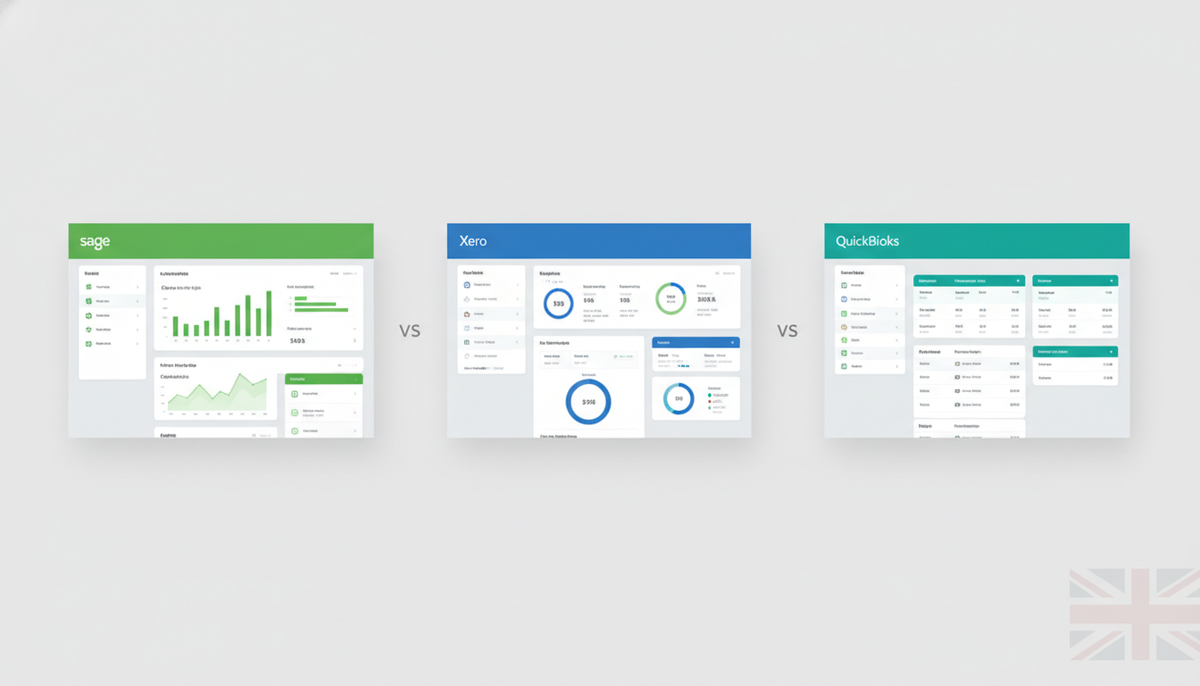
Three names dominate UK cloud accounting: Sage, Xero, and QuickBooks. Between them they handle the books for the majority of UK sole traders, small businesses, and the bookkeeping practices that look after them. The problem? All three raised their prices in 2025–2026, some significantly, and the differences between them have never mattered more when every pound of monthly software spend is under scrutiny.
This comparison looks at what each platform actually costs right now, what you get for it, how they stack up on MTD for Income Tax, and which one makes sense depending on how your practice or business is structured. Pricing throughout is exclusive of VAT.
Xero is the UK accountant default for a reason — try it free for 30 days
TL;DR
- Xero is still the preferred choice for UK bookkeepers and accountants with multiple clients — best integrations, unlimited users, strongest MTD workflow tools.
- Sage wins on payroll: it's included at no extra cost, which can make it significantly cheaper for businesses with employees.
- QuickBooks has the best management reporting and cheapest MTD-compliant entry point (£10/month), but cumulative price increases of ~75% since 2022 have damaged trust in ways that don't wash off quickly.
2026 Pricing at a Glance
Payroll is one of the starkest pricing differences between the three platforms. Sage bundles payroll into its Accounting Standard plan at no per-employee charge, while Xero and QuickBooks both apply per-employee fees that compound as your team grows. We break down the full cost-at-headcount comparison in our guide to the best payroll software for UK small businesses.
Here's where each platform sits right now. All prices are per month, exclusive of VAT, based on standard published rates in May 2026.
| Tool | Entry Plan | Mid Plan | Full Plan | MTD ITSA | Payroll | Free Trial |
|---|---|---|---|---|---|---|
| Sage | £18/mo (Start) | £39/mo (Standard) | £59/mo (Plus) | ✅ All plans | ✅ Included | 90% off for 6 months |
| Xero | £7/mo (Simple) | £39 (Grow) | £70 (Ultimate) | ✅ All plans | Add-on cost | 30 days |
| QuickBooks | £10/mo (Sole Trader+) | £38/mo (Essentials) | £56/mo (Plus) | ✅ All plans | Add-on cost | 30 days |
Note: Xero also offers an Ignite plan at £18/month (capped at 20 invoices/month) and a Comprehensive plan at £55/month. QuickBooks Simple Start costs £18. All prices ex-VAT, May 2026.
Sage: The Payroll Argument
Sage has a reputation for being the old guard — and the criticism isn't entirely unfair. Its interface is less polished than Xero, its app ecosystem is the smallest of the three, and some long-time users describe the experience as "clunky." But Sage has one structural advantage that none of its competitors can match at this price point: payroll is included in every plan.
For a business with five employees, Xero adds roughly £15–20/month for payroll on top of its base plan cost. QuickBooks charges similarly. Over a year, that's £180–240 saved — enough to offset the gap between Sage Standard at £43/month and Xero Grow at £39/month, and then some.
Sage Copilot, its AI assistant, is now available across all plans. It handles receipt capture, cash flow forecasting, and VAT assistance. Whether it's as capable as Xero's AI tooling in practice is another question — but it's not the also-ran product it was two years ago.
On MTD: Sage's Start plan (£20/month) covers MTD for Income Tax Self Assessment. If you're VAT-registered, you'll need Standard at £43/month. Worth noting: when MTD for VAT launched, Sage charged separately for an MTD submission bolt-on — a move that generated significant ill-will among users that hasn't entirely dissipated. The current plans include MTD as standard.
Best for: Businesses with employees (payroll bundled saves real money), users who prefer phone support, and practices already embedded in the Sage ecosystem.
Limitations: Smallest third-party app ecosystem; no project-based billing or time tracking; Android app rated 2.9/5 compared to iOS at 4.5/5; interface dated compared to competitors.
Xero: Still the UK Accountant Default — But For How Long?
Xero holds roughly 45% of UK accounting software PPC spend — more than Sage and QuickBooks combined. It has 900,000 UK subscribers, a thousand-plus integration ecosystem, and the features UK accountants actually rely on: Cash Coding, Find and Recode, and an accountant access structure that makes managing multiple clients practical. For practices managing MTD ITSA across a client book, Xero's tooling is the most advanced of the three.
Its AI roadmap has accelerated too. An Anthropic partnership announced in early 2026 is bringing natural-language accounting capabilities directly into the platform — you can read more about what's already live in our guide to Xero's AI features for UK bookkeepers.
The concern about Xero is pricing. September 2025 brought another round of increases: Grow went from £33 to £39/month, Comprehensive from £47 to £55/month, Ultimate from £59 to £70/month. Some users on the old Standard plan saw effective increases of 55% when their plans were restructured. On AccountingWEB — the dominant UK practitioner forum — the comment that Xero risks "doing a Sage" (coasting on legacy market share while eroding practitioner goodwill through pricing) appeared with notable frequency.
The other persistent complaint is support. Xero has no phone line. Help comes via email and help articles only. For a practitioner with a filing deadline and an unfamiliar error, that matters.
On entry-tier pricing, Xero's Simple plan at £7/month is the cheapest MTD ITSA-compliant option from a major provider — but it caps invoices at 10 per month and doesn't support VAT. Most businesses will need Ignite at £20/month (still invoice-capped at 20) or Grow at £39/month for full functionality.
Best for: Bookkeepers managing multiple clients, practices that rely on Xero's ecosystem integrations, businesses needing unlimited multi-user access without paying per seat.
Limitations: No phone support; payroll is an add-on; price increases have eroded goodwill; multi-currency only from £55. Unsure which Xero plan you actually need? Our Xero Ignite vs Xero Grow breakdown covers the invoice cap and feature differences that decide it.
QuickBooks: Excellent Software, Complicated Relationship
QuickBooks has the strongest inventory management of the three, the deepest management reporting, and the only platform to include CIS (Construction Industry Scheme) functionality at entry tier — which matters for UK trades businesses and subcontractors. Its mobile app scores well for mileage tracking and receipt capture. And its Sole Trader Plus plan at £10/month remains the cheapest MTD ITSA-compliant option across all major providers.
The problem is the pricing history. QuickBooks Plus has risen from £26/month in November 2022 to approximately £56/month by January 2026 — a cumulative increase of around 75% in just over three years, across multiple separate announcements. On Intuit's own UK community forums, the language used by UK bookkeepers to describe these increases is blunt: "price gouging," "extortion," and "insulting" appear verbatim in threads that run to hundreds of replies.
One AccountingWEB comment that circulated widely: "There is no other explanation for this other than simple price gouging." A practice managing 141 clients on QuickBooks described absorbing an extra £2,000+ per month in software costs in a single year. The knock-on effect for bookkeepers is real — software cost increases don't always translate into equivalent fee increases, and the timing of price rises (typically January, when conversations with clients are hardest) creates specific resentment.
QuickBooks Self-Employed was also discontinued in 2024, pushing users to the newer Sole Trader Plus plan. For some this was a minor disruption; for others it disrupted established workflows at an inconvenient time.
For practices considering building a full digital workflow — combining accounting software with AI receipt capture and automated bank reconciliation — our complete AI bookkeeping stack guide covers how QuickBooks fits into a broader tool setup.
Best for: Product-based businesses needing inventory; trades businesses using CIS; users who value phone support; sole traders wanting the cheapest compliant MTD option (£10/month).
Limitations: Price increases have damaged trust significantly; payroll is an add-on; bank feeds can require reconnection every 90 days; app ecosystem smaller than Xero for UK-specific tools.
MTD for Income Tax: Where Do They Stand?
MTD for Income Tax Self Assessment became mandatory on 6 April 2026 for sole traders and landlords with qualifying income above £50,000. The first quarterly submission covers April–July 2026, with a filing deadline of 7 August 2026. HMRC is operating a soft-landing on penalty points for 2026–27, but the compliance requirement is real. The threshold drops to £30,000 in April 2027 and £20,000 in April 2028, bringing significantly more taxpayers into scope.
All three platforms — Sage, Xero, and QuickBooks — are HMRC-recognised for MTD ITSA. On pure compliance, there is no meaningful gap between them. Quarterly updates and the Final Declaration work on all three.
Where they differ is in workflow and price:
- Cheapest compliant option: QuickBooks Sole Trader Plus at £10/month (non-VAT sole traders); Xero Simple at £7/month if invoice volume stays below 10/month
- Best for accountants managing multiple ITSA clients: Xero — the Cash Coding and Find and Recode tools make client-level reconciliation significantly faster
- Best for VAT-registered sole traders: All three support VAT at their respective mid-tier plans; Xero Grow at £39/month is the cheapest full-featured option
Our dedicated article on HMRC-approved MTD software for 2026 goes deeper on compliance specifics and covers bridging software options for those not ready to switch platforms.
What About FreeAgent?
All three platforms now ship with built-in AI. For a dedicated feature-by-feature breakdown, see our Xero JAX vs QuickBooks Intuit Assist vs Sage Copilot AI comparison.
No honest comparison of UK accounting software in 2026 can ignore FreeAgent. It doesn't have a traditional affiliate programme, so we have no financial incentive to mention it — but if you or your clients bank with NatWest, RBS, or Mettle, FreeAgent is free as part of the account. It's HMRC-recognised for MTD ITSA. It handles Self Assessment filing directly. For non-VAT sole traders with a qualifying bank account, it eliminates the cost argument for both QuickBooks Sole Trader Plus and Xero Simple.
It's not a replacement for the full functionality of Xero or QuickBooks for more complex businesses — but for straightforward sole-trader bookkeeping, the price is hard to argue with. Our FreeAgent review for 2026 covers the full picture.
The Right Pick For...
- A bookkeeping practice managing 10–50 clients: Xero. The accountant tools, unlimited users, and app ecosystem make the workflow economics work despite the price.
- A sole trader under £50k income, NatWest banking: FreeAgent (free). No further argument needed.
- A sole trader over £50k income, non-NatWest, few invoices: Xero Simple at £7/month (if under 10 invoices/month) or QuickBooks Sole Trader Plus at £10/month.
- A business with 3+ employees: Sage. The bundled payroll is a genuine cost saving. Start at £20/month with payroll included outperforms Xero Ignite at £20/month plus payroll add-on.
- A product-based business needing inventory: QuickBooks Essentials or Plus. Xero and Sage don't match its inventory management depth.
- A trades business in construction (CIS): QuickBooks includes CIS at entry tier. Sage handles CIS on Standard (£43/month). Xero requires the Comprehensive plan (£55/month).
Frequently Asked Questions
Is Xero better than QuickBooks for UK bookkeepers?
For practices managing multiple clients, yes — Xero's Cash Coding, Find and Recode, and unlimited user access without per-seat charges make it more efficient for multi-client work. For a sole trader or small business owner doing their own books, the answer depends more on price and which features matter to them. Our Xero vs QuickBooks comparison goes deeper on this specific matchup.
Is Sage Accounting worth it in 2026?
If you have employees, the bundled payroll makes Sage competitive on total cost. If you don't, it's harder to justify over Xero or QuickBooks. Its interface is less modern, its app ecosystem smaller, and its AI capabilities still catching up. The phone support and compliance heritage are real advantages, particularly for businesses that have been using Sage products for years.
Which accounting software is cheapest for MTD ITSA compliance?
QuickBooks Sole Trader Plus at £10/month and Xero Simple at £7/month are the cheapest compliant options from major providers. Both are HMRC-recognised. Xero Simple is cheaper but caps invoices at 10/month; QuickBooks Sole Trader Plus is slightly more but more flexible. If you bank with NatWest or Mettle, FreeAgent is free.
Can I switch between these platforms without losing data?
Yes, though it involves effort. Xero offers a free migration service via Movemybooks. QuickBooks provides export tools. Sage data can be migrated via Dataswitcher. Bank reconciliation history rarely transfers cleanly, so most practices pick a clean start date. Factor in 3–5 hours for a straightforward migration.
Do all three support Making Tax Digital for VAT?
Yes. All three are HMRC-recognised for MTD VAT as well as MTD ITSA. You'll need at least the mid-tier plan on each to access VAT functionality: Sage Standard (£43/month), Xero Ignite (£20/month) or Grow (£39/month) depending on needs, or QuickBooks Simple Start (£18).
Related Reading
- Xero vs QuickBooks for UK Sole Traders: Which Is Better in 2026? — a head-to-head on the two market leaders
- MTD for Income Tax Is Live: Which Software Is HMRC-Approved? — full MTD ITSA software guide for 2026
- The Complete AI Bookkeeping Stack for UK Sole Traders (Under £60/Month) — how accounting software fits into a full digital workflow
For a deeper two-way Xero vs Sage comparison with full payroll cost tables and post-September 2026 pricing, see our Xero vs Sage for UK Small Businesses (2026) head-to-head guide.
Affiliate disclosure: Some links in this article are affiliate links. If you sign up through them, we may earn a commission at no extra cost to you. We only recommend tools we've genuinely assessed.
Planning a switch? Our guide to switching accounting software in the UK without losing your data covers data migration, HMRC record-keeping obligations, and how to choose the right cut-off date.
Once you have decided which platform suits your practice, see our step-by-step UK guide to switching accounting software without losing your data.