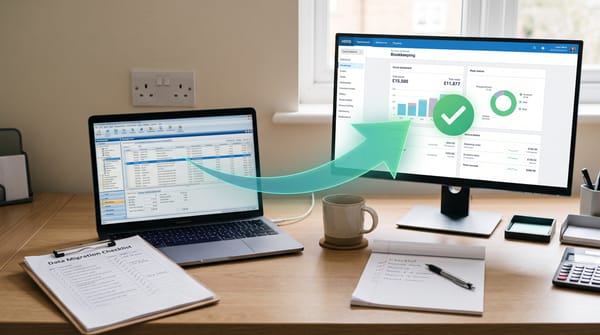
MTD for Income Tax Is Live: Which Software Is HMRC-Approved? (2026 Guide)

Making Tax Digital for Income Tax Self Assessment (MTD ITSA) is no longer a future concern — it's here. Phase 1 went live on 6 April 2026 for self-employed individuals and landlords earning over £50,000, and if you're one of them (or you have clients who are), you need MTD income tax software that's HMRC-approved and ready to go. The penalties for non-compliance are real, and the quarterly reporting deadlines wait for no one. This guide explains exactly what's required, reviews the approved software options with honest assessments, and gives you a practical action plan.
The good news is that the software landscape has matured significantly since HMRC first announced MTD ITSA. Several established platforms now offer genuine, tested MTD compliance — and the cheapest option starts at just £7 per month. The bad news is that not every tool claiming to be "MTD-ready" actually is, and some popular platforms still don't support the Income Tax side of Making Tax Digital at all.
The easiest way to get MTD-ready today

What MTD for Income Tax Actually Requires
Before diving into software, let's be clear about what HMRC now demands under MTD ITSA. The requirements boil down to three obligations:
1. Digital Record-Keeping
You must keep digital records of all business income and expenses using HMRC-compatible software. Spreadsheets alone are no longer sufficient — your software must be able to communicate directly with HMRC's systems via their API. Paper records, manual ledgers, and standalone Excel files don't meet the digital record-keeping standard.
2. Quarterly Updates
Instead of filing a single Self Assessment tax return once a year, you now need to submit quarterly updates to HMRC summarising your income and expenses for each quarter. The quarterly periods align with the tax year:
- Q1: 6 April to 5 July — update due by 7 August
- Q2: 6 July to 5 October — update due by 7 November
- Q3: 6 October to 5 January — update due by 7 February
- Q4: 6 January to 5 April — update due by 7 May
Each quarterly update is a summary, not a full tax calculation. Think of it as a checkpoint showing HMRC your running totals for the period.
3. Final Declaration
After the tax year ends (5 April), you submit a final declaration by 31 January the following year. This replaces the traditional Self Assessment tax return and confirms your total income, expenses, allowances, and tax liability for the year. This is where adjustments, reliefs, and additional income sources get factored in.
The MTD ITSA Rollout Timeline
MTD for Income Tax is being introduced in phases based on income thresholds:
| Phase | Go-Live Date | Who's Affected |
|---|---|---|
| Phase 1 | 6 April 2026 | Self-employed and landlords earning over £50,000 |
| Phase 2 | 6 April 2027 | Self-employed and landlords earning over £30,000 |
| Phase 3 | 6 April 2028 | Self-employed and landlords earning over £20,000 |
If you earn between £30,000 and £50,000, you have until April 2027 — but starting now gives you a full year to get comfortable with the software and workflows before it becomes mandatory.
HMRC-Approved MTD Income Tax Software: Honest Reviews
1. Xero — Best Overall (From £7/Month)
Xero is MTD-ready across all three of its plans, making it the most accessible option on this list. Even the entry-level Simple plan at £7 per month supports MTD for Income Tax quarterly submissions and final declarations.
Pros: All plans are MTD ITSA compliant. Clean, modern interface. Excellent bank feeds with most UK banks. AI-powered bank categorisation and reconciliation. Hubdoc included free for document capture. Strong app marketplace with 1,000+ integrations. 30-day free trial. Currently offering 80% off for the first 6 months.
Cons: The Simple plan (£7/month) limits you to 20 invoices and 5 bills per month, which may be too restrictive for active businesses. Advanced AI features like JAX auto-reconciliation require the Grow plan at £37/month. Learning curve if you're switching from spreadsheets.
Pricing: Simple £7/month, Ignite £16/month (unlimited invoices/bills), Grow £37/month (multi-currency, projects, AI features).
Our take: For pure MTD compliance at the lowest cost, Xero Simple at £7/month is hard to beat. For a more capable all-round platform, Ignite at £16/month hits the sweet spot.
2. QuickBooks — Strong Alternative (From £10/Month)
QuickBooks is fully MTD-approved for Income Tax across all its UK plans, starting from £10 per month. It's a mature, reliable platform backed by Intuit's significant investment in UK compliance.
Pros: All plans MTD ITSA ready. Built-in receipt capture. Mileage tracking included. Good mobile app. Self-employed-specific features. Strong integration with banks and payment processors.
Cons: Slightly more expensive than Xero's entry-level. Interface can feel cluttered for simple businesses. Some advanced features locked to higher tiers.
Pricing: Simple Start from £10/month, Essentials from £18/month, Plus from £25/month.
Our take: A solid choice, particularly if you're already in the Intuit ecosystem. QuickBooks' self-employed features are well-designed, though Xero offers better value at the entry level for pure MTD compliance.
3. FreeAgent — Best Value (£19/Month or Free with NatWest/RBS)
FreeAgent was purpose-built for UK freelancers and sole traders, and it shows. The MTD ITSA implementation is straightforward and well-documented, and all features are included on a single plan — no tier-hopping required.
Pros: All features included at one price. Excellent UK tax calculations (automatically handles Class 2/4 NIC, student loan repayments, etc.). Built-in Self Assessment and MTD filing. Free for NatWest, RBS, and Ulster Bank business customers. Receipt capture and bank feeds included. Particularly strong for sole traders and freelancers.
Cons: Less suitable for growing businesses with complex needs. Fewer third-party integrations than Xero. Interface feels dated compared to Xero. Limited multi-currency support.
Pricing: £19/month for sole traders — or completely free if you have a NatWest, RBS, or Ulster Bank business account.
Our take: If you bank with NatWest or RBS, this is a no-brainer. Free, fully MTD-compliant software with UK tax expertise baked in. Even at £19/month, it's excellent value for sole traders who want everything in one place.
HMRC-Approved Software Comparison
| Software | Starting Price | MTD ITSA | Free Option |
|---|---|---|---|
| Xero | £7/month | All plans | 30-day trial |
| QuickBooks | £10/month | All plans | Trial available |
| FreeAgent | £19/month | All features | Free with NatWest/RBS |
Software That Is NOT MTD ITSA Compatible
It's equally important to know which tools don't meet MTD for Income Tax requirements:
Kick is an AI-powered bookkeeping tool that's gained attention for its automated approach, but it is not MTD-compatible and is primarily focused on the US market. It cannot submit quarterly updates to HMRC and does not maintain HMRC-approved digital records. Do not rely on Kick for UK tax compliance.
Spreadsheets (Excel, Google Sheets) on their own are not MTD-compliant. While HMRC does allow bridging software that can submit data from spreadsheets, this adds complexity and cost. Purpose-built software is strongly recommended.
What to Do Right Now If You're Affected
If you're self-employed or a landlord earning over £50,000, MTD ITSA is already your reality. Here's your action plan:
If You Already Use Cloud Accounting Software
Check your plan is MTD ITSA enabled. Log into your Xero, QuickBooks, or FreeAgent account and verify that MTD for Income Tax is activated. In Xero, look under Settings > Making Tax Digital. In QuickBooks, check Taxes > MTD. You may need to authorise your software with HMRC — this involves linking your Government Gateway ID through the software.
If You're Using Spreadsheets or Paper Records
Switch to approved software immediately. Your first quarterly update (for Q1: 6 April to 5 July 2026) is due by 7 August 2026. That gives you roughly three months to get set up, migrate your records, and submit. We recommend starting with Xero Simple at £7/month — it's the cheapest HMRC-approved option and you get 30 days free to test it.
If You Earn Between £30,000 and £50,000
Start preparing now. Phase 2 arrives in April 2027, and the transition is much smoother if you're already using compliant software before the deadline. Use the next 12 months to set up your digital records, get comfortable with quarterly workflows, and iron out any issues while there's no penalty pressure.
If You Have an Accountant or Bookkeeper
Confirm they're MTD-ready. Your accountant or bookkeeper needs to use MTD-compatible software to file on your behalf. Ask them which platform they use and whether they've tested the MTD ITSA submission process. If they haven't, that's a red flag.
The Bottom Line
MTD for Income Tax is live, and the software options are mature enough that compliance shouldn't be painful or expensive. Xero at £7/month offers the cheapest entry point, FreeAgent is unbeatable if you bank with NatWest or RBS, and QuickBooks is a solid alternative for those who prefer it. The worst thing you can do is wait until the deadline is breathing down your neck. Start your free trial today, connect your bank, and file that first quarterly update with confidence.
Affiliate disclosure: Some links in this article are affiliate links. If you sign up through them, we may earn a commission at no extra cost to you. We only recommend tools we've genuinely assessed.