
Is Kick Accounting Any Good? (And Why UK Users Should Think Twice)
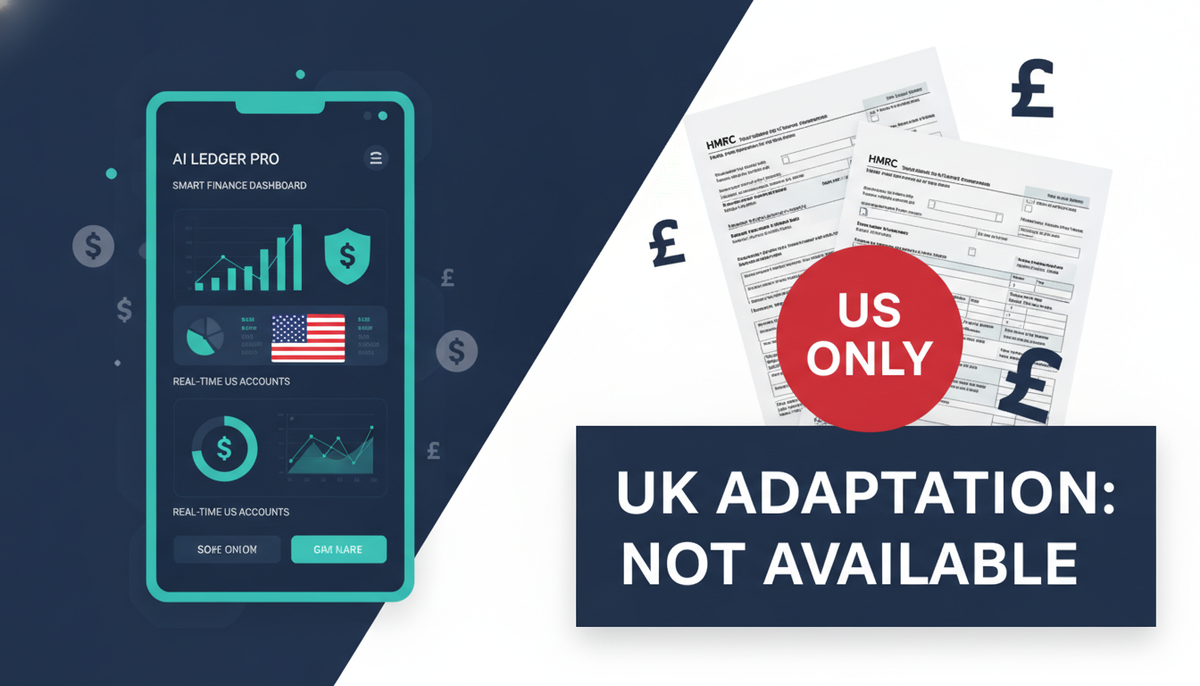
Is Kick Accounting Any Good? (And Why UK Users Should Think Twice)
Kick has collected glowing reviews from US-based publications in 2026, positioning itself as an AI-native "self-driving bookkeeping" platform that could replace QuickBooks Online. If you've come across those reviews and wondered whether it might work for your UK practice or sole trader business, this article gives you the honest answer — and explains exactly why UK users need to pause before getting interested.
The short version: Kick is genuinely impressive software. It's just not available to UK users, and even if it were, it couldn't handle your HMRC obligations. Here's what you need to know before spending another minute on it.
Looking for AI bookkeeping tools that actually work in the UK?
See our 2026 picks for UK bookkeepers →
What Is Kick Accounting?
Kick (kick.co) is an AI-powered bookkeeping platform founded in the US around 2021. It raised $20 million in funding in 2025 and has attracted attention for its "self-driving bookkeeping" approach, which aims to automate 97% of the work involved in maintaining business accounts.
The core product handles transaction categorisation automatically, matches receipts to transactions, generates Profit & Loss statements and Balance Sheets in real time, and produces year-end exports aligned to US tax return formats. For multi-entity US businesses — founders running several LLCs under one login — it offers a structural advantage over QuickBooks Online, which charges a separate subscription per entity.
On paper, the feature set looks compelling:
- AI auto-categorisation — processes 95–97% of transactions without manual input, learning from corrections over time
- Smart receipt matching — no manual uploads required; receipts are matched automatically from connected accounts
- Real-time financial statements — P&L and Balance Sheet available at any time, not just month-end
- Multi-entity support — manage multiple business entities under a single subscription
- Integrations — connects with Stripe, PayPal, Ramp, Mercury, and Gusto, plus around 50 others
For a US-based freelancer, digital agency, or multi-entity founder, this is a credible alternative to QuickBooks Online. The reviews from US sources reflect that accurately.
The Fundamental Problem: Kick Is US-Only
Here is what most Kick reviews don't state clearly enough: Kick is US-only at every layer of the product. This is not a minor limitation or a missing feature that's "coming soon". It's a structural design decision that means UK users cannot meaningfully use Kick at all.
Specifically:
- Bank feeds — Kick's bank connectivity runs through US-based services (Plaid, Relay, Mercury). UK banks are not supported. You cannot connect a Barclays, HSBC, Lloyds, NatWest, Starling, Monzo, or any other UK bank account.
- Tax deduction logic — the AI's categorisation engine is trained on US tax categories (IRS schedules, US deduction rules). It doesn't understand UK tax categories, self-assessment rules, or allowable expenses under HMRC guidance.
- Payment rails — integrations with Ramp and Gusto are US-specific. There is no UK payroll support.
- Entity types — Kick is built around US business structures (LLCs, S-Corps). UK sole traders, partnerships, and limited companies have different legal and accounting requirements.
- Pricing currency — all plans are priced in US dollars. There is no GBP pricing, no UK VAT charged on subscriptions, and no UK billing support.
As one independent review from 2026 put it plainly: "Firms with UK, EU, Australian, or Canadian clients cannot use it." This is not a workaround situation. The product simply does not support non-US operations.
No MTD ITSA Compatibility — A Critical Issue from April 2026
Even if Kick's geographic limitations didn't apply to you, there's a second fundamental problem: Kick has no HMRC recognition and cannot submit quarterly updates under Making Tax Digital for Income Tax.
MTD ITSA went live on 6 April 2026 for sole traders and landlords with income above £50,000. The first quarterly update deadline for Q1 (6 April to 5 July 2026) is 7 August 2026. If you're in this cohort, you need HMRC-recognised software — not just any cloud bookkeeping tool.
Kick does not appear on HMRC's list of compatible software. It cannot submit quarterly updates to HMRC. It cannot generate the digital records HMRC requires. It was built to produce US-format tax outputs, not UK Self Assessment or MTD quarterly update submissions.
Using Kick as your primary bookkeeping tool while relying on a separate bridging solution for HMRC submissions would be technically possible in theory, but you'd be running two systems, paying for both, and potentially introducing reconciliation errors between them. This isn't a workable solution for a UK practice.
If you need a clear picture of which software is HMRC-approved for MTD ITSA compliance in 2026, we've covered that in detail separately.
What Kick Costs (in US Dollars)
For completeness, here is the current pricing structure — in USD, as it's not available in GBP:
| Plan | Price (USD) | Annual expense cap | Entities |
|---|---|---|---|
| Free | $0/mo | Up to $25,000/year | 1 |
| Basic | $35/mo (billed at $420/yr) | Up to $250,000/year | Unlimited |
| Plus | $125/mo (billed quarterly) | Unlimited | Up to 5 |
| Custom | From $200/mo | Unlimited | Unlimited + dedicated support |
At current exchange rates, the Basic plan works out to approximately £28/month and the Plus plan to approximately £99/month. Neither figure is relevant, however, since the product isn't available to UK users and offers no UK bank connectivity or HMRC integration.
What Kick Does Well (for US Users)
In the interest of a fair assessment: within its intended market, Kick is a well-designed product that solves a real problem. QuickBooks Online has accumulated 25 years of interface complexity and charges per-entity subscriptions that make multi-LLC management expensive. Kick's cleaner UX, flatter pricing structure for multi-entity operations, and stronger AI categorisation make it a credible alternative for US-based small businesses.
The auto-categorisation accuracy of 95–97% is consistently reported across independent reviews, and the financial outputs are described as "tax-ready" in the sense that they align with how US tax returns are prepared. For a US creator, freelancer, or digital agency that runs on Stripe and wants to stop thinking about bookkeeping, Kick delivers on its promises.
Its limitations within the US market — cash-basis accounting only, shallow accrual support, limited integrations beyond the core Stripe/PayPal/Ramp stack — are worth noting for US users considering it, but those are secondary considerations for a UK audience who simply cannot use the product.
UK Alternatives: What to Use Instead
The market for AI-assisted bookkeeping tools for UK users is well-developed. All of the following are HMRC-recognised for MTD ITSA, support UK bank feeds, and handle UK VAT and Self Assessment requirements:
| Tool | Best for | Price (GBP) | MTD ITSA | AI features |
|---|---|---|---|---|
| Xero Simple | Budget-conscious sole traders | £7/mo (+VAT) | ✓ Approved | Bank rules, auto-categorisation, Xero JAX AI |
| FreeAgent | NatWest/RBS/Mettle customers | Free (with eligible bank account) | ✓ Approved | Smart categorisation, automated reminders |
| QuickBooks Sole Trader | Mobile-first users, mileage tracking | From £10/mo (+VAT) | ✓ Approved | Intuit Assist AI, receipt capture, auto-categorisation |
| Sage Accounting | Growing businesses, payroll needs | From £15/mo (+VAT) | ✓ Approved | Sage Copilot AI, cashflow forecasting |
For a detailed comparison of the big three platforms, our Sage vs Xero vs QuickBooks guide for UK users covers pricing, feature differences, and which works best for different practice types.
If AI-assisted receipt capture is what caught your eye about Kick's smart matching feature, that specific capability is handled separately in the UK market by tools like Dext, which integrates directly with Xero, QuickBooks, and Sage to automate the receipt-to-ledger workflow. It's a different architecture to Kick's all-in-one approach, but it works with UK bank feeds and HMRC requirements.
The Right Pick for Different UK Users
You're a sole trader earning over £50,000 and need MTD ITSA compliance immediately
Use Xero Simple (£7/mo) or FreeAgent (free with NatWest/RBS/Mettle). Both are HMRC-approved and have MTD quarterly submission built in. Your first submission deadline is 7 August 2026.
You want the cheapest possible fully-compliant option
FreeAgent is free for NatWest, RBS, Ulster Bank, and Mettle business account holders. If you're not with those banks, Xero Simple at £7/mo is the cheapest mainstream MTD-approved option.
You run a small bookkeeping practice and handle multiple clients
Xero's accountant/partner programme gives you discounted access across client files, with a dashboard to manage all of them. QuickBooks also has an accountant version. Neither requires the per-entity subscription model that makes QuickBooks expensive for multi-entity US founders — Xero's practice pricing works differently.
You wanted Kick's AI auto-categorisation specifically
Xero's bank rules and Xero JAX AI assistant, QuickBooks Intuit Assist, and Sage Copilot all offer AI-assisted categorisation that learns from your transaction patterns. Pair any of these with Dext for receipt capture and you get the closest UK equivalent to what Kick offers in the US.
You're an accountant recommending tools to US-based clients who also have UK operations
Kick for the US entity, Xero for the UK entity. They are not compatible, but there's no single tool that handles both markets well at this level. Use the right tool for each jurisdiction.
Frequently Asked Questions
Is Kick Accounting available in the UK?
No. As of June 2026, Kick is US-only at every layer — bank feeds, tax logic, payment integrations, and entity support. UK users cannot connect UK bank accounts, and the software has no HMRC integration.
Does Kick support Making Tax Digital (MTD)?
No. Kick is not on HMRC's list of recognised software for MTD ITSA. It cannot submit quarterly updates or final declarations to HMRC. UK businesses with MTD obligations need separate HMRC-approved software.
Will Kick expand to the UK?
Kick has not announced UK expansion plans as of mid-2026. Even if it did, a UK launch would require significant product work — UK bank feed integrations, HMRC API connections, UK VAT handling, and localised tax categorisation logic. This is months to years of development work.
What's the closest UK equivalent to Kick?
For the all-in-one AI bookkeeping experience, Xero at the Ignite tier (£18) or QuickBooks with Intuit Assist comes closest in terms of AI-assisted categorisation and real-time financial reporting, with full UK compliance. For receipt capture specifically, Dext is the market leader for UK practices.
Can I use Kick alongside UK accounting software?
In theory, you could use Kick for a US entity and Xero for UK operations, but Kick does not integrate with Xero, QuickBooks UK, or Sage. There is no data sync between the platforms. This only makes sense for genuinely separate business entities in different jurisdictions — not as a UK workaround.
Related Reading
- MTD for Income Tax Is Live: Which Software Is HMRC-Approved? (2026 Guide)
- Best AI Tools for UK Bookkeepers (2026) — our money page
- The Complete AI Bookkeeping Stack for UK Sole Traders (Under £60/Month)
Affiliate disclosure: Some links in this article are affiliate links. If you sign up through them, we may earn a commission at no extra cost to you. We only recommend tools we've genuinely assessed.