Xero vs FreeAgent UK 2026: Which Is Better for Sole Traders?
Xero vs FreeAgent UK 2026: Which Is Better for Sole Traders?
Last updated: October 2026
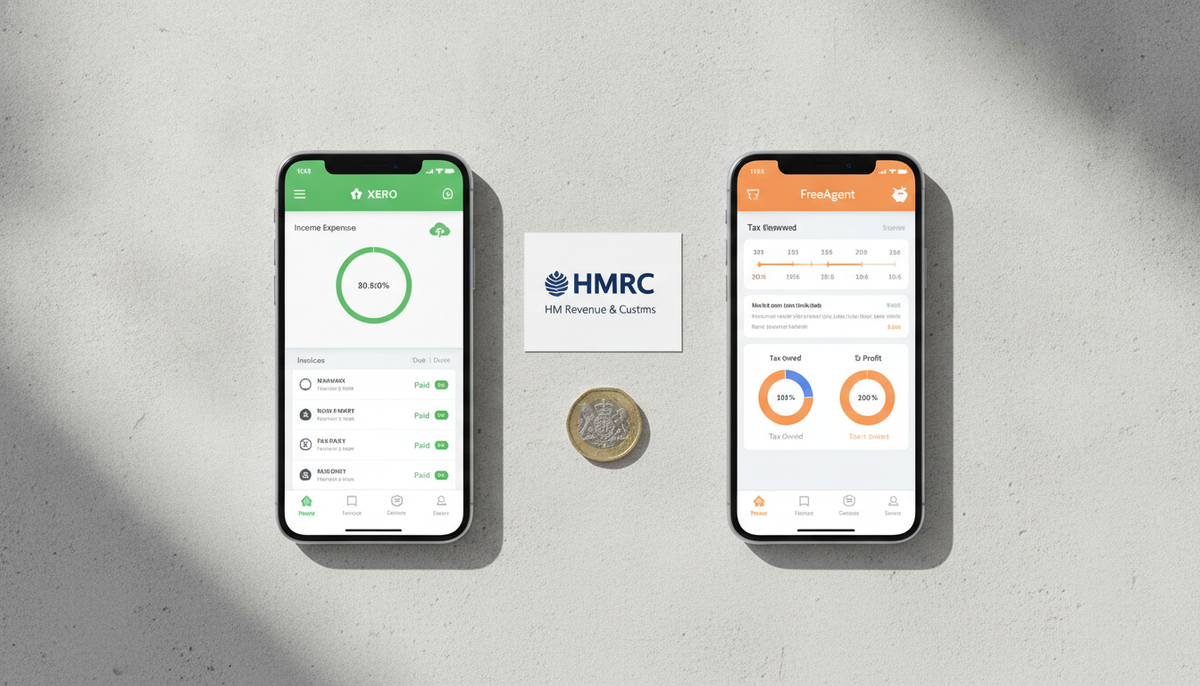
Two accounting tools dominate every conversation about sole trader software in the UK right now. Xero is the one your accountant almost certainly uses. FreeAgent is the one that might cost you nothing at all. Both are HMRC-recognised for Making Tax Digital for Income Tax. Both handle invoicing, bank feeds, and expenses. The decision comes down to one question more than any other: who do you bank with?
This head-to-head covers just these two platforms. For a broader comparison including QuickBooks, Sage, and Zoho Books — plus the cheapest MTD ITSA-compliant options — see our best accounting software for UK sole traders guide.
This guide cuts through the noise and tells you exactly which platform makes sense for your situation — with current 2026 pricing, a feature-by-feature comparison, and a clear verdict for each type of sole trader.
Whichever platform you choose, pair it with a receipt capture tool that keeps your records MTD-ready automatically.
Try Dext Free — Works with Both Xero and FreeAgent
The quick answer
If you hold a business current account with NatWest, Royal Bank of Scotland, Ulster Bank, or Mettle — use FreeAgent. It is free, fully featured, and HMRC-recognised for MTD. There is no meaningful financial argument for paying for Xero in that situation.
If you do not bank with the NatWest Group and are not planning to switch, Xero is the stronger platform for most sole traders. It is actually cheaper at the entry level than FreeAgent's standalone price, it scales further as your business grows, and it is the platform most UK accountants use by a significant margin.
The nuance lives in the edges. Read on if you want to know which edge applies to you.
Pricing compared (July 2026)
Xero and FreeAgent take entirely different approaches to pricing, which makes a straightforward comparison harder than it looks.
Xero UK pricing 2026
Xero currently runs five plans in the UK. All prices exclude VAT and are monthly:
| Plan | Current price | From 1 Sept 2026 | Invoices |
|---|---|---|---|
| Simple | £7/mo | £7/mo (unchanged) | Up to 10/mo |
| Ignite | £18/mo | £18/mo (+£2) | Up to 20/mo |
| Grow | £39/mo | £39/mo (+£2) | Unlimited |
| Comprehensive | £55/mo | £55/mo (+£5) | Unlimited + payroll |
| Ultimate | £70/mo | £70/mo (+£5) | Unlimited + expenses |
New UK customers currently get 90% off for the first six months. For most sole traders, the choice is between Simple at £7 (capped at 10 invoices) and Ignite at £18. Our Xero Ignite vs Grow guide covers exactly where that line sits for different types of sole trader business.
FreeAgent UK pricing 2026
FreeAgent prices by business type, not by feature tier. Standalone monthly prices (all exclude VAT):
- Landlord: £10/mo (or free with eligible bank account)
- Sole trader: £19/mo (or free with eligible bank account)
- Partnership / LLP: £24/mo (or free)
- Limited company: £29/mo (or free)
The free route: Hold a business current account with NatWest, RBS, Ulster Bank, or Mettle — and FreeAgent is included at no cost for as long as you retain the account. This is the full product, not a lite version. Mettle (NatWest's digital-only business bank) is free to open with no monthly fees. Many sole traders open a Mettle account purely for the FreeAgent access and keep their main banking elsewhere — one transaction per month through Mettle is all that is required to stay active.
FreeAgent's standalone price of £19+VAT/month (£22.80 including VAT) is actually higher than Xero Ignite at £18+VAT. This is something many comparison articles get backwards. If you are paying the full standalone price for FreeAgent rather than accessing it via a NatWest Group account, Xero is cheaper.
MTD for Income Tax: what changes on 7 August 2026
The first quarterly submission deadline under Making Tax Digital for Income Tax Self Assessment is 7 August 2026. If you are a sole trader or landlord earning over £50,000 in 2025/26, you need HMRC-recognised software filed and connected before that date.
Both Xero and FreeAgent are on the HMRC-recognised software list. Both will handle your quarterly submissions and Final Declaration. The practical differences are smaller than you might expect. For a fuller breakdown of what you need to do and which software meets the requirement, see our MTD for Income Tax: HMRC-approved software guide.
FreeAgent's MTD edge: FreeAgent has been running its MTD for Income Tax pilot with HMRC since 2023 — longer than any other provider. More quarterly submission cycles completed in live conditions, more edge cases resolved. The guided tax timeline, which walks you through each quarterly update and the Final Declaration, is genuinely well designed for sole traders who manage their own submissions without an accountant.
Xero's MTD edge: Xero launched AI-powered data capture in February 2026 specifically for MTD — automatically extracting data from receipts, invoices, and rental statements to build cleaner digital records. At Xerocon London in July 2026, Xero announced Smart Document Capture (JAX reads source documents and auto-extracts data into Xero), Auto Bank Reconciliation (real-time transaction matching), and document chasing (JAX automatically flags missing receipts). For bookkeepers and sole traders with messier records, this automation matters.
For most straightforward sole traders, the MTD question is a draw — choose based on other factors.
Feature comparison
| Feature | Xero | FreeAgent |
|---|---|---|
| Entry price (excl. VAT) | £7/mo (Simple) | Free (NatWest Group) / £19/mo standalone |
| MTD ITSA | ✓ HMRC-recognised; AI data capture | ✓ HMRC-recognised; pilot since 2023 |
| Self Assessment filing | Estimates only — file separately | ✓ Direct to HMRC — built in |
| AI assistant | ✓ JAX (Claude-powered) — natural language queries, cash flow, overdue invoices | AI-assisted categorisation; no conversational assistant |
| Time tracking | Via third-party app (Simple/Ignite) | ✓ Built in — billable hours to invoices |
| Receipt capture | ✓ Unlimited (Hubdoc included) | 10 free/mo; £5/mo for unlimited |
| App integrations | ✓ 1,000+ (Dext, Stripe, Shopify, etc.) | Smaller ecosystem; covers essentials |
| Multi-currency | ✓ 160+ currencies (Comprehensive+) | Limited |
| Users | ✓ Unlimited on all plans | Single user (sole trader plan) |
| UK accountant adoption | ✓ Dominant — most UK practices | Popular with freelancer specialists |
| Scalability | ✓ Seamless sole trader to limited company | Separate plan required for Ltd |
| Real-time tax estimate | ✓ | ✓ |
Xero's JAX AI: what changed at Xerocon London (July 2026)
Xero used Xerocon London in July 2026 to announce the most significant product update in years. The headline feature is Smart Document Capture: JAX (Just Ask Xero — built on Anthropic's Claude AI) now reads source documents and automatically extracts data directly into Xero. Supplier invoices, receipts, bank statements — JAX pulls the relevant figures without manual entry.
Alongside Smart Document Capture, Xero announced Auto Bank Reconciliation (transactions matched to bank feeds in real time, with complex splits handled automatically) and a document chasing feature where JAX proactively identifies transactions without attached receipts and flags them for follow-up.
For UK bookkeepers and practices managing client accounts, these features are genuinely significant. For a straightforward sole trader doing their own books, they are a quality-of-life improvement rather than a reason to switch platforms. FreeAgent's receipt categorisation handles most of what a simple sole trader practice needs — the JAX advantage is more pronounced at higher volumes or with multiple income streams. Our guide to Xero AI features for UK bookkeepers covers the full JAX capability in detail.
FreeAgent's strengths: what Xero does not do as well
FreeAgent was built by freelancers in Edinburgh in 2007, and that heritage shows in some genuinely useful sole-trader-specific features that Xero does not match at the entry level.
Direct Self Assessment filing: FreeAgent files your Self Assessment return directly to HMRC from within the platform. Xero provides real-time tax estimates but does not submit the return itself — you either file separately via HMRC's website or hand off to your accountant. For sole traders who manage their own tax return, this is a meaningful difference. Less so if you use an accountant, who will likely have their own filing workflow regardless of platform.
Built-in time tracking: FreeAgent includes billable hours tracking that links directly to invoicing — log time against a client, generate an invoice at the end of the month. Xero requires a third-party integration for equivalent functionality on its entry-level plans. For consultants, designers, and anyone billing hourly, this is a FreeAgent win. For anyone not billing by the hour, it is irrelevant.
Mileage tracking: FreeAgent's mileage feature calculates HMRC-approved rates automatically as you log journeys. Xero handles mileage via the expenses module, which is not included on the Simple or Ignite plan as standard. If you drive regularly for client visits, FreeAgent has the better built-in tool.
Receipt capture limits: FreeAgent includes 10 receipt scans per month on all plans. More than that costs £5/month extra. Xero includes unlimited receipt capture via Hubdoc on all plans, including Simple at £7. If you are running high receipt volumes, Xero avoids an incremental add-on cost — or consider pairing either platform with a dedicated tool like Dext, which offers more powerful receipt processing than Hubdoc and integrates with both Xero and FreeAgent.
Who should use Xero
- Your accountant uses Xero. This is the single most decisive factor. Using the same platform as your accountant eliminates friction, reduces errors in handover, and makes your annual accounts significantly cheaper to prepare. Most UK accountants are Xero-certified.
- You are planning to grow. Xero scales seamlessly from sole trader to limited company, with payroll on Comprehensive and unlimited users on every plan. There is no platform migration when you hire, incorporate, or bring a bookkeeper on. Our accounting software comparison for UK freelancers covers the growth path in more detail.
- You need integrations. Xero's app marketplace lists over 1,000 integrations. Dext, Stripe, Shopify, GoCardless, HubSpot, Tradify — if you rely on other business tools, the probability of a native Xero integration is high. FreeAgent covers the essentials but cannot match the breadth.
- You have international clients. Multi-currency invoicing is available on Xero Comprehensive upwards, across 160+ currencies. FreeAgent's multi-currency support is limited by comparison.
Who should use FreeAgent
- You bank with NatWest, RBS, Ulster Bank, or Mettle. Full platform, no restrictions, completely free. Switch your business account to Mettle (which is also free to open and has no monthly fees) and you get FreeAgent at zero ongoing cost. The Current Account Switch Service takes approximately seven working days and is free.
- You are a freelancer who bills by the hour. Built-in time tracking that flows into invoicing is a genuine productivity advantage over Xero's entry plans. For consultants, coaches, contractors, and designers, FreeAgent's workflow is more cohesive.
- You file your own Self Assessment. Direct HMRC submission from within FreeAgent removes one step from your annual tax process. If you have an accountant who handles this, the advantage disappears.
- You want the simplest interface. FreeAgent is notably easier to navigate for people without an accounting background. Xero has become more polished over the years, but FreeAgent remains the more intuitive choice for non-accountants managing their own books. If you are new to accounting software, the learning curve is shallower with FreeAgent.
The pricing reality check
Several comparison articles present FreeAgent as the cheaper option. This is only true if you are accessing it through a NatWest Group bank account. At standalone prices, Xero is less expensive. FreeAgent Sole Trader at £19+VAT/month (£22.80 including VAT) is more than Xero Simple at £7+VAT or Xero Ignite at £18+VAT.
Factor in FreeAgent's £5/month receipt capture add-on for unlimited scans, and the standalone price reaches £24/month before VAT for any sole trader running a modest volume of transactions. At that point, Xero Grow at £39/month starts to look competitive given the feature set it includes.
The bank partnership route genuinely changes the calculation entirely — free beats £18–22/month in any comparison. But the standalone-vs-standalone comparison favours Xero. Make sure you are using the right basis when you run the numbers.
The right pick for...
- NatWest or RBS business account holders: FreeAgent. No conditions, no debate.
- Sole traders with an accountant who uses Xero: Xero. Platform alignment saves time and money in the long run.
- Consultants and hourly billing freelancers: FreeAgent (for time tracking), unless you need Xero for accountant alignment.
- Sole traders planning to incorporate: Xero. The growth path is cleaner and you avoid a platform migration.
- High receipt volume sole traders not using a NatWest account: Xero Simple or Ignite with Hubdoc included, or either platform with a dedicated Dext subscription for more powerful capture.
- Complete beginners managing their own books: FreeAgent (simpler interface, guided tax timeline, built-in Self Assessment filing).
Frequently asked questions
Is FreeAgent really free with NatWest?
Yes. Customers holding a business current account with NatWest, Royal Bank of Scotland, Ulster Bank, or Mettle get the full FreeAgent platform — every feature, no time limit, no restrictions — at no cost for as long as they retain the account. Approximately 40% of FreeAgent's 200,000+ UK customer base accesses it this way. The offer has been running since NatWest acquired FreeAgent in 2018.
Does Xero include MTD for Income Tax?
Yes. All current Xero plans are HMRC-recognised for Making Tax Digital for Income Tax. Xero Simple at £7/month includes MTD ITSA, bank feeds, and receipt capture. However, VAT returns require Ignite or above (£18/month). The first quarterly submission deadline is 7 August 2026 for sole traders and landlords with qualifying income over £55,000. See our complete guide to Making Tax Digital for what you need to do.
Can FreeAgent do Self Assessment?
Yes — and it is one of FreeAgent's strongest features. FreeAgent files your Self Assessment tax return directly to HMRC from within the platform, auto-populating income and expense data from your bookkeeping records. Xero provides real-time tax estimates but does not file the return directly; you submit separately via HMRC's website or through your accountant.
Which is better for a landlord with rental income?
Both platforms handle rental income under MTD ITSA. FreeAgent has a dedicated landlord plan at £10+VAT/month (or free with a NatWest Group account) with property reporting features designed specifically for unincorporated landlords. Xero is the stronger choice for landlords who also have additional complexity — multiple properties, mixed commercial and residential portfolios, or a separate limited company structure. Our AI bookkeeping guide for UK landlords covers both platforms in the property-specific context.
Will Xero prices increase in 2026?
Related Reading
- FreeAgent Review 2026: Is It Still the Best Free Option for UK Sole Traders?
- Best MTD Software for UK Sole Traders (2026): The Complete Guide
- Sage vs Xero vs QuickBooks: Which UK Accounting Software Wins in 2026?
Affiliate disclosure: Some links in this article are affiliate links. If you sign up through them, we may earn a commission at no extra cost to you. We only recommend tools we've genuinely assessed.
Xero users who also use receipt capture tools should read our Dext vs Xero UK 2026 guide — which explains what Dext adds on top of Xero, whether Hubdoc (free with all plans) is sufficient for your volume, and what the combined monthly cost looks like at different practice sizes.