Dext Pricing UK 2026: What You Actually Pay (Per Client, Per Month)
Dext Pricing UK 2026: What You Actually Pay (Per Client, Per Month)
If you've visited Dext's pricing page recently and come away none the wiser, you're not alone. The partner/practice pricing now says "build your plan" and directs you to a quote — no published numbers, no comparison table, nothing you can sanity-check before picking up the phone. This article cuts through that. Below is a complete breakdown of what Dext actually costs UK bookkeepers and accountants in 2026: per client, per month, across all three product lines.
The short answer: Dext runs two completely different pricing tracks. Dext Solo — the MTD IT product for sole traders and landlords — has clear, published pricing. Dext Prepare — the receipt capture and bookkeeping automation platform that most practices actually use — is quote-based, negotiated per firm. The per-client rate depends heavily on how many clients you put on the platform.
Ready to start your free Dext trial? Get 14 days free — no credit card required.
Dext Solo: The MTD IT Product (Published Pricing)
Dext Solo is Dext's HMRC-recognised MTD for Income Tax product — designed specifically for sole traders and landlords who are not VAT-registered. Unlike the practice platform, this product has fully transparent, publicly listed pricing.
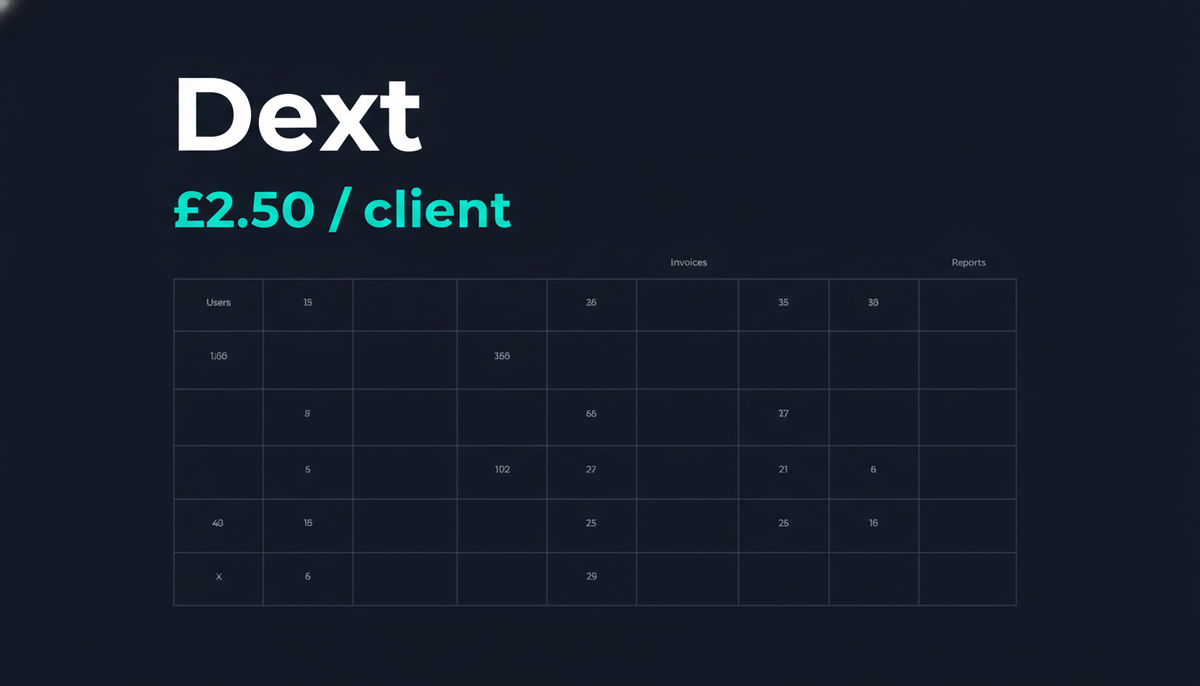
Dext Solo: £2.50 per client per month (ex VAT)
That price is on an annual subscription billed monthly, with a minimum of 5 clients. So the entry-level cost is £12.50/month (ex VAT) for your first five MTD IT clients. Additional clients are added at the same rate.
| Number of clients | Monthly cost (ex VAT) | Per client per month |
|---|---|---|
| 5 clients | £12.50 | £2.50 |
| 10 clients | £25.00 | £2.50 |
| 25 clients | £62.50 | £2.50 |
| 50 clients | £125.00 | £2.50 |
Dext Solo includes the AI Assist feature (which handles auto-categorisation and custom guidance), supports up to 5 income sources per client licence, handles jointly-let properties with automatic apportionment, and submits quarterly updates directly to HMRC. It works alongside your existing tax software — you don't need to replace your SA return tool to add it. Over 20,000 clients are already on the platform, and it's trusted by firms in the UK top 100.
One thing worth noting: Dext Solo sits separately from a practice's main Dext Prepare subscription. If you're already a Dext Prepare partner, you contact your account manager to add Solo clients on top. If you're brand new to Dext, you can trial Solo as a standalone for 14 days.
Dext Prepare: The Receipt Capture Platform (Quote-Based)
Dext Prepare is the main product that most UK bookkeepers and accountants will recognise — the one that captures receipts, invoices, and bank statements, categorises them automatically, and pushes the data into Xero, QuickBooks, or Sage. As covered in our full Dext Prepare review, it's the market leader for a reason: accuracy is consistently above 99%, submission channels are broad (app, email, WhatsApp, drag and drop), and the integration with Xero in particular is tight.
Since mid-2024, Dext moved Prepare's practice pricing to a fully custom/quote-based model. The pricing page now says "Build your plan" and routes you to a consultation call. No published per-client rates appear on the website.
What the industry knows from historical pricing decks — and what conversations with Dext account managers consistently confirm — is the general structure:
- Two plan tiers: Essentials (data capture + automation) and Advanced (adds practice productivity tools — MTD deadlines dashboard, workflows, teams and locations, insights)
- Pricing bundles: Available in groups of 5 clients. Single-client licences also available for practices not ready to move to the next bundle
- Volume discounts: Per-client cost drops materially as you add more clients — the pricing structure rewards volume
- Annual vs monthly contract: Annual (ACPM) is roughly 13% cheaper than rolling monthly (MPM)
- Credits system: Bank statement extraction, line item extraction, and supplier statement processing each consume credits from a monthly allowance, with additional bundles available
What the Prepare Pricing Looks Like in Practice
The table below reflects the pricing structure from Dext's most recently published pricing deck for the UK, adjusted for context. Dext has not confirmed 2026 rate changes publicly. Use these as directional benchmarks; your actual quote may differ, and you should verify with Dext directly before committing.
| Clients | Essentials/month (ex VAT) | Per client | Advanced/month (ex VAT) | Per client |
|---|---|---|---|---|
| 5 | ~£90 | ~£18 | ~£95 | ~£19 |
| 10 | ~£165 | ~£16.50 | ~£175 | ~£17.50 |
| 20 | ~£240 | ~£12 | ~£260 | ~£13 |
| 30 | ~£315 | ~£10.50 | ~£345 | ~£11.50 |
| 50 | ~£465 | ~£9.30 | ~£515 | ~£10.30 |
Annual contract (ACPM), billed monthly. Source: Dext UK pricing deck. Figures are approximate; your actual quote may vary. All prices exclude VAT.
Essentials vs Advanced: Which Plan Does Your Practice Need?
The Essentials plan covers the core data capture and automation workflow: mobile app, multiple submission channels, automatic document extraction and categorisation, bank statement extraction (to a credit allowance), line item extraction, and auto-categorisation. For most small UK practices handling 5–20 clients, Essentials is sufficient.
Advanced adds the practice management layer: a dedicated MTD and deadlines dashboard, workflow management tools, teams and locations for multi-site practices, and expanded client insights. If you run a growing practice with staff managing different client portfolios, or multiple offices, Advanced starts to justify itself. For a sole bookkeeper with a handful of clients, it's overhead you don't need.
The honest answer for most readers of this site: start with Essentials. You can upgrade if the practice management tools become relevant as your client list grows. The per-client rate difference is typically £1–2/client/month, so for 10 clients that's £10–20 more per month — not nothing, but not a fortune if the workflows tool genuinely saves you admin time.
Add-On Costs That Catch Practices Out
The headline per-client rate isn't the full picture. Dext Prepare includes a monthly allowance of credits for specific premium extractions. Once you exceed that allowance, you buy additional bundles:
- Bank statement extraction: ~£10 per 50 pages, ~£19 per 100 pages (ex VAT). This applies when clients submit PDF bank statements rather than using a connected bank feed
- Line item extraction: ~£16.50 per 50 documents, ~£30 per 100 documents (ex VAT). Used when Dext breaks down individual line items from invoices rather than just the total
- Supplier statement extraction: Separate credit bundle, similar pricing structure
Practices with clients who submit many PDF bank statements — common with older sole traders who don't use open banking — can find their monthly bill higher than the base per-client rate suggests. Factor this in if that describes a significant portion of your client base.
When setting up Dext alongside Xero, encouraging clients to connect bank feeds directly removes the bank statement extraction step entirely and keeps costs predictable.
How Dext Compares to Receipt Bot on Price
Receipt Bot is the most credible budget alternative to Dext Prepare for small UK practices. Its pricing is fully transparent and published publicly — roughly £20/month for 25 clients, which works out at approximately £0.80/client/month. That's a significant difference compared to Dext Prepare's ~£9–18/client/month.
The gap isn't simply margin. Dext's accuracy figures are higher (the platform claims 99.99% extraction accuracy), the integration ecosystem is broader, AI Assist adds categorisation intelligence, and Dext's submission channels — including WhatsApp receipt submission — are more developed. For a practice moving 40+ clients through a consistent workflow, Dext's time savings per document typically justify the premium. For a practice with 5–10 straightforward clients, Receipt Bot's lower price point is a legitimate choice. Our full Dext vs Receipt Bot comparison breaks down exactly where each tool wins.
Is Dext's Pricing Worth It?
Worth is relative to how much time it saves. A sole bookkeeper handling 10 clients manually — chasing receipts by email, keying figures from PDFs, matching against bank statements — spends somewhere between 3 and 6 hours per client per quarter on data entry alone. At £35/hour (a conservative rate for a UK bookkeeper), that's £420–£840 per quarter, per client. Dext Prepare at ~£16.50/client/month is £49.50/client/quarter before VAT.
Even if Dext saves you a single hour per client per quarter, the maths works. Most practices report significantly more than that, particularly once clients are set up on the mobile app and submitting receipts in real time.
The pricing concern worth taking seriously is the credit system. If your clients have complex bank statement requirements and you're burning through extraction credits regularly, the effective cost per client rises. Know your client mix before you commit to a plan size.
For MTD IT specifically, our guide to the best MTD software for UK sole traders gives a broader picture — Dext Solo sits in that comparison alongside FreeAgent, Xero, and dedicated bridging tools.
The Right Pick For…
- A practice with 5–15 clients wanting Dext Prepare: Essentials plan, annual contract. Budget ~£90–£202 per month (ex VAT). Use a 14-day trial first.
- A practice scaling to 30–50+ clients: The per-client rate drops meaningfully above 25 clients. Advanced starts to pay for itself if you have staff managing client portfolios.
- Any practice with MTD IT clients (sole traders, landlords): Dext Solo at £2.50/client/month is the most cost-effective HMRC-recognised option available for that specific use case.
- A solo bookkeeper with under 10 clients watching cash flow: Receipt Bot at ~£0.80/client/month is a credible starting point. You can migrate to Dext later if the practice grows and the features justify the jump.
- A practice already using Dext Prepare: Ask your account manager about adding Dext Solo on top for your MTD IT clients. It sits alongside the existing subscription rather than replacing it.
Frequently Asked Questions
Does Dext charge per user or per client?
Dext Prepare charges per client — the number of client organisations you manage on the platform. You can have multiple users (team members at your practice) accessing those client records without paying extra per user. Dext Solo also charges per client, not per user.
Can I start with a monthly contract and move to annual later?
Yes. Monthly (MPM) contracts are available but run approximately 15% more expensive than annual contracts. If you're evaluating Dext for the first time, the 14-day free trial is a better starting point than a monthly rolling contract — it gives you full platform access without the cost.
Does the price include VAT?
No. All Dext pricing is quoted excluding VAT. Add 20% to all figures. For a practice on 10 Prepare clients at ~£165/month ex VAT, the actual monthly payment is £198.
What happens if I need more bank statement extraction than my plan includes?
You purchase additional credit bundles. These are available in increments of 50, 100, 150 pages and above. The cost is ~£0.18–£0.20 per page ex VAT depending on bundle size. If you regularly exceed your included allowance, it may be worth reviewing your plan size or encouraging affected clients to use bank feeds rather than PDF statements.
Is there a minimum contract length?
Annual contracts (ACPM) lock you in for 12 months. Monthly contracts (MPM) have no lock-in. Dext Solo requires an annual subscription billed monthly, with a minimum of 5 clients on the account.
Can I compare Dext pricing against other receipt capture tools?
Yes — our Dext vs Hubdoc vs AutoEntry comparison covers the three leading UK receipt capture platforms side by side, including current GBP pricing, MTD readiness, and a verdict on which suits different practice sizes.
Related Reading
- Dext Review 2026: Is It Worth the Price for UK Bookkeepers? — a full product verdict covering accuracy, integrations, and workflow
- Dext vs Receipt Bot: Which Is Right for Your Solo Bookkeeping Practice? — the clearest head-to-head comparison for smaller practices
- Best Receipt Capture Software for UK Bookkeepers (2026) — the full category comparison including Hubdoc, AutoEntry, and Datamolino
If your practice is on Xero or QuickBooks and you want to automate beyond receipt capture — specifically the transaction categorisation and reconciliation prep — our independent Booke AI UK review covers what the tool actually costs in GBP (£89/month per client) and where its UK limitations lie.
Affiliate disclosure: Some links in this article are affiliate links. If you sign up through them, we may earn a commission at no extra cost to you. We only recommend tools we've genuinely assessed.
For practices evaluating whether Dext's per-client costs are justified at scale, see our Tofu AI Receipt Capture review — Tofu charges a flat ~£62/month for up to 20 clients, which changes the maths significantly as your client list grows.