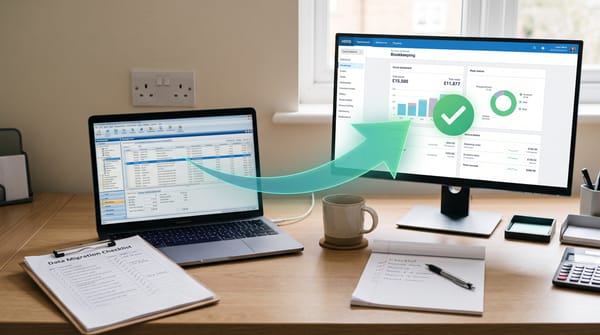
Booke AI UK Review 2026: Is This AI-Native Bookkeeping Tool Worth Switching From Dext?
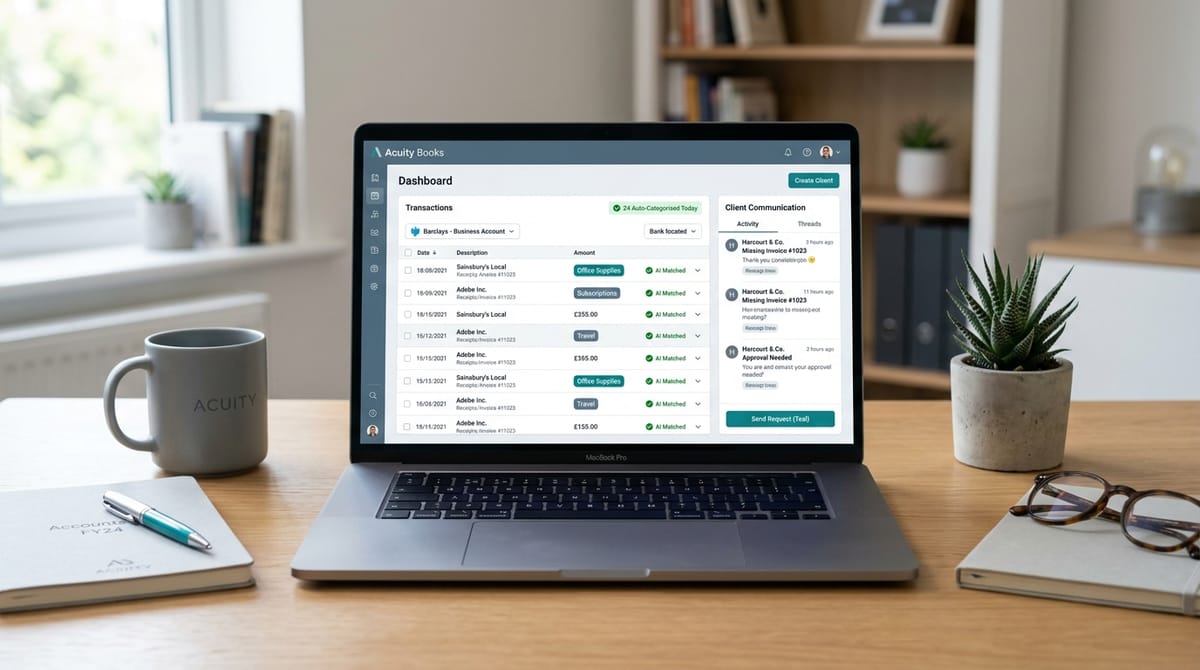
Booke AI UK Review 2026: Is This AI-Native Bookkeeping Tool Worth Switching From Dext?
Booke AI keeps appearing at the top of AI bookkeeping comparisons — rated the best AI-native option in at least two separate roundups published in early 2026. Yet very few UK bookkeepers have a clear picture of what it actually does, what it costs in pounds, and whether it belongs in a UK practice stack. This review answers all three, and deals honestly with the parts the marketing pages skip over.
Short version: Booke AI is not a Dext replacement. It is a different layer of automation entirely. The question is not "Booke AI or Dext" — it is whether you need what Booke AI specifically does, and whether a UK bookkeeping practice can rely on it given its current limitations.
Still using Dext? Compare it against the field — or try it for 14 days free.
What Booke AI actually is
Booke AI (booke.ai) is a US company — incorporated in Wilmington, Delaware, founded 2020, a team of approximately five people as of mid-2026. It offers an AI Bookkeeper product that connects to your existing QuickBooks Online or Xero account and works the bank feed daily: it reads incoming transactions, categorises them, matches receipts and invoices to the right bank lines, flags low-confidence items for your review, and prepares reconciliation for your sign-off.
That is its lane, and it stays in it. It does not replace your accounting platform. It does not generate a P&L, produce a balance sheet, run payroll, pay bills, raise invoices, or close the month. The close still happens — you are still the adult in the room. Booke AI handles the data-entry layer: the daily categorisation grind that eats a disproportionate amount of bookkeeping time on high-transaction clients.
Crucially, this is a different job from what Dext does. Dext captures documents — photographs, forwarded invoices, supplier emails — runs OCR on them, and pushes extracted data into your accounting software as draft transactions. Booke AI then codes those transactions to the correct accounts. If your practice pain is getting receipts out of clients' pockets and into Xero, Booke AI does not fix that. If your pain is the hours spent categorising 400 bank transactions a month for a busy sole trader, Booke AI might.
Features: what the product actually does in 2026
The Business plan includes the following, from Booke AI's UK pricing page:
- Daily bank feed categorisation — the model reads each new transaction against the client's historical patterns and assigns an account code. Anything below its confidence threshold goes to a review queue rather than posting silently to the wrong account. That exception-routing is the product's most valuable design decision.
- Smart document matching — if you are also running OCR (via Dext, Receipt Bot, or Booke's own OCR module), it matches the prepared document to the bank line it belongs to, including split transactions and multi-invoice payments.
- Missing document requests — sends automated prompts to clients when a transaction needs a supporting receipt they have not yet provided.
- Custom thresholds and rules — you set the confidence threshold at which items go for human review, and can add supplier-specific coding rules on top of the AI layer.
- Exception review and audit trail — every categorisation decision is logged. Useful if a client or HMRC ever queries why a transaction landed in a specific account.
- OCR for bills, invoices and receipts — Booke includes its own OCR module. The review from Litmus describes it as "the part that won me over": it reads line items, tax rates, and totals across multiple languages and currencies, then matches the document to the bank transaction. If you already run Dext for document capture, there is overlap here, but Booke's OCR feeds directly into its categorisation workflow rather than stopping at extraction.
- Client portal (desktop and mobile) — clients can submit documents and respond to queries through a branded portal. The white-label option is available on the Accounting Firms tier.
- Xero browser extension — enables bulk reconciliation directly in the Xero interface. Some Xero features run through this extension rather than a fully embedded integration, which is a minor friction point but not a dealbreaker for most practices.
- Per-client isolated AI model — each client's transaction history trains only that client's AI model. No client's data improves the categorisation on another client's books.
What it does not do
Worth being specific, because some of these omissions matter for UK practices:
- No accruals or adjusting journal entries
- No financial statements (P&L, balance sheet)
- No bill pay or accounts payable automation
- No invoicing or accounts receivable
- No payroll integration
- No multi-entity consolidation
- No dedicated VAT classification engine (more on this below)
- No Sage integration
- No FreeAgent integration
Booke AI UK pricing: what you actually pay
The UK-specific pricing, as shown on booke.ai/en-gb/pricing, is £89 per business per month. A "business" means each client whose books you manage. The Accounting Firms tier is quote-only and adds multi-client management, white-label client experience, and priority onboarding.
There is no free plan and no free trial on the UK pricing page. The company does offer a 14-day refund window from subscription start if the product does not work for you — but that is a refund policy, not a trial. You are committing £89 before you see how the model handles your clients' actual books.
For a practice context: if you run 10 active bookkeeping clients, you are looking at £890/month or £10,680/year at current rates. That is a material line item. The per-client structure means costs scale with your book of business, which is the right shape for a growing practice — but the entry cost per client is high relative to what Booke AI does in isolation. You still need your accounting software, your receipt capture tool, and your own time reviewing exceptions.
Note: some third-party directories still list legacy pricing tiers of $20–$50 per client. These were removed from the official pricing page as of mid-2026. The current UK price is £89/month per business. If a sales contact quotes you a different number, get it in writing before you commit.
The UK-specific questions: VAT, Sage, and HMRC compliance
This is where UK bookkeepers need to slow down and read carefully, because the product's US origins create genuine gaps.
No dedicated VAT classification engine
UK bookkeeping is not just categorisation. VAT treatment — standard-rated, reduced, zero-rated, exempt, outside scope, reverse charge — has to be correct, and it is account-level, not just line-item-level. Booke AI has no dedicated VAT classification engine. It relies on whatever VAT rules are already configured inside your Xero or QuickBooks account. That means your chart of accounts needs to be properly set up with the right VAT codes before Booke AI can categorise correctly against them. If a client's books are messy, Booke's categorisation accuracy will reflect that messiness.
For practices where VAT classification is the hard part — particularly those with clients in construction (domestic reverse charge), healthcare (mixed exempt/zero-rated), or retail (complex baskets) — Booke AI's lack of a VAT engine is a genuine gap, not a marketing edge case. This is the opposite of what you need when you're already navigating Making Tax Digital requirements.
No Sage or FreeAgent support
A significant portion of UK bookkeeping practices run on Sage. If that is your platform, Booke AI is not available to you. Similarly, FreeAgent — which is free for NatWest, RBS, and Mettle business account holders and popular with sole traders — is not supported. The product works on QuickBooks Online and Xero only. Zoho Books is listed as a third supported platform on some pages, but it is not prominent in the UK-facing materials.
MTD ITSA compliance
Booke AI categorises transactions in your accounting platform. It does not file MTD quarterly updates itself — that is handled by your accounting software (Xero or QuickBooks). If your clients are now in the first MTD ITSA cohort (self-employed and landlords with income above £50,000), Booke AI does not change the compliance picture. MTD-compatible accounting software still needs to be running underneath it. Booke AI is an automation layer on top, not a compliance solution.
GDPR and data residency
Booke AI is a US company processing UK client data. The company's privacy policy should be reviewed carefully against your GDPR obligations as a data controller. SOC 2 compliance is unconfirmed across all reviewed pages. For practices with clients who require a confirmed SOC 2 vendor in their stack — typically those in financial services or listed entities — treat that as a blocking question for Booke's sales team before you sign up.
Booke AI vs Dext: the honest comparison
These are not competing tools. They solve different problems at different points in the bookkeeping workflow.
| Feature | Dext | Booke AI |
|---|---|---|
| Primary function | Document capture and OCR extraction | Transaction categorisation and reconciliation prep |
| Receipt/invoice capture | Yes — core feature | Yes — included but secondary |
| Bank feed categorisation | No | Yes — daily, AI-driven |
| Reconciliation prep | No | Yes |
| Accounting platforms | Xero, QuickBooks, Sage, FreeAgent | Xero, QuickBooks only |
| UK VAT engine | Reads VAT from receipt; no broader classification | No — relies on platform VAT codes |
| UK pricing | From £24/month | £89/month per client |
| Free trial | 14-day free trial | No — 14-day refund window only |
| Client-facing portal | Yes | Yes |
| Company | UK-headquartered, established 2010 | US (Delaware), founded 2020, ~5 staff |
The more interesting question is whether you need both. Booke AI suggests you can: use Dext for client document intake, then let Booke AI handle the categorisation and reconciliation on the back end. Some practices do exactly that. The Dext and Xero integration already handles the document-to-platform leg; Booke AI would then take over from the categorisation step onwards.
The counter-argument is cost. If Dext runs from £24/month at the practice level (covering multiple clients depending on your plan) and Booke AI costs £89/month per client, a 10-client practice adding Booke AI is adding £890/month on top of existing Dext spend. That has to close from time saved — and the time savings depend entirely on how much of your work is categorisation volume versus the document capture Dext already solves.
Accuracy and the messy-books problem
The vendor advertises "up to 98% accuracy" and "80% faster transaction categorisation." The "up to" qualifier is doing heavy lifting on both figures. Against a clean client with a stable chart of accounts and regular, predictable vendor patterns, you will get close to those numbers. Against a client who mixes personal and business spending, uses fifteen different tools, and submits documents in irregular batches — the clients who need the most help — accuracy drops noticeably.
The most useful design choice Booke AI has made is that it fails loudly: low-confidence items land in your review queue with an audit trail, rather than posting silently to the wrong account. You can catch problems before they embed. The risk is not catastrophic miscoding — it is that you spend more time reviewing exceptions on messy clients than you save on categorisation. Pilot on two clients (one clean, one messy) for a full close cycle before rolling out to a full roster. If the exception rate on the messy client is still saving you time, you have a real ROI. If not, you know before you have committed to 10 clients at £89/month each.
This also ties into a broader question about which AI tools UK bookkeepers actually benefit from: the tools that compound value over time are the ones that learn from your corrections and get incrementally more accurate. Booke AI's per-client isolated AI model does this — each correction trains that client's model without affecting others.
The right pick for…
Booke AI makes sense if:
- Your practice runs on Xero or QuickBooks Online exclusively, and has no Sage or FreeAgent clients
- Your time bottleneck is transaction categorisation volume, not document capture (document capture is already solved — use Dext or Receipt Bot)
- Your clients have reasonably clean books with consistent vendor patterns
- You are comfortable with a US company holding UK client transaction data and can satisfy GDPR obligations
- You can pilot it on two clients before committing the full roster
Booke AI does not fit if:
- Any of your clients are on Sage or FreeAgent
- You need a UK VAT classification engine — for construction reverse charge, healthcare exemptions, or complex retail
- Your main problem is getting documents from clients (that is Dext's job, not Booke's)
- You need SOC 2 certification for audit-readiness or contractual reasons
- Your client base has genuinely messy books — the ROI disappears when exception rates are high
- Budget is a concern: £89/client/month adds up quickly across a practice
If you are a sole trader doing your own books — rather than a bookkeeper managing clients — Booke AI is not designed for you. It is built for bookkeeping practices managing multiple clients' books, where the per-client pricing model makes sense. Sole traders doing their own accounts should look at full-service UK accounting software like FreeAgent, Xero, or Zoho Books instead.
The continuity question
A small team is brilliant when it has time for you and absent when it doesn't. Booke AI is a roughly five-person company, and third-party reviews report a wide spread in support quality: some describe ten-minute resolutions to complex multi-currency issues; others report demo no-shows and weeks of silence. The review corpus is thin — around 39 Trustpilot reviews and a handful on G2 and Capterra as of mid-2026 — which means the scores carry wider error bars than a mature product.
The bookkeeping software category buries its dead. Bench, a well-funded US bookkeeping service, was scrambled into a rushed acquisition and customers temporarily lost access to their books. Botkeeper wound down its core product. Booke AI is a small company with modest funding. The design is right — per-client AI isolation, exception routing, audit trails — but the organisational question of whether a five-person team can scale support quality as it grows is unanswered. Keep your data exportable. Do not let Booke become the only place a client's categorisation history lives.
FAQ
Is Booke AI available in the UK?
Yes. Booke AI has a UK pricing page (booke.ai/en-gb/pricing) with GBP pricing at £89/month per business. However, the product is US-built and US-focused, and some UK-specific features — particularly VAT classification — are not supported.
Does Booke AI work with Sage?
No. Booke AI supports QuickBooks Online and Xero only. Sage, FreeAgent, Pandle, and other UK platforms are not supported.
Is Booke AI MTD-compliant?
Booke AI categorises transactions inside your Xero or QuickBooks account. MTD quarterly updates are submitted by your accounting software — Booke AI does not file with HMRC directly. It is neither MTD-approved nor HMRC-recognised in its own right; compliance runs through the underlying accounting platform. See our MTD-ready vs HMRC-recognised guide for a full explanation of the distinction.
Does Booke AI replace Dext?
No. Dext captures documents and pushes extracted data into your accounting software. Booke AI then categorises those transactions and prepares reconciliation. They operate at different stages of the bookkeeping workflow and can be used together. If you want one tool that does both, compare your receipt capture options separately from your categorisation options.
What happens if Booke AI makes a categorisation error?
Low-confidence items are routed to a review queue before posting — they do not silently land in the wrong account. If a posted categorisation is wrong, you correct it, and the model learns from that correction for future transactions on the same client's books.
Related Reading
- Best AI Receipt Capture Tools for UK Bookkeepers (2026) — what to run for document capture, which is a separate problem from what Booke AI solves
- Dext Review 2026: Is It Worth the Price for UK Bookkeepers? — the full case for Dext as your document capture layer
- Best AI Tools for UK Bookkeepers (2026) — the full stack, from capture through to reporting
Affiliate disclosure: Some links in this article are affiliate links. If you sign up through them, we may earn a commission at no extra cost to you. We only recommend tools we've genuinely assessed.