Best Mileage Tracking Apps for UK Self-Employed in 2026
HMRC raised the approved mileage rate from 45p to 55p per mile in April 2026. If you're self-employed and driving for work, that's a 22% increase in the deduction you can claim — but only if you have a contemporaneous record of every business journey. No log, no claim.
The good news is that mileage tracking has got easier and, in some cases, considerably cheaper. A new generation of UK-built apps has emerged alongside the rate change, and several tools that once seemed worth the money have quietly doubled in price.
This guide compares six mileage tracking approaches for UK sole traders and self-employed people in 2026: what each costs, what it does, and who should actually use it.
Already using Dext for receipt capture? Mileage tracking is included free in every plan.
The 2026 HMRC mileage rate change: what it means in practice
From 6 April 2026, HMRC's Approved Mileage Allowance Payment (AMAP) rates for cars and vans rose from 45p to 55p per mile for the first 10,000 business miles in a tax year. Above 10,000 miles, the rate stays at 25p. Motorcycles remain at 24p flat.
This is the first change to the AMAP rate since 2011. The practical effect is significant: 10,000 business miles now generates a £5,500 deduction instead of £4,500 — worth £1,100 extra to a basic-rate taxpayer, or £2,200 at higher rate.
But HMRC's rules haven't changed: you need a contemporaneous record of each journey showing the date, start and end points, purpose, and distance. "I drove about this much" is not a record. If HMRC opens an enquiry, they want trip-by-trip detail. That's what a mileage app provides automatically.
Most reputable apps have already updated to the 55p rate. A few US-built apps default to IRS rates and need manual configuration. If you're using one of those, check the settings before you file.
At a glance: mileage tracking apps for UK self-employed (2026)
| App | Free plan | Paid plan | Tracking method | HMRC-ready | Best for |
|---|---|---|---|---|---|
| Dext | Included in subscription | From £15/mo (bookkeeper plan) | GPS | Yes | Dext users; Xero/QBO integration |
| MileClear | Unlimited trips | £4.99/mo | GPS | Yes — SA103 export | UK-built, gig workers, high mileage |
| Trippi | 14-day trial | £80/yr (£6.66/mo) | Calendar-based | Yes | Sole traders living in their calendar |
| Driversnote | 15 trips/month | £8/mo (excl. VAT) | GPS / iBeacon | Yes | Teams; reliable GPS logging |
| MileIQ | 40 drives/month | £9.49/mo (or £95/yr) | GPS | Yes (manual setup) | Occasional business drivers |
| FreeAgent | Included (free for NatWest/RBS/Mettle users) | £19/mo (sole trader plan) | Manual entry | Yes — AMAP rates built in | FreeAgent users; low mileage volumes |
| QuickBooks | Included in all plans | From £10/mo (Simple Start) | GPS | Yes | Existing QuickBooks users |
Prices correct as of October 2026. Check vendor sites for current pricing.
Dext: mileage included, Xero and QuickBooks integration built in
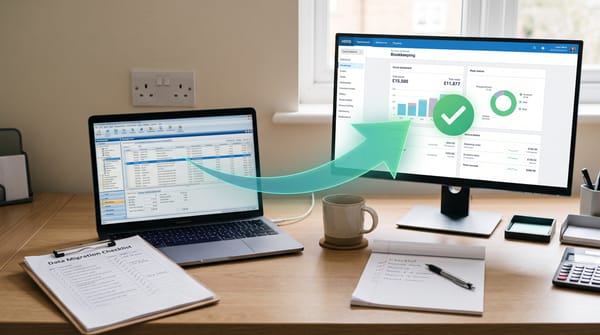
If you're already using Dext for receipt capture, you don't need a separate mileage app. Dext's GPS mileage tracker is included in every plan at no extra cost: it logs business trips automatically using your phone's location, applies HMRC's current AMAP rates (55p/mile up to 10,000 miles from April 2026), and routes approved claims straight into your accounting software.
The integration is the key advantage. A mileage claim approved in Dext lands in Xero or QuickBooks already categorised and with the correct VAT treatment, with no re-entry. For a bookkeeper or sole trader who's already processing receipts through Dext, adding mileage to the same workflow costs nothing and removes one more piece of end-of-year tidying.
Dext mileage also handles the team approval workflow: employees submit claims from the mobile app, approvers handle them in the web interface, and everything lands in the ledger once approved. For a small practice managing several client expense workflows, this matters.
What it costs: Mileage is included in all Dext subscriptions. Dext plans start from around £15/month for bookkeeper plans (per client pricing applies — see our detailed Dext pricing breakdown for current figures). Sole traders can use Dext if their bookkeeper provides it, or via a direct Dext subscription.
Limitations: Dext doesn't currently support custom mileage rates (though this is on the roadmap). If your employer reimburses at a rate different to HMRC's AMAP, you'll need to handle the Mileage Allowance Relief calculation separately. Dext also requires a paid subscription — it's not a free standalone mileage tracker.
Best for: Anyone already using Dext for bookkeeping, and any bookkeeper who wants mileage to flow into Xero or QuickBooks without a separate tool.
MileClear: unlimited free GPS tracking, built in the UK
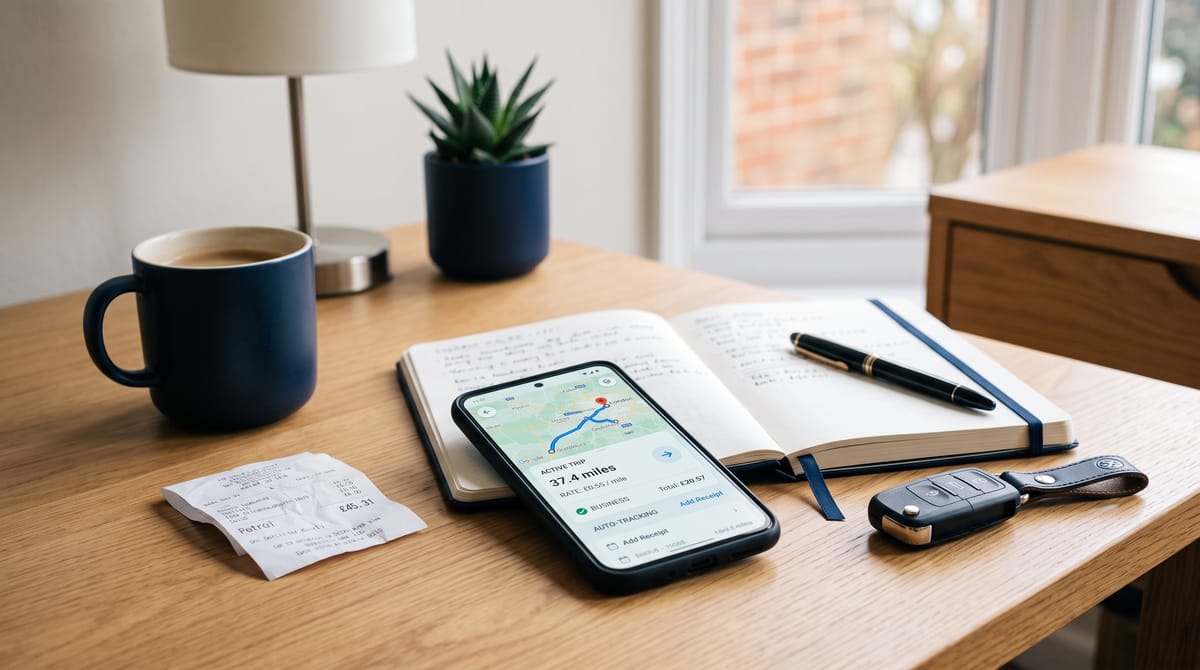
MileClear is a straightforward proposition: unlimited background GPS tracking, HMRC rates applied automatically (including the 55p rate from 6 April 2026), and a Self Assessment-ready PDF when you need it. The core tracking is free with no monthly drive cap — a deliberate contrast to MileIQ's 40-drive limit and Driversnote's 15-trip ceiling.
It was built by a UK self-employed driver for UK drivers, which shows in the detail. The tax year runs 6 April to 5 April, not 1 January. Rates switch automatically on the correct date — trips in March 2026 use 45p; trips in April 2026 use 55p. Exports are formatted for the SA103 box on your Self Assessment return. Platform tagging covers Uber, Deliveroo, Amazon Flex, Just Eat, DPD, Evri, and others, which is useful for gig workers who need to separate income by platform.
MileClear also includes an MTD ITSA integration for quarterly submissions, a live tax readiness estimate showing your running Income Tax and National Insurance liability, and a DVLA vehicle lookup that auto-fills make, model, and fuel type from your registration plate.
What it costs: Free tier covers unlimited trip tracking, HMRC rate calculations, vehicle records, and a Self Assessment walkthrough. Pro is £4.99/month and adds the SA103 PDF export, CSV export with a signed attestation, an accountant portal, and unlimited saved locations. Annual pricing is available through the iPhone app.
Limitations: MileClear is a newer app — launched in 2026 — so it doesn't have the multi-year track record of MileIQ or Driversnote. Free tier is limited to one vehicle. The web app is in development; it's primarily mobile-first. Android app is newer than the iPhone version.
Best for: UK self-employed people who want free unlimited GPS tracking without monthly drive caps. Particularly well-suited to gig workers on Deliveroo, DPD, or Amazon Flex, and to any sole trader driving regularly for work who needs proper HMRC records without a monthly fee.
Trippi: calendar-based mileage, no GPS needed
Trippi takes a different approach entirely. Instead of GPS, it reads your Google Calendar or Microsoft Outlook calendar and calculates business mileage from the meeting locations already on your appointments. If you have a client visit at a postcoded address in your diary, Trippi calculates the distance and applies HMRC rates. No app running in the background. No battery drain. No reviewing and classifying 50 trips that were actually personal journeys.
This is genuinely useful for a particular type of sole trader: the consultant, contractor, or accountant who drives to client meetings, already keeps those meetings in their calendar with location data, and finds the "start tracking, remember to classify it later" GPS model more hassle than it's worth.
Trippi is UK-only by design. HMRC's AMAP rates (55p/25p for cars) are built in from the start, reports are formatted for UK tax returns, and there's no US-origin onboarding to navigate around. The 14-day free trial is the full product with no card required — a proper trial rather than a permanently capped free tier.
What it costs: £8/month, or £80/year (£6.66/month) on an annual plan. No free tier beyond the 14-day trial. No per-trip limits on any paid plan.
Limitations: Only works if your business meetings have location data in your calendar. Doesn't capture unscheduled journeys (a spontaneous drive to pick up supplies won't appear). If a significant chunk of your business mileage isn't reflected in calendar appointments, Trippi will give you an incomplete log. Also: UK-only, so no use if you drive for work internationally.
Best for: Sole traders and consultants who drive to client meetings, already use Google Calendar or Outlook, and want mileage records without running GPS continuously.
Driversnote: solid GPS with iBeacon accuracy
Driversnote has been one of the more popular dedicated mileage trackers for UK drivers for several years. It works on iOS, Android, and the web, supports HMRC mileage rates, and generates PDF and Excel reports for tax purposes or employer claim submissions. The optional iBeacon hardware device connects via Bluetooth when you get into your car and triggers tracking automatically, which improves accuracy — particularly for short city journeys where GPS takes a moment to settle.
Driversnote also has a team product (Driversnote Teams) for businesses that need to approve and reimburse employee mileage claims. If your employer already uses Driversnote, the employee app is free to use within that workflow.
What it costs: Free tier covers 15 trips per month. Pro plan is £8/month excluding VAT (£9.60 including VAT). iBeacon device is included with annual plans; costs extra otherwise. Team plans are priced per user.
Limitations: The 15-trip free tier is very restrictive — it covers occasional drivers but most sole traders doing regular business journeys will hit the ceiling within the first week of a busy month. The Pro plan at £8/month (excl. VAT) is competitive with Trippi but more expensive than MileClear Pro. US-based in origin; HMRC rates need to be confirmed as correctly configured.
Best for: Drivers who want proven GPS tracking with the option of iBeacon hardware for better accuracy, and teams or employers who need an approval workflow for employee mileage claims.
MileIQ: established, but the 111% price rise changes the calculation
MileIQ is probably the best-known dedicated mileage tracker in the UK. It has a large user base, a polished swipe-to-classify interface, and years of reliability data behind it. In 2026, it raised its monthly subscription price from £4.49 to £9.49 — an increase of around 111% — which has prompted many long-term users to reconsider.
The free tier allows 40 drives per month. For someone who drives to a handful of client meetings per month, that's adequate. For a sole trader doing regular site visits, a delivery driver, or anyone driving more than once or twice per week for work, 40 drives disappears quickly — and the paid plan at £9.49/month is now more expensive than both Trippi (£6.66/month annually) and MileClear Pro (£4.99/month).
MileIQ is US-based, and users need to configure HMRC rates manually rather than finding them applied by default. For UK users, that's an extra setup step that UK-first apps avoid.
What it costs: Free for 40 drives per month. Unlimited: £9.49/month or £95/year (£7.91/month). No change in what the product does since the price rise — just a higher price for the same features.
Limitations: Price has roughly doubled, making it the most expensive dedicated mileage app in this comparison. US-origin means HMRC rates aren't the default. No SA103-specific export or Self Assessment walkthrough. Free tier limit will frustrate regular business drivers.
Best for: Occasional business drivers comfortable with a 40-drive monthly cap, or existing MileIQ users who've decided the price increase is still worth paying for a tool they know well.
FreeAgent: built-in mileage for existing users (free with NatWest, RBS, Mettle)
FreeAgent's mileage tracking is manual — you enter each journey by hand or import from a CSV — rather than GPS-automatic. That's a meaningful difference if you're doing regular business driving and don't want to remember to log every trip. But for sole traders who drive occasionally and are already using FreeAgent as their accounting software, it removes any need for a separate app.
FreeAgent updated its AMAP rates automatically when they changed on 6 April 2026: trips entered on or after that date use 55p, earlier trips use 45p. The system handles the 10,000-mile threshold and switches rates accordingly. Mileage claims feed directly into your FreeAgent accounts and Self Assessment calculation.
The standout point on FreeAgent is pricing: it's free for personal account holders with NatWest, Royal Bank of Scotland, or Mettle (NatWest's business banking brand). If you're banking with any of those and want a mileage record integrated with your accounting, you may already have this available at no additional cost. See our Xero vs FreeAgent comparison for a full look at what FreeAgent does across its plans.
What it costs: Free for NatWest, RBS, and Mettle personal account holders. £19/month for the sole trader plan otherwise.
Limitations: Manual entry rather than GPS auto-tracking. Not suitable for high mileage drivers who want automatic logging. Primarily useful as a mileage tool if you're already a FreeAgent user — there's no reason to pay for FreeAgent just for mileage tracking when dedicated apps do it better.
Best for: FreeAgent users who want mileage integrated directly into their accounts without a separate app, particularly NatWest/RBS/Mettle account holders for whom FreeAgent is already free.
QuickBooks: mileage included across all plans
QuickBooks includes GPS mileage tracking in its mobile app across all UK subscription plans, from Simple Start upwards. It auto-logs journeys using your phone's GPS, lets you swipe to classify trips as business or personal, and feeds approved mileage directly into your QuickBooks expense reports and tax calculations.
Like FreeAgent's built-in tool, QuickBooks mileage is most useful to people who are already QuickBooks subscribers — there's no reason to pay for QuickBooks as a mileage tracker when dedicated apps do it more cleanly and at lower cost. But if you're running your bookkeeping on QuickBooks anyway, the mileage feature is a solid addition that requires no additional tool.
QuickBooks raised its UK prices significantly in 2026 — the Simple Start plan went up by around 47% — so this should factor into any assessment of QuickBooks as a combined accounting and mileage solution. Our QuickBooks price rise analysis covers the current plan costs in detail.
What it costs: Included with all QuickBooks Online plans. Simple Start from £10/month (post-2026 price rise). Mileage is not available as a standalone product.
Best for: Existing QuickBooks users who want mileage tracking without a separate app.
How much is the mileage deduction actually worth?
Before deciding how much to spend on a mileage tracker, it's worth understanding what the AMAP deduction is actually worth to you. Here are some worked examples at the current 55p rate (2026/27 tax year):
| Annual business miles | Deduction (£) | Tax saving (basic rate, 20%) | Tax saving (higher rate, 40%) |
|---|---|---|---|
| 2,000 miles | £1,100 | £220 | £440 |
| 5,000 miles | £2,750 | £550 | £1,100 |
| 10,000 miles | £5,500 | £1,100 | £2,200 |
| 15,000 miles (10k at 55p + 5k at 25p) | £6,750 | £1,350 | £2,700 |
Put differently: a basic-rate taxpayer doing 10,000 business miles per year gets £1,100 back from HMRC. MileClear Pro at £4.99/month costs £60/year. Trippi at £80/year. Even MileIQ at £95/year. The maths strongly favours tracking properly.
The bigger risk is claiming without adequate records. HMRC can disallow mileage claims without contemporaneous logs, and can charge penalties on top. Our guide to claiming expenses as a UK sole trader covers what records you actually need to keep.
Which mileage tracking app should you choose?
The right answer depends on what you're already using and how much you drive for work.
If you already use Dext for receipt capture: Don't add a separate mileage app. Dext includes GPS mileage tracking in every plan, and it integrates directly with Xero and QuickBooks. If you're building out a complete digital bookkeeping stack, Dext handles both receipts and mileage in one place. Try Dext free for 14 days →
If you drive regularly and want free GPS tracking: MileClear. Unlimited trips with no monthly cap, UK-built with HMRC rates by default, and free to use for the core tracking. Pay £4.99/month for Pro only when you need the SA103 PDF or CSV exports at year end.
If you're a consultant or contractor who lives in their calendar: Trippi. If your client meetings are in Google Calendar or Outlook with postcoded addresses, Trippi turns those into an HMRC-ready mileage log without any background tracking. £80/year is reasonable for what it does.
If you want proven GPS with hardware support: Driversnote. The iBeacon option improves accuracy for urban drivers, and the team version works well if you're managing employee expense claims alongside your own. Plan for £8/month (excl. VAT) on Pro.
If you're an occasional business driver (under 40 trips/month): MileIQ's free tier. The 40-drive monthly limit is adequate for someone who drives to client meetings a few times a week. Just be aware the price has more than doubled if you ever need to go unlimited.
If you're already on FreeAgent or QuickBooks: Use the built-in mileage feature if your mileage volumes are manageable. For high mileage or complex trip classification, add a dedicated app anyway — the integrated record-keeping saves you manual data entry at year end.
If you're a gig worker on Deliveroo, DPD, Amazon Flex, or similar: MileClear, which has specific platform-tagging for UK gig apps and no drive caps that would cut out mid-shift. Our gig economy bookkeeping guide covers the full picture for platform workers.
Making Tax Digital and mileage: what changes from 2026
MTD for Income Tax is now live for sole traders and landlords with qualifying income above £50,000. Quarterly updates to HMRC require digital records of income and expenditure — and mileage is an expenditure that feeds into those quarterly figures.
Most of the apps above can export in formats that work for MTD. Dext integrates directly with MTD-compatible software like Xero, which then handles quarterly submissions. MileClear has built-in MTD ITSA quarterly submission. FreeAgent and QuickBooks both handle MTD submissions natively.
If your mileage currently lives in a notebook or spreadsheet, 2026 is the year to move it to a digital record — not just for convenience, but because MTD requires it. Our guide to HMRC-approved MTD software covers which platforms are on both the VAT and ITSA compatibility lists.
FAQ: mileage tracking for UK self-employed
What is the HMRC mileage rate for 2026/27?
55p per mile for the first 10,000 business miles in a tax year (cars and vans). 25p per mile above 10,000 miles. 24p per mile for motorcycles. The 55p rate applies to trips from 6 April 2026 onwards; the previous rate of 45p applied until 5 April 2026. You can also claim passenger allowance of 5p per mile per passenger for business journeys.
Do I need to log every single business trip?
Yes, if you're claiming AMAP mileage on Self Assessment. HMRC requires a contemporaneous record of each journey showing the date, start and end points, business purpose, and distance. In practice, a good mileage app does this automatically. If HMRC opens an enquiry into your Self Assessment, they can request these records — and "I drove approximately this much" is not the same as a proper log.
Can I claim mileage if I use my personal car for business?
Yes — in fact, that's exactly what AMAP is designed for. The HMRC approved mileage rates compensate sole traders for using their own vehicles for business purposes, covering fuel, wear and tear, and running costs. You cannot separately claim fuel receipts or running costs on top of the AMAP rate — AMAP is the all-in flat rate. If you use a company car or van, different rules apply.
What if my employer pays me a lower mileage rate than HMRC's 55p?
You can claim Mileage Allowance Relief (MAR) on the difference. If your employer pays 30p/mile and HMRC's rate is 55p, you can claim the 25p difference per mile as an employment expense on your Self Assessment. This is separate from sole trader AMAP claims. MileClear's app can help calculate MAR on the free plan; the SA103 export (for sole trader AMAP) is Pro only.
Which apps are MTD ITSA compliant for mileage?
MTD ITSA requires digital records, not a specific app format. Any app that lets you export digital mileage records to MTD-compatible software meets the requirement. Dext integrates directly with Xero and QuickBooks, which are both HMRC-recognised for MTD ITSA. MileClear has built-in quarterly submission. FreeAgent and QuickBooks handle mileage within their MTD workflows natively.
Is Dext mileage tracking free?
Mileage is included in all Dext subscriptions at no additional charge. You need a paid Dext plan to access it — there's no standalone free version. Dext plans start from around £15/month for bookkeeper plans.
Related reading
- How to Claim Expenses as a UK Sole Trader: The Complete Digital Guide
- Bookkeeping Apps for UK Gig Economy Workers: Uber, Deliveroo and Amazon Flex
- Best Accounting Software for UK Sole Traders (2026)
Affiliate disclosure: Some links in this article are affiliate links. If you sign up through them, we may earn a commission at no extra cost to you. We only recommend tools we've genuinely assessed.