How to Claim Expenses as a UK Sole Trader: The Complete Digital Guide (2026)
How to Claim Expenses as a UK Sole Trader: The Complete Digital Guide (2026)
Most UK sole traders overpay tax every year — not because they're earning too much, but because they miss legitimate expenses. If you're self-employed and filing a Self Assessment return for 2025/26, the expenses you record between now and 5 April 2026 will directly reduce your tax bill. Done properly, a sole trader with £40,000 turnover might cut their taxable profit by £8,000–£12,000 through allowable expenses alone. Done badly — or not at all — you hand that money to HMRC.
This guide covers every category of allowable expense HMRC recognises, the flat-rate shortcuts that save time, what you genuinely cannot claim, and how to use digital tools to capture everything without shoebox receipts. If you're already wondering whether a specific purchase qualifies, that instinct is worth following — the answer is usually yes, provided you can show the expense was incurred wholly and exclusively for your business.
Stop losing receipts and missing expense claims — Dext captures them automatically from your phone, email, and bank.
What HMRC counts as an allowable expense
The HMRC rule is deceptively simple: an expense is allowable if it is incurred "wholly and exclusively" for the purposes of your trade. That means the cost must be a genuine business cost, not a personal one dressed up as business. In practice, many costs serve both purposes (a phone you use for work and personal calls; a car you drive to client meetings and the supermarket), and HMRC has specific rules for splitting these — more on that below.
Allowable expenses reduce your taxable profit, not your turnover. If you earned £50,000 and have £12,000 of allowable expenses, you pay Income Tax and National Insurance on £38,000. At the basic rate of 20%, that's a £2,400 saving. Every claim matters.
The most common bookkeeping mistakes UK sole traders make cluster around expenses: either not claiming them at all, claiming the wrong category, or claiming personal costs and hoping HMRC won't notice. The last approach is a compliance risk; the first two simply cost you money.
The main expense categories — with the figures that matter
Travel and vehicles
If you use a vehicle for business travel, you have two options: claim actual running costs (fuel, insurance, servicing, depreciation) and apportion the business percentage, or use HMRC's simplified mileage rates. For most sole traders, the simplified rates are easier and often more generous:
- Cars and vans: 45p per mile for the first 10,000 business miles in a tax year, then 25p per mile
- Motorcycles: 24p per mile (flat rate)
- Bicycles: 20p per mile (flat rate)
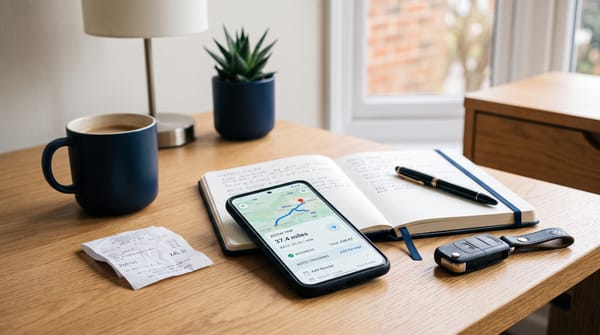
If you drive 12,000 business miles in 2025/26, your mileage claim is (10,000 × 45p) + (2,000 × 25p) = £4,500 + £500 = £5,000. Keep a mileage log — date, destination, purpose, miles. HMRC can ask for this. A simple spreadsheet or the mileage tracker inside FreeAgent or Dext will do.
Note: if you've already claimed capital allowances on a vehicle, you cannot switch to the flat mileage rate for that vehicle. Pick one method at the start and stick with it.
Train fares, taxis, buses, and parking for business journeys are all claimable at actual cost. The commute from home to a regular place of work is not — that is personal travel, regardless of how far it is.
Working from home
If you work from home (as many sole traders do), you can claim a proportion of household bills — heating, electricity, broadband, even some mortgage interest or rent. HMRC offers two methods:
Simplified flat rate (easier for most):
- 25 to 50 hours of business use per month: £10/month
- 51 to 100 hours per month: £18/month
- 101 or more hours per month: £26/month
These are monthly figures, not weekly. The £6/week figure that circulates on social media applies to employed workers claiming working from home relief through PAYE — it is not the sole trader rate.
Actual cost method (better if your home bills are high): Calculate the proportion of your home used for business, multiplied by the relevant bills. A sole trader using one room out of five in their house for 40% of the time could claim 8% (1/5 × 40%) of eligible household costs. This method requires more record-keeping but can yield a larger claim if your bills are substantial.
Office costs and equipment
Stationery, printer ink, postage, and software subscriptions are straightforward — claim the business-use proportion at actual cost. A laptop bought solely for work is an allowable capital expense under the Annual Investment Allowance (AIA), which currently sits at £1,000,000 — far above anything a sole trader would spend in a year. This means you can deduct the full cost of business equipment in the year you buy it, rather than depreciating it over time.
Phone and broadband: if you have a dedicated business line, claim 100% of the cost. If you use your personal phone for business, claim the business-use percentage. HMRC is pragmatic about this — a reasonable estimate (say, 50%) backed by a brief calculation is usually fine.
Clothing
Standard business attire — a suit for meetings — is not claimable. HMRC's position is that a suit can be worn outside work, so it isn't wholly and exclusively for business. However, uniforms with a business logo, protective clothing (hard hats, hi-vis, safety boots), and specialist work gear (a chef's whites, a performer's costume) are allowable. The test is whether the item could reasonably be worn in everyday life.
Marketing and advertising
Website costs, hosting, domain names, paid advertising (Google Ads, Meta Ads), business cards, brochures, sponsorships — all allowable at actual cost. If you pay a design agency or copywriter, that's a professional services cost (see below), but the ad spend itself goes here.
Professional fees, training, and subscriptions
Accountant and bookkeeper fees are allowable — somewhat pleasingly. So are solicitor fees for business contracts, membership fees for professional bodies relevant to your trade, and training courses that update or maintain existing skills. The key word is "maintain" — HMRC does not allow training to acquire an entirely new skill set (e.g., a plumber retraining as an accountant). But CPD, software training, or a course in a technique you already practise professionally will generally pass.
Financial costs
Business bank account charges, merchant services fees (card processing), trade insurance, and professional indemnity insurance are all allowable. Loan interest on business borrowing is allowable; capital repayments are not. Automating your bookkeeping with AI can help you separate these correctly without manual categorisation for every transaction.
What you cannot claim
The list of non-allowable expenses is shorter but worth knowing:
- Personal clothing (anything you could wear off-duty)
- Entertaining clients or customers — business entertainment is explicitly excluded from Income Tax relief, unlike for companies
- Fines and penalties — speeding tickets, late filing penalties, parking fines while on business travel
- The personal portion of dual-use costs — claim only the business percentage
- Your own salary or drawings — as a sole trader, you don't pay yourself a salary; you simply take profit
Dual-use is the most common area of dispute. If HMRC enquires into your return, they will look at expenses where there is an obvious personal element — a dinner that could be personal; a hotel for a conference that happened to include a weekend. Document the business purpose clearly at the time of the expense.
The £1,000 trading allowance: a quick exit if your expenses are low
If your total allowable business expenses come to less than £1,000 in a tax year, you can claim the £1,000 trading allowance instead — a flat deduction with no receipts required. It cannot be combined with actual expenses; you choose one or the other.
For a sole trader with minimal overheads (a consultant working from home with a laptop they already owned), the trading allowance may be the simpler option. For anyone with real business costs — a vehicle, office space, software, staff — claiming actual expenses will almost always yield a larger deduction. Run the numbers before deciding.
Digital records and Making Tax Digital: what changes from April 2026
From 6 April 2026, sole traders and landlords with income over £50,000 are required to keep digital records and submit quarterly updates to HMRC under Making Tax Digital for Income Tax (MTD ITSA). The practical implication for expenses: every cost needs to be recorded in a compatible digital format — not a spreadsheet saved on your desktop, but in MTD-compatible software that can submit directly to HMRC.
Even if you are below the £50,000 threshold (the £30,000 cohort joins in April 2027), adopting digital expense tracking now means you are not scrambling to change habits at the threshold. The benefit of going digital is immediate: expenses captured at source, categorised automatically, and ready for your accountant at year-end without a shoebox in sight.
The best digital tools for tracking expenses
The right tool depends on how you work. Here is a practical summary:
| Tool | Best for | Price (from) | Receipt capture | MTD-compatible |
|---|---|---|---|---|
| Dext | High-volume receipt capture; integrates with Xero/QBO | ~£22/mo (solo) | ✅ OCR + email | Via Xero/QBO |
| FreeAgent | Sole traders on NatWest/RBS/Mettle (free) | Free (via bank) / £19/mo | ✅ Basic snap | ✅ Yes |
| QuickBooks Simple Start | Sole traders wanting integrated invoicing + expenses | £10/mo (intro) | ✅ Snap receipts | ✅ Yes |
| Xero Ignite | Growing practices, accountant-friendly | £18/mo | ✅ Basic | ✅ Yes |
For capturing receipts and invoices automatically — especially if you have a high volume or use multiple suppliers — Dext is the dedicated solution. You photograph a receipt the moment you get it, and Dext extracts the supplier name, date, amount, and VAT automatically. The data flows into Xero, QuickBooks, or Sage — no manual entry, and nothing lost in a coat pocket.
For sole traders who want the full picture (invoicing, bank reconciliation, expense tracking, and MTD submission) in a single app, the best free accounting software options include FreeAgent (free through most NatWest Group accounts) and Wave. Review the best receipt capture apps for UK bookkeepers if your primary need is keeping digital records of costs.
How to actually claim expenses on your Self Assessment
Expenses are entered on your SA103 (Self-Employment) supplementary pages when completing your Self Assessment return. You do not attach receipts; you simply enter the totals for each category. HMRC may open an enquiry at any point, usually within 12 months of the filing date, at which point you will need to produce your records.
Keep all supporting records for at least 5 years after the 31 January filing deadline for the relevant tax year. For 2025/26, that means keeping records until at least January 2032.
The deadline to file online and pay any tax due for 2025/26 is 31 January 2027. Paper returns must be filed by 31 October 2026.
If you use accounting software that is MTD-compatible, your expenses are already in the right format. Your accountant (or you, using the software directly) can submit quarterly updates and the end-of-period statement to HMRC without re-keying anything.
Five common mistakes sole traders make with expenses
- Not recording expenses in the year they were incurred. You can't go back and claim costs from a prior tax year on the current year's return (with narrow exceptions). Capture expenses as they happen.
- Using personal bank accounts for business spending. This makes separating personal and business costs unnecessarily difficult. A dedicated business account (most UK banks offer free ones for sole traders) keeps everything clean.
- Claiming the full cost of dual-use items. A phone that's 60% business use and 40% personal should be claimed at 60%, not 100%. Be consistent and reasonable.
- Forgetting small recurring costs. Monthly software subscriptions, annual domain renewals, small postage costs — they add up. A Dext or expense-tracking app catches these automatically from your bank feed.
- Confusing the trading allowance with the personal allowance. The £1,000 trading allowance is a business income deduction — not the same as the personal allowance (£12,570 for 2025/26), which is a different relief entirely.
Frequently asked questions
Can I claim expenses if I use the flat-rate simplified expenses?
Yes — simplified expenses only apply to specific categories (working from home, vehicles, and live-in business premises). You can use actual costs for everything else (office equipment, professional fees, advertising) while using the flat rates for mileage and home working. They are not mutually exclusive.
Do I need a receipt for every expense?
HMRC requires you to keep records that support your tax return, but does not specify exactly what form those records must take. A bank or credit card statement showing the payment, combined with a note of the business purpose, is generally acceptable for small amounts. For larger expenditure, a VAT receipt or invoice is preferable. Digital copies are as valid as paper originals.
Can I claim expenses from before I officially registered as self-employed?
Yes, within limits. Pre-trading expenses incurred in the 7 years before you started trading — provided they would have been allowable had they been incurred after trading began — can be claimed in the first year of trading. This is relevant if you bought equipment or undertook training before formally starting your business.
I work from home but also rent a desk at a co-working space. Can I claim both?
Yes. Co-working space costs are straightforward business premises expenses, claimable in full. You can also claim your home-working costs (either flat rate or actual) for time worked at home. The two do not cancel each other out — they simply reflect that you work in different locations at different times.
Does MTD ITSA affect how I claim expenses?
Not the categories you can claim — HMRC's allowable expense rules don't change under MTD. What changes is the record-keeping: you will need to store expense records digitally and submit them quarterly, rather than entering everything in a single January rush. Start with MTD-compatible software before you hit the threshold — it is easier than changing systems under pressure.
Related Reading
- Best Receipt Capture Software for UK Bookkeepers (2026) — the tools that make digital record-keeping effortless
- 10 Bookkeeping Mistakes UK Sole Traders Make (And How AI Fixes Them) — the costliest errors and how to avoid them
- What Is Making Tax Digital? The Complete UK Guide (2026) — everything you need to know about MTD ITSA deadlines and software requirements
For the simplest way to make sure your mileage claim is complete before filing, see our guide to the best mileage tracking apps for UK self-employed people in 2026 — including which apps handle the new 55p HMRC rate automatically.
Affiliate disclosure: Some links in this article are affiliate links. If you sign up through them, we may earn a commission at no extra cost to you. We only recommend tools we've genuinely assessed.