
Best Expense Management Software for UK Small Businesses (2026): Pleo, Soldo, Expensify and Payhawk Compared
Best Expense Management Software for UK Small Businesses (2026): Pleo, Soldo, Expensify and Payhawk Compared
UK small businesses lose hours every month chasing receipts, approving ad-hoc expense claims and manually reconciling company card spend with their accounting software. The right expense management platform closes that loop, catching every transaction before it reaches Xero, QuickBooks or Sage and giving finance teams real control rather than retrospective regret.
This guide covers the five platforms most commonly used by UK small businesses and their bookkeepers in 2026, with verified UK pricing, a plain-language breakdown of what each tool actually does, and a clear framework for choosing between them. Prices are verified from each vendor's live UK site or confirmed third-party reviews as at October 2026.
Whatever expense platform your business runs, Dext handles the paper receipts, supplier invoices and mileage claims that sit behind it — feeding Xero, QuickBooks and Sage automatically, with 99.9% data accuracy.
TL;DR: Which Tool for Which Business?
- Lowest entry point: Expensify Collect at £5 per member per month
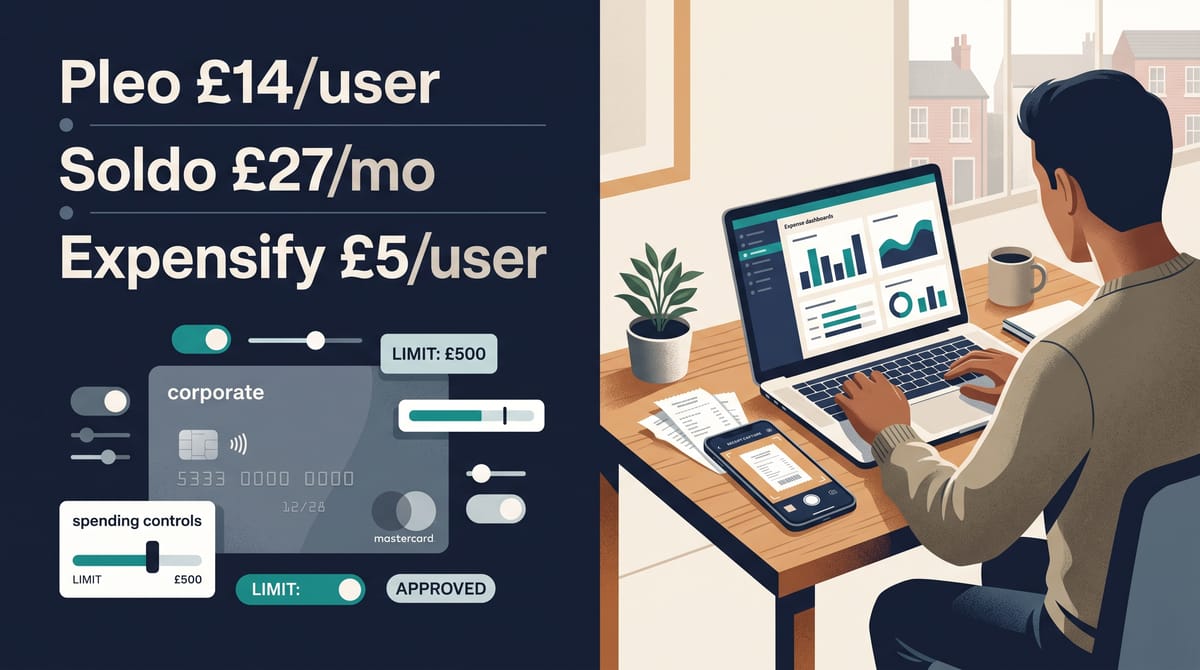
- Best card-led platform with published pricing: Pleo Build at £14 per user per month (annual)
- Best for incorporated UK businesses needing spend controls: Soldo Standard from £27 per month + VAT
- Best for multi-entity businesses with ERP needs: Payhawk Growth Program from £149 per month
- Best receipt capture layer (works with all of the above): Dext captures out-of-pocket receipts and mileage that card platforms miss
Expense Management Software Comparison Table
Pricing verified from vendor sites and third-party reviews as at October 2026. Prices exclude VAT unless otherwise stated.
| Tool | Best For | Price From | Xero | Sole Traders | Free Trial |
|---|---|---|---|---|---|
| Dext | Receipt capture + expense layer | From ~£24/mo (1 client) | ✓ | ✓ | 14 days |
| Expensify Collect | Low-cost reimbursements | £5/member/mo | ✓ | ✓ | Free (individuals) |
| Pleo Build | Card-led teams, published pricing | £14/user/mo (annual) | ✓ | Start plan only | No |
| Soldo Standard | Incorporated UK businesses | £27/mo + VAT | ✓ | No | 30 days |
| Payhawk Growth | Multi-entity, ERP integrations | £149/mo | ✓ | No | 7 days |
What Is Expense Management Software? (And How Does It Differ From Receipt Capture?)
Expense management software handles the full workflow around company spending: issuing cards to employees, enforcing spending policies, routing claims for approval, calculating mileage reimbursements and syncing everything to your accounting package. Receipt capture tools — like Dext and Receipt Bot — sit alongside them, extracting data from paper receipts, email invoices and supplier bills.
In practice, most UK small businesses need both: a card platform to manage employee spend before it happens, and a capture tool for the out-of-pocket expenses that still arrive as crumpled paper. Expense platforms handle card transactions automatically; a good receipt capture tool handles everything else. If you are putting together a complete bookkeeping stack, the two complement rather than replace each other.
MTD for Income Tax is also a factor from April 2026. HMRC's quarterly reporting obligation requires digital records of income and expenses. Any tool that captures receipts and syncs to HMRC-recognised accounting software helps create those records — but none of the platforms below are MTD filing tools in their own right. That is the accounting software's job.
Dext: The Receipt Capture Layer That Also Handles Expenses
Dext is best known as a receipt and invoice capture tool for bookkeeping practices, but it has expanded into expense management territory: mileage tracking with GPS, approval workflows, expense claims cycles and, in the UK, Dext Payments for paying suppliers and employees directly from within the platform.
What It Costs
Dext is primarily sold to bookkeeping and accounting practices on a per-client subscription. For a full breakdown of what practitioners and businesses actually pay, see the Dext pricing guide. Practice plans start from around £24 per month for one client on the Essentials tier, with volume discounts as client numbers rise. Direct business plans are available but typically quoted on request.
Key Features
- Receipt and invoice capture: Mobile app, email forwarding, WhatsApp and browser upload. 99.9% claimed data accuracy with AI extraction of supplier, date, amount, VAT and line items.
- Expense claims: Employees submit out-of-pocket receipts and Dext can auto-create expense claim cycles weekly, fortnightly or monthly. Claims route through configurable approval workflows before publishing to Xero as bills.
- GPS mileage tracking: Dext calculates mileage claims using HMRC's approved rates — including the 55p per mile rate that came in from April 2026, the first AMAP increase in 15 years. Custom rates are also configurable.
- Dext Payments (UK only): Pay suppliers and employees directly from within Dext, with built-in payment security checks against mismatched bank details.
- Supplier statement reconciliation: Three-way match between supplier statements, documents in Dext and the connected ledger.
- Dext Vault: Storage for non-financial documents (leases, HR records, contracts).
Best For
Any UK business that uses a bookkeeper and wants AI-powered capture feeding Xero, QuickBooks or Sage. Practices managing clients who need expense approval workflows, mileage reimbursement and supplier payment runs in a single tool. Unlike dedicated expense platforms, Dext does not issue company cards, so it works alongside Pleo, Soldo or Expensify rather than competing with them.
Limitations
Dext is not a standalone expense platform: it needs an accounting package as the ledger. It does not issue corporate cards, set pre-purchase spending limits or consolidate multi-entity spend. For those needs, pair it with one of the card-led tools below.
Start a free 14-day Dext trial →
If you are looking for a lower-cost alternative for pure receipt capture, Receipt Bot handles automated document processing at a more accessible price point, though without Dext's full expense management and payment features.
Pleo: Card-Led Expense Management With Published Pricing
Pleo's main advantage is transparency. Most expense platforms quote pricing only after a sales call. Pleo publishes a full rate card on its UK site, which makes it the default comparison tool for any UK finance team budgeting before they buy.
What It Costs
Pleo has three plans for businesses with 1-49 employees, all priced per user:
| Plan | Price | Min Bill | Key Additions |
|---|---|---|---|
| Start | £8/user/month (monthly only) | £8/month | 1 admin, 1 vendor card only. No mileage, reimbursements or approvals. |
| Build | £14/user/month (annual only) | £42/month (3 users) | Up to 15 vendor cards, mileage, reimbursements, approval workflows |
| Optimise | £18/user/month (annual only) | £54/month (3 users) | Cashback (eligible customers), budget management, HRIS integrations, 50 vendor cards, live chat support |
For a five-person team on Pleo Build: 5 × £14 = £70 per month, billed annually. On Start: 5 × £8 = £40 per month (no annual commitment, but no mileage or reimbursements). Businesses with 50-1,000 employees move to Scale (from £249 per month) or Lead (from £499 per month).
Pleo does not state whether its prices include or exclude VAT. Confirm with Pleo before budgeting.
Key Features
- Physical and virtual Mastercard company cards on all plans
- Auto-categorisation of transactions with real-time receipt capture
- Mileage tracking from the Build plan (includes HMRC-compliant rates)
- Direct reimbursements from Build (0.90% fee per reimbursement)
- Approval workflows from Build
- Xero and QuickBooks integrations on all plans
- FX fees: Start 2%, Build 1.75%, Optimise 1.49% above Mastercard rate
Best For
UK businesses with 5-30 employees that want a card-first expense platform with predictable, published pricing. Finance teams that need mileage, reimbursements and approval workflows without paying for a heavy enterprise suite. The Pleo Start plan — at £8 per user per month on monthly billing — is a reasonable entry for a very small team, though its single-vendor-card limit and absence of mileage and reimbursements mean most businesses quickly need Build.
Limitations
No free tier at any plan level. Trustpilot sits at approximately 3.7 out of 5, with recurring complaints about support response times. Per-user fees on Build and Optimise scale with headcount, so a 15-person team on Optimise pays £270 per month before any card or FX fees. Start plan's single admin limitation makes it impractical for any real team. Cashback from Optimise is available to "eligible customers" — Pleo does not publish the cashback rate.
Soldo: Wallet-Based Spend Control for Incorporated UK Businesses
Soldo is a prepaid Mastercard spend management platform for UK incorporated businesses. Its main differentiator from Pleo is the wallet model: rather than setting per-user card limits, you fund ring-fenced wallets for teams or projects, and issue cards that can only draw from their assigned wallet. This appeals to businesses running multiple cost centres or project budgets simultaneously.
What It Costs
Soldo publishes two plans (prices from businessexpert.co.uk, rates verified October 2026):
| Plan | Monthly Fee | Includes | Extra Users |
|---|---|---|---|
| Standard | £27/month + VAT | 3 users, 3 physical or virtual cards, 1 company wallet, receipt capture, accounting exports, 20 outbound transfers/month | £9/user/month + VAT |
| Plus | £39/month + VAT | 3 company wallets, OCR receipt capture, VAT extraction, reimbursements, mileage, multi-currency, 30 outbound transfers/month | £13/user/month + VAT |
| Unlimited | Quote only | Unlimited users, cards, wallets; advanced workflows; SAP Concur and Business API; named customer success manager | - |
Additional fees apply: physical card issue £5, virtual card £1, cash withdrawal 1% (minimum £2), FX 1.5% above Mastercard rate (corrected from the 1% figure cited by older sources). Outbound GBP transfers above the monthly allowance cost £0.75 each. Both Standard and Plus include a 30-day free trial.
Important cost note: the £9/month user fee on Standard applies to every user on the account — including admin logins and approvers who hold no card. A finance director needing dashboard access without a card still costs £9/month. If two administrators need read access, that is £18/month before a single card is issued. Build your full user count before choosing a plan.
Worked example for 10 users on Standard: £27 + 7 extra users × £9 = £90 per month + VAT.
Key Features
- Prepaid Mastercard company cards (physical, virtual, temporary single-use)
- Ring-fenced wallets: fund teams or projects separately, preventing overspend before it happens
- Per-card transaction, time-period, category and ATM limits
- OCR receipt capture, VAT extraction and supplier statement export (Plus and above)
- Reimbursements and mileage claims on Plus
- Accounting integrations: Xero (automatic daily bank feed), QuickBooks Online (one-click reconciliation), Sage Intacct, Exact Online on Standard and Plus. NetSuite is a paid add-on on Plus or included on Unlimited.
- FreeAgent: CSV/manual export only (note for practices with FreeAgent clients)
Best For
UK incorporated businesses — private limited companies, LLPs and PLCs — with 5-20 employees that want prepaid card control across multiple teams or departments. Businesses where the finance team needs to allocate budgets before spend happens, rather than reconcile after. The 30-day free trial makes it easy to test the workflow before committing.
Limitations
Sole traders cannot open a Soldo account. Soldo explicitly states on its FAQ that it only serves incorporated entities. Any bookkeeper recommending Soldo to a sole-trader client should check this first.
The Standard plan lacks approval workflows — pre-purchase authorisation requires Plus. Standard also has no OCR or mileage. FX fees at 1.5% above Mastercard are higher than Payhawk (0.3%). For businesses with heavy international card spend, compare FX costs carefully. FreeAgent integration is manual CSV only, which adds friction for practices relying on FreeAgent.
Expensify: Budget Receipt Scanning and Reimbursements
Expensify has been around far longer than most of its competitors and built its reputation on SmartScan: a fast, accurate mobile receipt scanner with a free tier for individuals. In the UK it is the cheapest route to a team expense workflow with proper accounting integrations.
What It Costs
| Plan | Price | Key Includes |
|---|---|---|
| Free (Submit) | £0 — individuals only | Unlimited SmartScan, mileage, manual expenses, CSV export. No team approvals or accounting integrations. |
| Collect | £5/member/month (pay-as-used, no annual minimum) | Team expense reports, approvals, SmartScan, Xero and QuickBooks integrations, reimbursements, accounting export |
| Control | £14/member/month (annual) or £28/month (no commitment) | Multi-level approvals, custom expense policies, corporate cards, NetSuite, Sage Intacct, Workday integrations, SSO, advanced reporting |
| Card-linked Control | From £7/member/month (requires eligible Expensify Card use) | All Control features; Expensify Card required; confirm UK eligibility before committing |
For a five-person team on Collect: £25 per month with no annual commitment. On Control (annual): £70 per month. The £5 Collect plan bills per unique member provisioned, not per active user — check the billing basis before inviting occasional submitters.
Key Features
- SmartScan receipt OCR: fast, accurate, free for individuals indefinitely
- Team expense reports and approval workflows on Collect
- Xero and QuickBooks Online on Collect; NetSuite, Sage Intacct and Workday on Control
- Mileage tracking on all plans
- Reimbursements on Collect and above
- Expensify Card (physical and virtual): available in the UK, though the UK card programme was still in beta in mid-2025 — confirm current UK availability and no-FX claim before relying on it
- Pricing in GBP — UK buyers can budget directly without currency conversion
Best For
UK businesses that mainly need fast receipt scanning and simple team reimbursements without committing to a long annual contract. The £5 Collect plan with no minimum commitment is genuinely useful for small businesses testing whether a digital expense workflow changes behaviour before spending more. Individual sole traders and freelancers tracking their own expenses for HMRC expense claims can use the free tier indefinitely.
Limitations
Expensify does not issue company cards on the entry plan — that requires Control with the Expensify Card, and UK card availability needs confirming. Some reviewers flag recurring app stability complaints and a divisive interface redesign. Annual Control commitments cannot be reduced before renewal, so count your likely member numbers carefully before signing. Control tier pricing without an annual commitment (£28/member/month) is high for a business that wants flexibility.
Payhawk: Multi-Entity Expense Management for Businesses That Have Outgrown Simpler Tools
Payhawk is the most powerful platform in this comparison, and also the most expensive to start. Its Growth Program costs £149 per month — several times the entry price of Expensify Collect or Pleo Start — but it offers capabilities the cheaper tools cannot match: two-way ERP sync, multi-entity management and OCR in 65+ languages for businesses with international operations.
What It Costs
| Tier | Price | What It Includes |
|---|---|---|
| Growth Program | From £149/month | Single entity, up to 20 employees, 10 Visa cards, 10 seats (8 employee + 2 admin), up to 15 invoices and 15 reimbursements per month, AI data extraction, Xero integration. 7-day free trial. |
| Standard | Quote only | Platform fee + per-user + module usage. Multi-entity consolidation, advanced approval workflows, HRIS integrations. |
| Enterprise | Quote only | Full module set including Travel, Bill Pay, Procure-to-Pay; two-way NetSuite and Dynamics 365 sync; dedicated customer success. |
Above the Growth Program, Payhawk charges a platform fee plus per-user and usage-based fees across four modules: Travel, Cards and Expenses, Bill Pay and Procure-to-Pay. Choosing only the modules your business needs is more flexible than a fixed bundle, but it means the real cost requires a tailored quote rather than a pricing page.
FX rate: 0.3% above mid-market for EUR, GBP, USD and CHF — significantly lower than Pleo or Soldo for businesses spending abroad.
Key Features
- Physical and virtual Visa cards (including credit cards after a credit assessment)
- Two-way ERP sync: NetSuite, Microsoft Dynamics 365 Business Central and Finance; Xero (real-time reconciliation); QuickBooks and Exact via export
- Multi-entity management with per-entity budgets and approval chains (Standard and above)
- OCR receipt capture in 65+ languages
- Mileage and per-diem handling
- AI-powered financial controller and procurement agents (preview for some features as at October 2026)
- GDPR-compliant, ISO 27001 certified, SOC 1 and 2 Type 2, PCI DSS Level 1
Best For
UK businesses that have outgrown a single-tool expense solution: groups running two or more legal entities, companies already on NetSuite or Dynamics that need native two-way sync rather than a monthly CSV export, and businesses with significant international card spend where a 0.3% FX rate beats the 1.5-2% charged by card-led rivals. The Growth Program is a credible starting point for businesses under 20 employees that need more structure than Pleo or Soldo offers.
Limitations
The Growth Program is single-entity only and caps invoices and reimbursements at 15 per month each — a real constraint for businesses with active supplier relationships. Above that, pricing is opaque until a sales quote. KYB (Know Your Business) onboarding for multi-entity setups can take several weeks, which is material if you need to go live quickly. At £149 per month, it is at least three times the cost of Pleo Build for a five-person team on the same headcount.
Two Tools Worth a Mention: Moss and Zoho Expense
Two platforms did not make the main comparison but deserve a note for specific situations.
Moss offers a free tier for up to three users with unlimited cards and 20 invoices per month — and, unusually, no per-user fee on paid plans either (paid pricing is quote-based). If your practice has clients with three or fewer employees who want corporate cards and invoice management at zero software cost, Moss is worth testing. It integrates with Xero and QuickBooks.
Zoho Expense provides a free plan for up to three users and a Standard plan from £3 per user per month (annual billing). It integrates with Zoho Books, Xero and QuickBooks. For businesses already in the Zoho ecosystem, Zoho Expense is the obvious choice — and the price point is the lowest of any proper team-expense tool in this market.
Which Expense Management Tool Should Your Business Choose?
The honest answer depends on four variables: legal structure, team size, accounting software and how your employees spend money.
If you are a sole trader or very small business (1-3 people)
Start with Dext or the Expensify free tier for receipt capture. Neither Soldo nor Payhawk will accept a sole trader application. Pleo's Start plan at £8 per user per month allows a single admin, so a sole trader can use it for vendor card management — but at that scale, Xero or FreeAgent's built-in expense features may cover the same ground for free. If you are putting together the leanest possible bookkeeping stack, add expense management only when the time cost of manual reconciliation clearly exceeds the subscription.
If you run a limited company with 3-10 employees
Pleo Build (£42 per month minimum for three users, annual) or Soldo Standard (£27 per month + VAT for three users, 30-day trial) are both solid starting points. Pleo is better if you want published pricing and predictable per-user scaling. Soldo is better if wallet-based budget control — separate pots for different teams or projects — matches how your finance function works. Add Dext on top for the out-of-pocket receipts and supplier invoices that do not go through company cards. For AI invoice processing, Dext handles the incoming supplier bill side while Pleo or Soldo handles the card side.
If you have 10-30 employees and need mileage, reimbursements and approvals
Move to Pleo Optimise (£18 per user per month, annual) or Soldo Plus (£39 per month + VAT for three users, £13 per additional user). Both unlock approval workflows, mileage and multi-currency. At 15 users, Pleo Optimise costs £270 per month versus Soldo Plus at £39 + 12 × £13 = £195 per month + VAT — Soldo's flat-base model works out cheaper at larger headcounts, though the per-admin-user fee can erode that advantage if your finance team also needs access.
If you run multiple legal entities
Payhawk is the realistic choice. Its multi-entity management and two-way ERP sync are genuinely rare in this market. The Growth Program at £149 per month is expensive for a single small entity but reasonable for a group with complex consolidation needs. Budget for a tailored quote on Standard or Enterprise once you have a clearer picture of which modules you need.
If budget is the primary constraint
Expensify Collect at £5 per member per month with no annual commitment is the cheapest way to give a team proper expense reports, approvals and Xero integration. A five-person team pays £25 per month. Combine it with Receipt Bot for automated supplier bill capture at a lower cost than Dext's full feature set, and your total stack for five people stays well under £60 per month.
If your business does significant international card spend
Payhawk's FX rate of 0.3% above mid-market makes it materially cheaper than Pleo (1.49-2% above Mastercard) or Soldo (1.5% above Mastercard) for teams that regularly pay in foreign currencies. Calculate actual monthly FX spend before dismissing Payhawk's higher base price — for businesses spending £20,000 per month on international cards, the FX saving alone can offset the platform premium.
The Expense Stack Most UK Bookkeeping Practices Recommend
For a practice managing 20-50 small business clients, the typical recommendation in 2026 runs like this:
- Receipt and invoice capture: Dext or Receipt Bot — handles the out-of-pocket receipts, supplier bills and mileage claims that card platforms never see
- Card spend management: Pleo Build (if 5+ employees) or Soldo Standard (if wallet-based budget control matters)
- Accounting software: Xero Ignite or Grow — receives the coded transactions from both Dext and the card platform via bank feed or direct integration
- Payroll: separate from expense management — see the UK payroll software comparison for how reimbursements connect to payroll runs
The workflow for a typical client: employees submit paper receipts and out-of-pocket expenses to Dext via WhatsApp or the mobile app; company card transactions flow directly from Pleo or Soldo into Xero via bank feed; the bookkeeper reviews and publishes everything in Dext before period end. Neither tool overlaps with the other — they genuinely complement.
FAQs: Expense Management Software for UK Small Businesses
Can sole traders use Pleo or Soldo?
Pleo's Start plan allows a single admin and does not restrict sole traders — but at £8 per user per month with only one vendor card and no mileage or reimbursements, it is marginal value for someone trading as an individual. Soldo explicitly excludes sole traders: it only accepts applications from incorporated entities (Ltd companies, LLPs and PLCs). Sole traders should look at Expensify's free individual tier or Dext's expense and mileage features instead.
Is Dext an expense management platform?
Dext handles receipt capture, expense claims, mileage tracking (GPS-calculated at HMRC rates), approval workflows and — in the UK — supplier and employee payments via Dext Payments. What it does not do is issue company cards or set pre-purchase spending limits. Think of it as the capture and workflow layer that sits below an accounting package, while Pleo and Soldo are card-first spend management platforms that sit above it. Most practices use both: Dext catches what the card platforms miss.
Which tools support the new 55p HMRC mileage rate?
Dext updates its UK mileage rate calculations to the HMRC AMAP rate automatically. Pleo (from Build), Soldo Plus and Payhawk Growth all support custom mileage rates — confirm with each vendor that their default rate reflects the 55p rate that took effect from 6 April 2026, the first increase since 2011. For a full comparison of mileage tracking tools, see the best mileage tracking apps guide.
Do these tools help with MTD ITSA compliance?
Expense management software creates digital expense records and syncs them to accounting software, which is the digital audit trail MTD requires. But none of the platforms in this guide are MTD ITSA filing tools themselves — quarterly submissions go through your accounting software (Xero, QuickBooks, Sage, FreeAgent). Using a card platform like Pleo or Soldo does not by itself satisfy MTD obligations. The accounting software and your bookkeeper together handle the submission layer.
How much does expense management software cost for a 5-person UK business?
Using verified October 2026 pricing: Expensify Collect at £25/month (no commitment), Pleo Build at £70/month (annual), Soldo Standard at approximately £45/month + VAT (base £27 + 2 extra users × £9), Payhawk Growth at £149/month. Add Dext or Receipt Bot as the receipt capture layer and total costs for a five-person team run from around £50/month to well over £200/month, depending on the combination and the plan tiers selected. Model your actual headcount — including finance-team admin logins — before choosing a plan.
Related Reading
- Best Receipt Capture Software for UK Bookkeepers (2026)
- Best Mileage Tracking Apps for UK Self-Employed in 2026
- The Complete AI Bookkeeping Stack for UK Sole Traders (Under £60/Month)
- How to Claim Expenses as a UK Sole Trader: The Complete Digital Guide (2026)
Affiliate disclosure: Some links in this article are affiliate links. If you sign up through them, we may earn a commission at no extra cost to you. We only recommend tools we've genuinely assessed.