
VT Transaction+ and VT Software Review 2026: Free MTD IT Filing for Desktop-First UK Bookkeepers
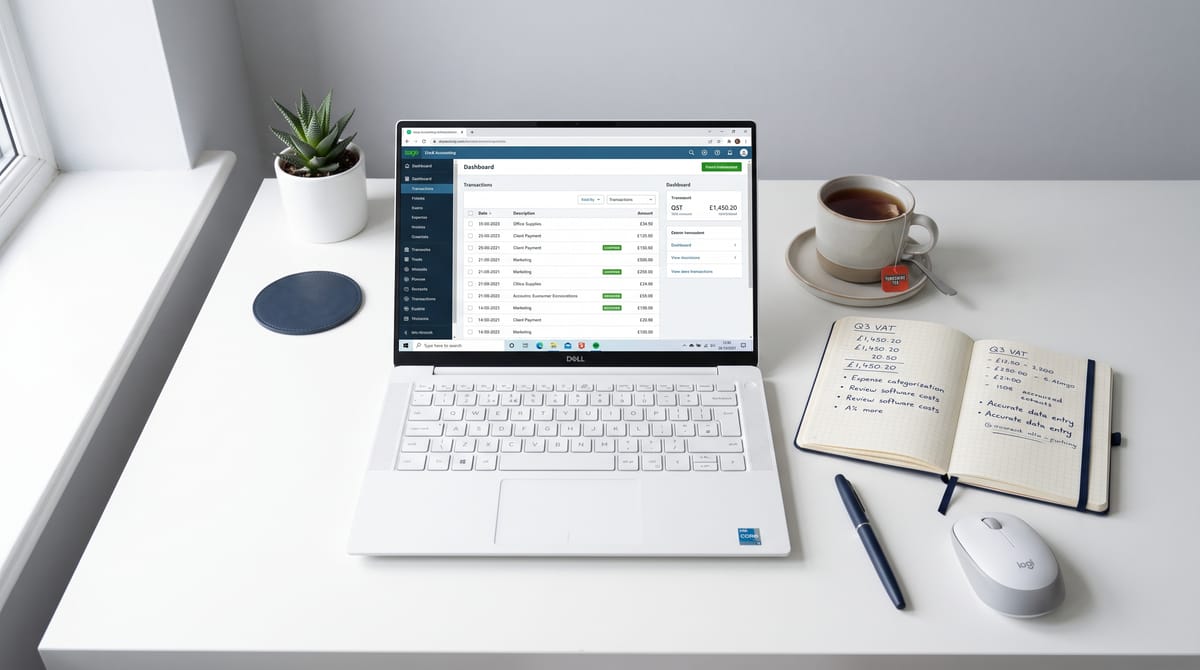
VT Transaction+ and VT Software Review 2026: Free MTD IT Filing for Desktop-First UK Bookkeepers
If you have been doing bookkeeping for UK clients for more than a decade, you almost certainly know someone who swears by VT Transaction+. It does not have a bank feed. It does not run in a browser. It has not been redesigned since roughly 2008. And yet it consistently scores 4.9 out of 5 for value for money among accounting practitioners, it handles unlimited companies on a single annual licence, and it now costs £90 + VAT a year at a time when Xero's entry-level plan has climbed to £18 a month. For desktop-first bookkeepers working through a client list, that arithmetic is very hard to ignore.
The bigger question for 2026 is Making Tax Digital for Income Tax. The first cohort of sole traders and landlords with income over £50,000 became mandated for MTD IT from April 2026, with quarterly updates due to HMRC. VT Software confirmed it would add MTD IT quarterly filing support at no additional cost to subscribers. This review covers what that means in practice, what VT still does not do, and whether the two-tool workflow it requires is a reasonable trade-off for a budget-conscious practice.
VT Transaction+ handles your bookkeeping. It does not handle receipt capture. Pair it with a dedicated capture tool to keep your records clean and MTD-compliant.
TL;DR
- VT Transaction+ costs £90 + VAT per year (single user), covers unlimited client companies, and now includes MTD IT quarterly filing at no extra charge.
- It is Windows-only, desktop-only. No cloud access, no mobile app, no bank feeds, and not compatible with Macs.
- VT does not provide a final declaration tool for MTD IT. You will need a separate tax package to finalise your clients' income tax positions. The quarterly data VT submits is retrievable by that package.
The VT Software product family
VT Software has been a London-based independent developer for over 25 years. Its product range for bookkeepers and accountants covers five tools. Here is what each does and what it costs.
| Product | What it does | Cost | MTD IT |
|---|---|---|---|
| VT Transaction+ | Full double-entry bookkeeping; VAT returns; MTD quarterly updates | £90 + VAT/year | Yes (quarterly only) |
| VT Cash Book | Simple cash payments/receipts; bank reconciliation | Free (MTD requires VT Transaction+ licence) | Yes (with licence) |
| VT Report | Spreadsheet and MTD bridging tool; VAT and quarterly income tax templates | Free (MTD requires VT Transaction+ licence) | Yes (with licence) |
| VT Final Accounts | Excel add-in; Companies House iXBRL filing | £175 + VAT/year (Accounts Suite) | No |
| VT Calculator | Desktop calculator tool | Free | No |
The VT Transaction+ subscription at £90 + VAT per year is the one most practices will buy. It covers an unlimited number of client companies on a single licence, which makes the per-client cost negligible once you have more than a handful of clients. For comparison, a Xero Ignite subscription for a single company costs £18 per month (£216 per year), and that is just one entity. The maths speak for themselves for a practice handling 20 or 30 small sole trader clients.
The VT Accounts Suite at £175 + VAT per year adds VT Final Accounts and VT Filer for practices that also file accounts with Companies House. If you are doing both bookkeeping and statutory accounts, this is still cheaper per client than most alternatives at scale.
All prices are exclusive of VAT at 20%. New customers can use VT Transaction+ free for 60 days with full functionality, including MTD VAT submissions.
VT Transaction+ and MTD for Income Tax in 2026
The mandatory MTD IT roll-out began in April 2026 for sole traders and landlords with qualifying income above £50,000. The next quarterly update deadline for that cohort is 7 November 2026 (Q2 of the 2026/27 tax year). If you have clients in this group, they need software now, not in December.
VT Software confirmed it would add MTD IT quarterly update functionality to VT Transaction+, VT Cash Book, and VT Report at no extra cost to existing subscribers. Philip Hodgson, the company's owner and director, was characteristically direct on the rationale: VT added the feature to keep its customers compliant, not because it sees any particular benefit in quarterly reporting for either taxpayers or HMRC. That pragmatic, no-frills stance is why the AccountingWEB community has been loyal to VT for so long.
What the quarterly filing covers in VT is straightforward: self-employment and property income and expenses are submitted directly to HMRC from the bookkeeping file. If you have been exporting profit and loss data from VT Transaction+ into a tax package, that process becomes redundant once quarterly updates are running. HMRC's system makes the quarterly data available to the tax package for the year-end final declaration.
What VT does not do: the final declaration
This is the critical limitation to understand before committing to VT for MTD IT. VT will not provide a final declaration tool. Under MTD IT, the quarterly update software and the final declaration software do not have to be the same product, and VT has decided to stay in its lane: bookkeeping and quarterly data only.
In practice, this means a two-tool workflow. Your client records and quarterly updates go through VT Transaction+. At year-end, the quarterly data is retrieved by your tax package (Digita, CCH, Sage, IRIS, and similar practice tax software) to produce the final income tax position and submit the final declaration. Practitioners who spoke to AccountingWEB about this setup described it as working cleanly, provided the tax package correctly retrieves the quarterly data. One described it as "my fastest, least-hassle quarterly submission" when combined with Thomson Reuters Digita.
It is worth understanding the difference between "MTD-ready" and "HMRC-recognised" status when evaluating whether VT covers your client's compliance needs. VT's quarterly submission functionality is recognised by HMRC for quarterly updates; the final declaration is handled by your separate tax package.
VT Cash Book: the free client option
One detail that does not get enough attention is VT Cash Book's role in the MTD IT workflow. VT Cash Book is free for clients to use without a licence. A bookkeeper with a VT Transaction+ subscription can submit quarterly updates on behalf of clients from records that the client has maintained themselves using the free VT Cash Book. The client pays nothing for the record-keeping software; the bookkeeper's single £90/year licence covers the submission step.
This is a genuinely useful arrangement for clients who are comfortable keeping basic digital records but do not want to pay £18-39 per month for a cloud accounting subscription. VT Cash Book is not a replacement for proper bookkeeping software in complex cases, but for a straightforward sole trader recording bank transactions from a CSV export, it does the job. The free digital record-keeping options for UK sole traders are not as limited as many people assume, and VT Cash Book is one of the more capable entries in that list.
What VT Transaction+ does well
Speed of data entry is the feature practitioners mention first. VT Transaction+ uses a spreadsheet-style Universal Input Sheet that allows bulk copying, pasting, and filling down of transaction data. Bank statement CSV imports are quick to set up, and the autocomplete function assigns transactions to the correct ledger account based on prior postings. Practitioners who have built up years of history report that day-to-day data entry takes a fraction of the time it would in a cloud tool. One AccountingWEB commenter described creating a custom import sheet for CSV bank downloads that makes the process nearly automatic.
Reliability is the other consistent theme. The software has been around for 25 years, the data files are stored locally on your PC, and there is no service outage risk. If HMRC's API is unavailable, you cannot submit; but that is a constraint shared by every MTD-compliant tool.
AccountingWEB's user ratings paint a consistent picture: 4.7 for functionality, 4.8 for ease of use, and 4.9 for value for money (112 reviews). These are not recent; the platform has not updated that section since 2019. But practitioners active in 2025 and 2026 discussions consistently endorse the same qualities.
Limitations you need to know before buying
Windows only, desktop only. VT Transaction+ requires Windows 10 or 11 for MTD submissions. It does not run on macOS. There is no web version, no browser access, and no mobile app. If your practice has moved to MacBooks or you need to access client files remotely, VT is not a practical option unless you are running Windows in a virtual machine.
No bank feeds. Transactions are imported via CSV. This is a workflow decision as much as a technical limitation: many practitioners prefer to download and review CSV files rather than rely on automated bank connections, particularly for error-checking. But if you are building a practice around open banking or bank rule automation, VT is not the right tool.
No final declaration for MTD IT. Covered above, but worth repeating: you will need a separate tax package for the final income tax declaration. The two-tool workflow is manageable and well-understood in the profession, but it is an additional piece of software to procure and maintain.
Data stored locally. Your bookkeeping files live on your PC or network server, not in the cloud. Regular backups are essential. VT makes this clear in its documentation. For practices comfortable with local file management, this is not a problem; for those who have migrated entirely to cloud storage, it requires some process adjustment.
Limited management reporting. VT Transaction+ generates standard accounting reports (P&L, balance sheet, trial balance, aged analysis) but does not offer the dashboards, KPI views, or cash flow forecasts that cloud tools like Xero or FreeAgent provide. For bookkeeping and compliance, it is more than sufficient. For clients who want business intelligence from their accounting software, you will need to point them elsewhere. Consider the growing range of desktop and cloud alternatives to Xero if richer reporting is a requirement.
Who VT Transaction+ is right for in 2026
Best for: sole practitioners and small practices handling 10 to 50 small company or sole trader clients on Windows. If you are doing the bookkeeping yourself, entering data from client-provided CSV exports or paper records, and using a separate tax package for year-end work, VT Transaction+ is an exceptionally cost-effective tool. The unlimited company licence means the per-client cost drops below £5 per year once you have 20 clients on it.
Also good for: practices already using VT Final Accounts. The integration between VT Transaction+ and VT Final Accounts for accounts production is the original design intent and still works well. If you are preparing statutory accounts for micro entities, the £175/year VT Accounts Suite covers both ends.
Not right for: practices that need cloud access or collaboration. If you work with clients who update their own records remotely, or you need to access files from multiple locations without a remote desktop setup, you need a cloud-first tool. VT is not it. If your practice is on Macs, VT is not it either.
If you are evaluating desktop alternatives more broadly, MTD bridging tools like VitalTax and 123 Sheets are worth considering for clients who want to keep spreadsheet-based records while still meeting their MTD obligations through a bridging layer. QuickFile is another strong option for practices that want browser access without the Xero price tag; there is a detailed QuickFile practitioner guide on this site if you want to compare the two approaches.
Receipt capture: the gap VT does not fill
VT Transaction+ handles the ledger. It does not handle receipt capture, invoice scanning, or document management. If you are managing MTD-compliant digital records for clients who generate receipts and supplier invoices, you need a capture tool alongside VT. Dext is the most widely used option in UK practices and integrates with VT Transaction+ via CSV export. Receipt Bot is a lower-cost alternative worth considering if your practice handles a high volume of receipts across multiple clients.
Frequently asked questions
Is VT Transaction+ HMRC-recognised for MTD IT in 2026?
VT Software's quarterly update functionality for MTD IT is available from April 2026 and is being tested with HMRC's developer test service. The developer confirmed it will test with live cases before the July 2026 user deadline. Check HMRC's current list of compatible software for MTD IT to verify the current recognition status before committing to VT for client submissions.
Can my clients file their own Self Assessment with VT?
No. VT Transaction+ handles quarterly updates of income and expenses only. The final income tax declaration must be submitted via a separate MTD-compliant tax package. VT is bookkeeping software used by accountants and bookkeepers on behalf of clients, not a self-service filing tool for the general public.
What happens at year-end with VT and MTD IT?
The quarterly data submitted to HMRC via VT Transaction+ is retrievable by your tax package (Digita, CCH, IRIS, etc.). The tax package uses that data to populate the final declaration. The mechanism replaces the existing process of exporting profit and loss figures from VT into the tax package manually. VT Software's documentation is clear that the final income tax position and declaration are outside its scope.
Does VT work with a Mettle or Starling business account?
There is no direct bank feed integration. You export your transaction data as a CSV file from your bank's web interface and import it into VT Transaction+ using the universal import sheet. Mettle, Starling, Monzo Business, and most UK business accounts support CSV exports. It is an extra step compared to a live bank feed, but many practitioners prefer the control it gives them over what goes into the ledger.
How much does VT Transaction+ cost compared to Xero in 2026?
VT Transaction+ costs £90 + VAT per year (£108 inc. VAT) for a single user covering unlimited client companies. Xero Ignite costs £18/month (£216/year) for a single company. Xero Grow costs £39/month (£468/year). For a practice managing multiple clients, VT offers a significant cost advantage. The trade-off is functionality: Xero includes bank feeds, cloud access, invoicing, and a full ecosystem of integrations that VT does not offer.
Related Reading
- Best Free Bookkeeping Tools for UK Sole Traders (2026)
- MTD Bridging Software UK 2026: VitalTax vs 123 Sheets vs AbraTax
- QuickFile Review 2026: The Free MTD-Compliant UK Bookkeeping Software Practitioners Actually Recommend
Affiliate disclosure: Some links in this article are affiliate links. If you sign up through them, we may earn a commission at no extra cost to you. We only recommend tools we've genuinely assessed.