QuickFile Review 2026: The Free MTD-Compliant UK Bookkeeping Software That Practitioners Actually Recommend
QuickFile Review 2026: The Free MTD-Compliant UK Bookkeeping Software That Practitioners Actually Recommend
There's a consistent pattern in UK accounting forums: someone asks for affordable bookkeeping software for a sole trader client, and within a few replies, a bookkeeper or accountant mentions QuickFile. Not a sponsored post. Not a referral push. Just a practitioner who's been quietly steering clients towards this York-built platform for years, because it works, it costs almost nothing, and it behaves like proper accounting software rather than a simplified consumer app. In 2026, with MTD ITSA now live and clients asking pointed questions about monthly software costs, that recommendation is worth examining properly.
This guide covers QuickFile from the practitioner's perspective — why bookkeepers and accountants recommend it, how the Affinity multi-client portal works, what MTD ITSA compliance actually looks like in practice, and where the platform genuinely falls short. If you're a sole trader whose practitioner has already suggested QuickFile, there's a full pricing breakdown here too.
QuickFile + Dext: automate receipt capture for your clients from day one. 30-day free trial, no card required.
TL;DR
- QuickFile is free for businesses processing up to 4,000 nominal entries/year — full double-entry bookkeeping, VAT MTD direct HMRC submission, invoicing, unlimited users, multi-currency. No card required, no expiry.
- MTD ITSA quarterly updates (live April 2026, mandatory at £50,000+ income) require the Power User subscription: £60 + VAT/year (£72 inc VAT). Bank feeds add £15 + VAT/year. Total all-in: £90 inc VAT/year — the lowest price for any HMRC-recognised MTD ITSA platform in the UK.
- The Affinity multi-client portal gives bookkeeping practices a single dashboard across all managed clients, with global branding, Companies House tracking, and MTD ITSA filing included free on Tier 3.
- Consistent limitations: forum-only support (no phone or live chat), no native payroll, a dated interface, and no direct API integration with Dext or Receipt Bot (Zapier bridge required).
Why Practitioners Recommend QuickFile
The honest answer is twofold: it works like proper accounting software, and it costs almost nothing.
Most entry-level bookkeeping apps are consumer tools with simplified charts of accounts, built around income-minus-expenses rather than proper bookkeeping. QuickFile is full double-entry from the ground up — nominal ledger, journals, trial balance, aged debtors and creditors, Companies House compatibility. A bookkeeper reviewing a QuickFile client file sees what they expect: properly coded transactions, a real balance sheet, a usable audit trail. That level of rigour is rare at entry-level pricing and it's why accountants are comfortable recommending it to clients who maintain their own books between year-end reviews.
The price point matters too. When a sole trader client pays a bookkeeper £100–£150 per month for quarterly reconciliation, recommending software at £90/year instead of £228–£468/year is a tangible demonstration of value. The savings are real and easily shown in a comparison table at onboarding.
QuickFile has been building in York since 2009 — UK-built, for the UK market, which shows in its HMRC integration, Companies House compatibility, and the fact that MTD VAT has been working reliably since the mandate launched in 2019. That track record matters when you're recommending it to clients who'll ask what happens if something goes wrong before a VAT deadline.
QuickFile Pricing 2026: The Complete Breakdown
QuickFile uses a volume-based pricing model rather than the feature-tiered monthly subscriptions that dominate the market. Understanding the tiers properly avoids the surprise that trips up new users.
Free Tier (Account Sizes XS, S, M, L)
Businesses processing up to 4,000 nominal entries per year pay nothing. A sole trader with 100–150 transactions per month sits comfortably within the free M or L bands. The free tier includes:
- Full double-entry bookkeeping with nominal ledger and chart of accounts
- Unlimited invoicing: branded client portals, automated reminders, Stripe/PayPal/GoCardless payment links, recurring invoices, credit notes
- VAT MTD: direct HMRC submission for standard, flat rate, and cash accounting schemes — free on all tiers
- Bank reconciliation and transaction tagging (CSV import always free)
- Multi-currency support
- Unlimited user accounts — one QuickFile account, multiple logins
- 1GB file storage, REST API access, two-factor authentication
Power User Subscription — £60 + VAT/year (£72 inc VAT)
This is the only meaningful paid tier for most clients. It unlocks:
- MTD ITSA quarterly updates — mandatory from April 2026 for sole traders with income over £50,000; extending to £30,000 from April 2027 and £20,000 from April 2028
- MTD VAT Bridging (for spreadsheet-based VAT submissions)
- Segmented Profit & Loss reporting (by department or project)
- Invoice revision history and six-month sent email log
- Split bank tagging and keyboard shortcuts
- AI Receipt Analyser at a reduced per-use rate
- Webhooks for third-party automation
Bank Feeds — £15 + VAT/year (£18 inc VAT)
Automated Open Banking connections (Starling, Monzo, Tide, NatWest, Barclays, Lloyds, and aggregator feeds via Yodlee/Plaid) are an optional add-on. CSV imports are always free. The add-on cost surprises some clients who expect bank feeds to be bundled, but with Power User included, the total is still below every comparable alternative.
What a MTD-Mandated Client Actually Pays
Power User + bank feeds = £75 + VAT/year (£90 inc VAT) — approximately £7.50/month all-in. In a market where software costs are rising sharply, this gap is significant. For context on how MTD ITSA software pricing has developed across the market, our guide to the best MTD software for UK sole traders benchmarks the full field with current 2026 pricing.
| Software | MTD ITSA | Monthly (approx) | Annual inc VAT |
|---|---|---|---|
| QuickFile (Power User + feeds) | ✅ HMRC-recognised | £7.50 | £90 |
| Zoho Books (Standard) | ✅ HMRC-recognised | £10 | £120 |
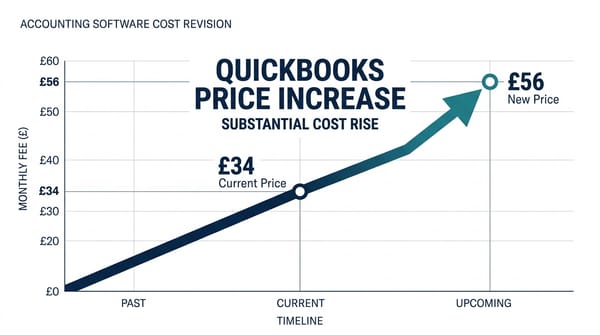
| QuickBooks Simple Start | ✅ HMRC-recognised | £16 | £192 |
| FreeAgent (list price) | ✅ HMRC-recognised | £19 | £228 |
| Xero Ignite | ✅ HMRC-recognised | £18 | £216 |
| Xero Grow | ✅ HMRC-recognised | £39 | £468 |
FreeAgent is free for clients banking with NatWest, RBS, or Mettle — that changes the calculation for that segment. For everyone else, QuickFile's cost advantage is significant at the MTD-mandated tier.
MTD ITSA 2026: QuickFile's Compliance Position in Practice
QuickFile is on HMRC's Software Choices list and has been handling MTD VAT since the mandate launched in 2019. The MTD ITSA quarterly update workflow has been live since the April 2026 mandate date.
The mechanics: cumulative quarterly updates are auto-generated from transaction data already in the account. Submissions go directly to HMRC via QuickFile's interface. The Final Declaration replaces the SA100, covering both standard and calendar quarter periods. No bridging software required.
One practical point for bookkeepers managing the April 2026 transition: QuickFile's ITSA module moved behind the Power User paywall for the live mandate year, having been accessible free during the 2025/26 pilot. HMRC's own Software Choices list describes QuickFile as supporting submissions, which is accurate — but ITSA specifically requires Power User active. Several practitioners reported client confusion in April when clients were told by HMRC's list that QuickFile was a free option, then hit the paywall at the submission step. Confirm Power User is active before the first quarterly deadline — the 7 August 2026 Q1 deadline was the first real test.
For the full picture of what MTD ITSA requires from both software and sole traders in 2026/27, including the soft landing provisions currently in effect, our complete Making Tax Digital guide for UK small businesses covers the mandate, the deadlines, and the differences between what software tools are actually required to do.
QuickFile Affinity: The Multi-Client Portal
Most sole traders using QuickFile will never need to know about Affinity. For bookkeepers and accountants managing multiple client accounts, it changes the economics considerably.
Affinity is QuickFile's multi-client practice portal: a single dashboard across all managed client accounts, global branding (your logo and colour scheme on all client-facing portals), Companies House tracking for filing dates and Confirmation Statements across your portfolio, shared workspaces for document exchange and year-end checklists, and volume discounts starting at 5% for Tier 1 practices.
Billing: Per-client, per-account-size, collected monthly. Volume discounts increase through three tiers. Tier 3 Affinity accounts include MTD ITSA quarterly filing for all managed profiles at no extra cost. Smaller profiles on lower tiers that need ITSA pay a £20 + VAT annual add-on per profile.
The Affinity billing structure is more granular than flat-rate accountant portals like Xero HQ, but per-client costs are substantially lower for practices where most clients are sole traders or micro-businesses with modest transaction volumes. One observation from AccountingWEB practitioners: the largest Affinity accounts cost around £60 per annum, which is below the monthly fee on any comparable platform.
For bookkeepers evaluating dedicated practice management tools that sit alongside QuickFile — CRM, job management, client communication — our guide to the best practice management software for UK bookkeepers covers Karbon, Senta, TaxCalc Practice Management, and their integration landscape.
QuickFile in a Modern Bookkeeping Stack
QuickFile handles the core accounting ledger confidently. Where it needs supplementing:
Receipt Capture
QuickFile includes iOS and Android apps for photo capture, a Receipt Hub for processing, and Dropbox bulk import. For bookkeepers managing significant supplier invoice volumes — or clients who generate a high volume of purchase receipts — Dext and Receipt Bot offer more robust extraction workflows with better OCR accuracy and automation rules.
The integration route matters here: Dext connects to QuickFile via Zapier rather than a native API push. This works reliably but adds a dependency point and requires the Zapier account to stay active. It's a meaningful difference from the direct push Dext delivers into Xero or QuickBooks. If you're weighing which receipt capture tool fits best alongside QuickFile, our Dext vs Receipt Bot comparison for solo practices covers extraction accuracy, UK pricing, and workflow differences.
Payroll
There's no native payroll module. FreeAgent includes payroll for up to three employees within its subscription; Xero and QuickBooks both offer paid payroll add-ons. For QuickFile clients with payroll requirements, the standard UK practitioner choices are BrightPay (~£139/year for unlimited employees) or Moneysoft Payroll Manager (£95/year, Windows-based). Both integrate with QuickFile via journal entries or CSV export.
Reporting
Standard P&L, balance sheet, trial balance, aged debtors and creditors, and project-level reporting are all included. Segmented P&L — for tracking profitability by department, project, or cost centre — requires Power User. The reporting suite is comprehensive for its price point. It's not as polished as Xero's report builder, but it covers everything a sole trader or small limited company needs for year-end review.
Where QuickFile Falls Short
Forum-only support. No phone line, no live chat. The community forum is staff-monitored and reasonably active, but "post in the forum" is not the same reassurance as a support team when a client is in distress during a bank reconciliation on the morning their accounts are due. This is the most consistent criticism across Trustpilot and accounting forum discussions, and it's a genuine limitation for clients who expect direct support access.
Dated interface. Functional, not polished. QuickFile doesn't compare visually with Xero or even the improved QuickBooks interface. For clients who care primarily about cost and accounting rigour, this matters less than it looks on a demo screenshot. For clients who care about UX, it's a real factor.
No native payroll. Covered above — needs a third-party solution for any client with employees, which adds complexity and cost to the stack recommendation.
Zapier dependency for Dext and Receipt Bot. Functional, but worth flagging at onboarding so clients don't expect the same frictionless setup they'd get with a Xero integration.
The Right Pick For…
Sole traders under £50,000 income: The free tier is genuinely hard to beat. Nothing else delivers this combination of accounting rigour, HMRC integration, and zero cost. Worth discussing the Power User upgrade path now — the £30,000 MTD ITSA threshold arrives April 2027.
MTD ITSA-mandated sole traders (£50,000+ income): QuickFile at £90/year inc VAT is the cheapest HMRC-recognised MTD ITSA option in the market. The only meaningful free alternative is FreeAgent via NatWest/RBS/Mettle banking.
Bookkeeping practices with small-volume client portfolios: Affinity changes the economics. The per-client billing structure beats flat-rate accountant subscriptions for practices where most clients are micro-businesses. ITSA filing at no extra cost on Tier 3 is a meaningful saving.
Clients who need support on demand: Recommend FreeAgent (phone and in-app chat), Xero (in-app chat, callback on higher plans), or QuickBooks (phone support) if the client expects a direct line when something goes wrong. QuickFile's forum model is the primary trade-off.
Small limited companies: QuickFile handles limited company accounting well — full double-entry, Companies House compatibility, statutory account preparation. Clear Books is the main alternative worth considering for this segment if a more polished interface matters. Our Clear Books review covers how the two platforms compare for small company work.
Clients weighing the full field: For a side-by-side view of QuickFile against all major UK accounting platforms at current 2026 pricing, our best accounting software for UK sole traders guide maps the complete landscape.
FAQ
Is QuickFile MTD ITSA compliant in 2026?
Yes. QuickFile is on HMRC's Software Choices list for MTD ITSA. Quarterly update submissions are live from April 2026. MTD ITSA requires the Power User subscription (£60 + VAT/year). VAT MTD remains free on all tiers.
Can a client use QuickFile without paying anything?
Yes — for invoicing, VAT MTD, bank reconciliation, and full double-entry bookkeeping, up to 4,000 nominal entries per year. The free tier has no time limit and requires no credit card. MTD ITSA quarterly updates and a handful of workflow features require Power User.
Does QuickFile integrate with Dext or Receipt Bot?
Via Zapier, not a native API. The integration works reliably but requires a Zapier account. It's one additional setup step compared to the native Dext-to-Xero or Dext-to-QuickBooks push.
What is QuickFile Affinity?
QuickFile's multi-client practice portal. It gives accountants and bookkeepers a single dashboard across all managed client accounts, global branding on client-facing portals, Companies House deadline tracking, and volume billing discounts. MTD ITSA filing is included free for managed profiles on Tier 3 Affinity accounts.
What's the best alternative to QuickFile for UK practitioners?
Depends on the requirement. Zoho Books (free tier, HMRC-recognised from July 2026 for MTD ITSA, strong mobile app), FreeAgent (free for NatWest/RBS/Mettle clients, includes payroll), and Clear Books (stronger limited company focus) are the closest direct alternatives. The right answer depends on the client's banking, payroll needs, and support expectations.
Related Reading
- Best Free Bookkeeping Tools for UK Sole Traders (2026) — QuickFile in direct comparison with Zoho Books, Wave, and Pandle
- Best Practice Management Software for UK Bookkeepers (2026) — tools to run alongside QuickFile for client management and job tracking
- Best MTD Software for UK Sole Traders (2026) — how QuickFile stacks up against every HMRC-recognised MTD ITSA platform
Affiliate disclosure: Some links in this article are affiliate links. If you sign up through them, we may earn a commission at no extra cost to you. We only recommend tools we've genuinely assessed.