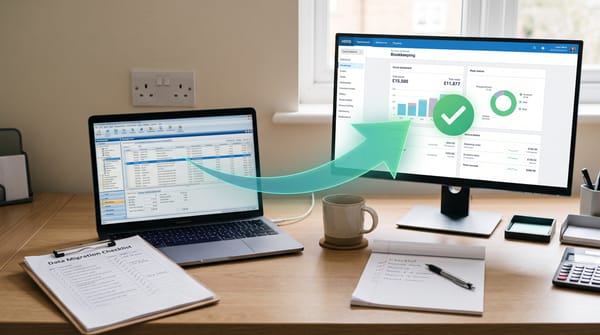
Clear Books Review 2026: MTD-Ready UK Accounting Built for Small Practices

Clear Books Review 2026: MTD-Ready UK Accounting Built for Small Practices
UK sole traders and small practices face a narrower choice than most comparison sites admit. You need software that speaks HMRC's language, handles Making Tax Digital for Income Tax without a bridging workaround, and doesn't cost £40 a month before you've added payroll. Clear Books has quietly been making exactly that case since 2008 — and 2026, with MTD ITSA now live, is arguably the year it matters most.
Founded in London by Tim Fouracre, Clear Books is one of the longest-running British cloud accounting platforms. It targets sole traders, landlords and small limited companies: the segment where fee sensitivity is real and HMRC compliance is non-negotiable. Clear Books earned HMRC recognition for MTD for Income Tax in October 2025, and during the 2025–26 soft-landing period it ranked in the top three nationally for quarterly update submissions. That is not a marketing statistic — it means real UK practices are using this platform to file, not just evaluate it.
Try Clear Books free for 30 days — no credit card required
TL;DR
- Best for: UK sole traders and landlords who need MTD ITSA compliance on a budget, and small limited companies wanting a cheaper alternative to Xero.
- Avoid if: You need a deep third-party app ecosystem, polished mobile experience, or live chat support.
- Starting price: Free (Sole Trader Free, Property Free); paid plans from £5/month.
Who is Clear Books for?
Clear Books does not try to serve every market. It is built and supported in the UK, priced for the UK, and focused on HMRC compliance above everything else. Its natural customers are:
- Self-employed sole traders — particularly those earning over £50,000 who needed to be MTD ITSA compliant from April 2026, and those under that threshold who want to get ready early.
- Residential and commercial landlords — Clear Books has a dedicated Property plan and handles split self-employment/property income correctly for ITSA, which several larger platforms handle clumsily.
- Small limited companies — typically one or two directors, modest invoicing volumes, no complex multi-entity structures.
- Construction contractors and subcontractors — Clear Books is HMRC-recognised for CIS300 filings natively, without a separate module or add-on.
- Charities and social enterprises — the platform has SORP-aware fund tracking built in, which Xero and QuickBooks only handle through paid third-party plugins.
- Bookkeepers supporting price-sensitive clients — the free Sole Trader and Property tiers are a genuine option for clients who refuse to pay for accounting software but need MTD ITSA compliance.
What Clear Books is not: a Xero replacement for a growing agency with Shopify, Stripe and seven staff. Its integrations ecosystem is materially smaller, and practitioners who rely on deep automation will feel the gap.
Clear Books pricing: what you actually pay
The pricing structure is more nuanced than most competitors. Clear Books divides its plans by business type — sole traders, landlords and limited companies each get their own tier — rather than a single ladder. All prices exclude VAT; annual billing saves roughly 10 per cent.
Sole trader plans
| Plan | Price (ex VAT) | What's included |
|---|---|---|
| Sole Trader Free | £0/month | MTD ITSA quarterly filing, expense and income tracking, basic reports, accountant access |
| Sole Trader | £5/month | Everything in Free, plus bank feeds, invoicing, business reporting, unlimited users |
| Sole Trader + VAT | £15/month | Everything in Sole Trader, plus MTD VAT filing and flat-rate scheme support |
Property (landlord) plans
| Plan | Price (ex VAT) | What's included |
|---|---|---|
| Property Free | £0/month | Property income and expense tracking, MTD ITSA filing, basic reports, accountant access |
| Property | £5/month | Multi-property tracking, bank feeds, automated matching, detailed reporting |
Small business (limited company) plans
| Plan | Price (ex VAT) | What's included |
|---|---|---|
| Small | £16/month (£8 for first 3 months) | Bank feeds, invoicing, quotes, stock management, journals, dividend tools, API access |
| Medium | £34/month (£17 for first 3 months) | Everything in Small, plus MTD VAT, purchase orders with approvals, CIS reporting, unlimited budgets |
| Large | £44/month (£22 for first 3 months) | Everything in Medium, plus project accounting, multi-currency, expense claims, fixed assets |
Optional add-ons sit on top of any plan: Payroll (30-day free trial for unlimited employees, then a per-employee monthly fee); Auto Bills for receipt and bill capture; and Instant Bank Payments for one-click invoice settlement.
To put this in context: a VAT-registered limited company on the Medium plan pays £34 a month — roughly £408 a year. The equivalent configuration on Xero's Standard plan costs more once VAT-filing capability is included. For landlords, the gap is even wider: a three-property portfolio can run on the £5 Property plan, against the much higher entry cost of Xero or QuickBooks. If you're weighing up your options, our guide to free accounting software for UK freelancers shows where Clear Books sits relative to Wave, Pandle and Zoho Books.
MTD for Income Tax: where Clear Books is genuinely strong
This is Clear Books' clearest competitive advantage in 2026. Understanding what Making Tax Digital actually requires makes this clearer: you need software that keeps digital records per income source, submits four quarterly updates by the 7th of the month following each quarter, and files an end-of-period statement at year-end — all directly to HMRC, not via bridging software.
Clear Books handles this end-to-end. The workflow is straightforward: navigate to Tax > Income Tax > MTD for Income Tax, connect your HMRC account, link your income sources, and submit. One-click submission is not marketing copy — the quarterly update process is genuinely simple once the initial authorisation is done. Agents can submit on behalf of clients by connecting their HMRC Agent Services Account (ASA) to Clear Books, which then authorises access across all clients at once rather than requiring a separate authorisation per client.
During the 2025–26 soft-landing year, Clear Books was ranked number one for Q3 MTD ITSA quarterly updates submitted nationally, and third overall for total quarterly updates across Q1–Q3. For sole traders and landlords in the first mandatory cohort (income over £50,000), this is meaningful evidence of production reliability.
The free Sole Trader and Property plans include full MTD ITSA functionality. There is no paywalling of the core compliance feature — which is the main practical argument for Clear Books over competitors charging £10 or more per month for ITSA access.
Core features worth knowing
Bank feeds: Open banking connections with Barclays, NatWest, Lloyds, HSBC and Monzo, plus Stripe feed support. Auto-categorisation learns from previous transactions over time, though it is less sophisticated than the AI-assisted reconciliation in Xero or FreeAgent. Manual import from CSV is also supported.
Invoicing: Standard invoicing with automatic payment reminders and GoCardless direct debit integration. One noted gap: Clear Books does not show when a client has viewed an invoice — a feature most competitors now include.
VAT: Comprehensive coverage of UK VAT schemes — standard accounting, cash accounting, flat rate, retail margin and partial exemption. MTD VAT filing is direct to HMRC without bridging software. This is available on the Sole Trader + VAT plan (£15/month) and the Medium business plan (£34/month).
CIS: The Construction Industry Scheme module handles CIS300 returns natively — no separate plugin required. This gives Clear Books a concrete advantage over FreeAgent and Wave for construction subcontractors.
Landlord-specific features: Multi-property tracking, income and expense recording per property, and correct separation of property income from self-employment income for MTD ITSA purposes. This is an area where several cloud accounting tools fall short, and it matters increasingly given the growing number of landlords entering the MTD system.
Receipt capture: The Auto Bills add-on handles basic receipt and bill capture within Clear Books. It is functional but less capable than dedicated receipt capture tools. Practices with significant receipt volumes — particularly those managing multiple clients — will find dedicated platforms worth the comparison. Our receipt capture software comparison covers this in detail, including how Dext integrates with cloud accounting platforms for practices handling higher document volumes.
Usability: what the reviews don't tell you
There is a consistent critique across independent reviews of Clear Books: the navigation feels like it grew organically rather than being designed top-down. The menu categories are non-standard — 'Money' refers to bank accounts rather than P&L, while Sales, Purchases and Tax are listed separately. Experienced bookkeepers may find this at odds with the terminology they use with clients.
Entering basic transactions is more steps than it should be. Processing a simple expense can involve multiple confirmation screens where a single-step input would suffice. For practices processing a high volume of transactions, this adds up.
The flip side: the search function is fast and genuinely useful, the dashboard gives an informative at-a-glance view of cash position, and the VAT return workflow is one of the clearest of any platform we have reviewed. The overall experience is fine for solo practitioners who follow a predictable weekly routine (reconcile, invoice, submit); it becomes frustrating for anyone doing bulk data entry or onboarding a client mid-year.
There is no live chat. Support is phone and email, Monday to Friday, 9am–5pm. User reviews on Trustpilot rate the support highly — Clear Books has an active community forum and a detailed support portal — but the absence of live chat is a real gap against FreeAgent and Xero.
How Clear Books compares to the alternatives
| Tool | Best for | Price from (£/mo, ex VAT) | MTD ITSA | Free tier | CIS native | Verdict |
|---|---|---|---|---|---|---|
| Clear Books | UK sole traders, landlords, small limited companies | Free / £5 / £16 | ✅ HMRC-recognised | ✅ Sole Trader & Property | ✅ | Best UK-built option for MTD on a budget |
| FreeAgent | Sole traders, freelancers (free via NatWest/RBS/Mettle) | Free (bank) / £19 | ✅ HMRC-recognised | ✅ (via bank only) | ❌ | Better UX; costs more without NatWest/RBS |
| Xero | Growing businesses needing deep integrations | £16 | ✅ HMRC-recognised | ❌ | ❌ (add-on) | More powerful; significantly more expensive |
| QuickBooks | Sole traders and SMEs needing solid reporting | £10 | ✅ HMRC-recognised | ❌ | ❌ | Strong reports; 47% price rise in Jan 2026 |
| Wave | Freelancers wanting basic free invoicing | Free | ❌ | ✅ | ❌ | No MTD ITSA — not viable from April 2026 |
| Pandle | Very small sole traders wanting free cloud bookkeeping | Free / £6 | ✅ (in development) | ✅ | ❌ | Simpler than Clear Books; ITSA less mature |
One comparison worth flagging: our full breakdown of Sage, Xero and QuickBooks shows that the big three platforms charge more for what Clear Books provides at a fraction of the cost — but that premium buys a deeper ecosystem of third-party integrations, better mobile apps, and more sophisticated financial planning tools. The question is whether your practice needs those things.
The right pick for…
- A self-employed sole trader earning £50,000–£90,000: Start with the free Sole Trader plan. You get full MTD ITSA quarterly filing at no cost. Upgrade to the £5 paid plan if you want bank feeds.
- A landlord with two or three rental properties: The Property plan at £5/month is a strong choice — multi-property tracking and correct MTD ITSA income source separation in one place. Most cloud accounting tools handle this poorly.
- A VAT-registered sole trader: The Sole Trader + VAT plan at £15/month covers both MTD ITSA and MTD VAT — cheaper than any equivalent plan from Xero or QuickBooks.
- A construction subcontractor: The Medium plan at £34/month includes native CIS300 filing alongside MTD VAT and invoicing — a rare combination without needing a third-party add-on.
- A small charity or social enterprise: Clear Books has built-in SORP fund tracking and charity-appropriate reporting. Xero and QuickBooks only offer this through paid third-party plugins, making Clear Books the more cost-effective choice here.
- A bookkeeper managing 15+ clients on tight margins: The free tiers are genuinely usable for clients who cannot justify a monthly subscription. The lack of live chat and the navigation quirks are more frustrating at scale, so factor in the extra admin time when building client fees.
Frequently asked questions
Is Clear Books free for sole traders?
Yes. The Sole Trader Free plan is genuinely free with no time limit. It includes MTD ITSA quarterly filing, income and expense tracking, and accountant access. You only need to upgrade to a paid plan if you want bank feeds, automated invoicing or VAT filing.
Is Clear Books HMRC-recognised for MTD ITSA?
Yes. Clear Books received HMRC recognition for MTD for Income Tax Self Assessment in October 2025 — earlier than several larger competitors. It covers all four quarterly update periods and the end-of-period statement filing for both self-employment and property income sources.
Does Clear Books work for landlords with multiple properties?
Yes — this is one of Clear Books' relative strengths. The Property plan tracks income and expenses per property and correctly handles the MTD ITSA requirement to submit updates per income source. You can manage both self-employment and property income in a single Clear Books account if you have both.
Is there a Clear Books mobile app?
Yes, but it is functional rather than exceptional. Users consistently rate it below the Xero and FreeAgent mobile apps in independent reviews. For receipt capture on the go, the Auto Bills add-on works via the browser rather than a dedicated mobile experience.
How does Clear Books handle the MTD ITSA quarterly deadlines?
Quarterly updates must be submitted by the 7th day of the month following each quarter. Clear Books shows upcoming obligations on the MTD Income Tax dashboard and sends reminders. You can submit a provisional update and resubmit the final figures later — HMRC only stores the most recent submission. Our MTD software guide for UK sole traders covers the full compliance timeline and how the major platforms compare.
Related Reading
- FreeAgent Review 2026: Is It Still the Best Free Option for UK Sole Traders?
- Best MTD Software for UK Sole Traders (2026): The Complete Guide
- Best Free Accounting Software for UK Freelancers in 2026
Affiliate disclosure: Some links in this article are affiliate links. If you sign up through them, we may earn a commission at no extra cost to you. We only recommend tools we've genuinely assessed.