Coconut App UK Review 2026: The Mobile-First Accounting App Sole Traders Either Love or Abandon
Coconut App UK Review 2026: The Mobile-First Accounting App Sole Traders Either Love or Abandon
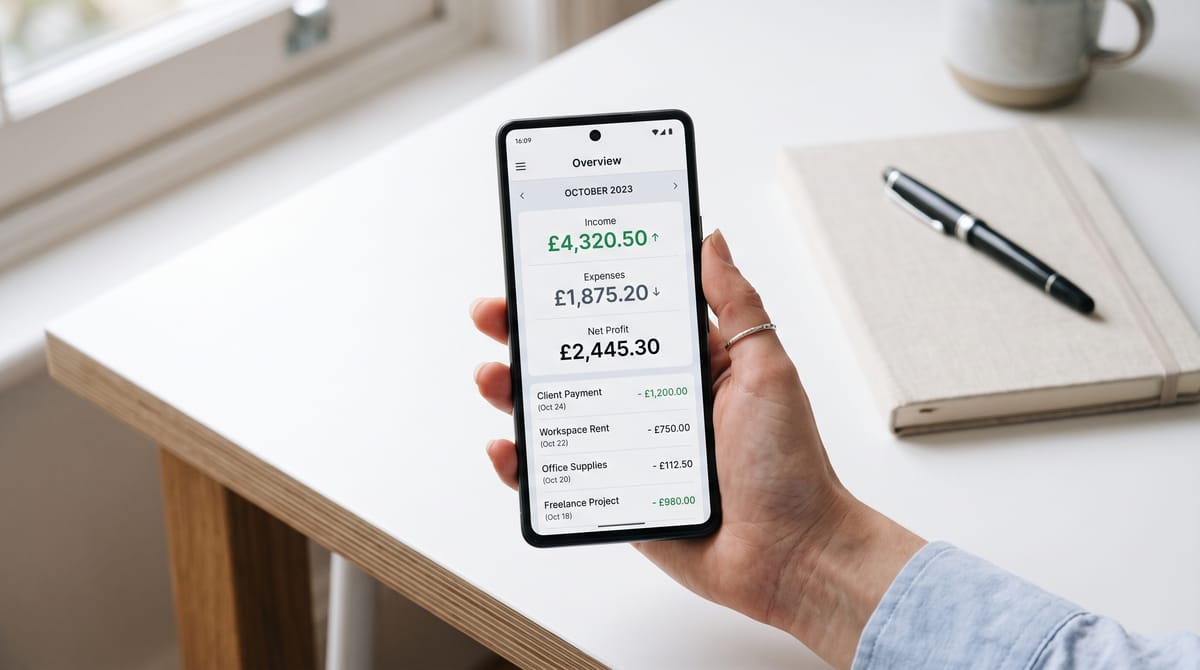
Coconut is a UK-built mobile-first bookkeeping and tax app aimed squarely at sole traders, freelancers, CIS subcontractors and individual landlords. It is one of the few accounting tools on the market that has positioned itself almost entirely around Making Tax Digital for Income Tax Self Assessment, rather than bolting MTD ITSA onto a wider small-business accounting platform as an afterthought. The result is a product that the right user finds genuinely useful — and that the wrong user abandons after three days.
This review covers what Coconut does, what it costs, where it earns its keep, and where it falls short. If you are a sole trader trying to work out whether Coconut deserves a place in your toolkit alongside or instead of FreeAgent, Hammock or Pandle, read on. If you are a limited company director or a VAT-registered business, save yourself some time: there are better options for your situation, and this review will explain why.
Need to capture receipts and automate bookkeeping alongside your accounting app?
TL;DR — Coconut App 2026
- HMRC-recognised for MTD for Income Tax Self Assessment — one of the most focused MTD ITSA tools on the UK market.
- Pricing runs from £99.99/year (Bookkeeping only) to £159.99/year for the full stack including MTD submissions and Self Assessment filing.
- Right choice if you are a UK sole trader, freelancer or individual landlord below the limited company threshold. Wrong choice if you run a limited company, employ staff, or are VAT-registered.
What Is Coconut?
Coconut is operated by Coconut Platform Ltd, a London-based fintech that launched around 2017. The original product combined a prepaid current account with built-in bookkeeping, but the business has since narrowed its focus: the proprietary current account has been wound down, and the platform now sits purely as a software product that sits on top of your existing UK bank accounts.
Coconut is FCA-authorised as an Account Information Service Provider (AISP), which is the regulatory permission needed to read your bank transactions via Open Banking. Your data is held in the UK with bank-level encryption in transit and at rest, and the platform falls under UK GDPR. For a sole trader handing over read access to their bank account, that regulatory standing matters.
The target user is narrow by design. Coconut is built for individuals who file a personal Self Assessment return — specifically those with self-employment income on SA103, or property income on SA105. It works well for freelancers, contractors trading as sole traders, CIS-registered subcontractors, tradespeople, and small landlords with one or a handful of buy-to-let properties. It is not built for limited companies, partnerships, employers, or VAT-registered businesses with complex VAT schemes.
That focus has become commercially relevant because Making Tax Digital for Income Tax Self Assessment is now live. From April 2026, sole traders and landlords with qualifying income above £50,000 must keep digital records and submit quarterly updates to HMRC. The threshold drops to £30,000 from April 2027 and £20,000 from April 2028. Coconut has built its entire product around that change — which is why it resonates with the users it is designed for, and why it cannot meet the needs of anyone outside that scope.
Coconut Pricing 2026
Coconut publishes four plans. All prices are inclusive figures from getcoconut.com at the time of this review.
| Plan | Annual price | Monthly option | Includes |
|---|---|---|---|
| Bookkeeping | £99.99/year | £16.99/month | Bank feeds, auto-categorisation, receipt storage, invoicing, P&L, accountant access, SA103/SA105 estimate |
| MTD Filing | £129.99/year | Annual only | Everything in Bookkeeping + quarterly MTD ITSA updates, end-of-period statements, final declaration, in-year tax estimates |
| +Self Assessment | £129.99/year | Annual only | Everything in Bookkeeping + direct SA100–SA109 submission to HMRC, tax-saving suggestions |
| Full | £159.99/year | Annual only | All of the above — MTD ITSA submissions and Self Assessment filing combined |
A 14-day free trial is available with no card details required. Coconut also has a long-running partnership with Zempler Bank: new Zempler current account holders can access Coconut free for two years. That is a genuinely useful deal if you are in the market for both a business bank account and a bookkeeping tool.
The pricing structure is honest. A sole trader who needs the full MTD ITSA and Self Assessment workflow pays £159.99 a year — £13.33 a month effective. That compares favourably with FreeAgent's sole trader pricing (free only for NatWest/RBS/Mettle customers; otherwise charged on subscription). There is no per-client uplift, no add-on tier for features that should be standard, and no surprise pricing at renewal.
Core Features
Open Banking and bank feeds
Coconut connects to more than 25 UK banks and financial providers via Open Banking, including the major high street banks (Barclays, NatWest, HSBC, Lloyds), the digital banks popular with the self-employed (Monzo, Starling, Revolut, Tide, Mettle, Cashplus, Zempler), PayPal and American Express imports. The connection is read-only, FCA-regulated and requires re-authorisation every 90 days under strong customer authentication rules.
Once connected, transactions appear in the app within minutes of clearing. The key differentiator is how those transactions are categorised: rather than mapping to a traditional chart of accounts, Coconut's categories map directly to the boxes on the SA103 self-employment supplementary page and SA105 property income page. That means a transaction marked as "vehicle costs" goes straight to the right box on the tax return without any further mapping step. For sole traders who find traditional bookkeeping categories abstract, this is a meaningful simplification.
Receipt capture and expense recording
Receipts are captured by photo from the mobile app and attached to a matched bank transaction, with images held in encrypted storage. Multiple receipts can be attached to a single transaction. A separate out-of-pocket entry covers cash expenses or anything paid from a personal card not connected to the Open Banking feed — important for sole traders who mix personal and business spending.
Coconut does not do full OCR extraction of receipt totals into editable fields, in the way Dext or Receipt Bot do. For the volume of receipts a typical sole trader produces, that is rarely a constraint. For a bookkeeper processing dozens of client receipts a week, it would be.
Invoicing
Unlimited invoicing is included on every plan. Invoices can be drafted from the mobile app or web, sent by email, marked paid manually or matched against an incoming bank transaction. Recurring invoices and payment reminders are supported. There is no integrated card payment processing on the invoice — clients pay by bank transfer rather than clicking a Stripe or GoCardless link — which is a gap for freelancers whose clients expect to pay by card from the invoice itself.
MTD for Income Tax quarterly filing
This is where Coconut earns its place. The MTD Filing plan handles all four quarterly updates required under MTD ITSA, the end-of-period statement for each business or property income source, and the final declaration that replaces the current Self Assessment return. The app prompts the user as each quarterly deadline approaches — Q2, for instance, covers 6 July to 5 October and falls due on 7 November 2026 — presents a summary of the period's income and expenses for review, and then submits directly to HMRC.
For users who have been using Coconut for day-to-day bookkeeping throughout the quarter, the quarterly submission is largely a confirmation exercise. The in-year tax estimate updates after each submission to give a running view of the probable tax bill. Coconut has also participated in the HMRC MTD ITSA pilot programme for several tax years, which means it has worked through the edge cases that newer entrants are still discovering. If you want to understand what the 2026/27 soft landing covers — and what it doesn't, that context matters before picking any MTD tool.
Self Assessment preparation and filing
The +Self Assessment and Full plans give the user direct submission to HMRC across the full Self Assessment family, SA100 to SA109. A sole trader with self-employment income (SA103), property income (SA105), employment income (SA102) and capital gains (SA108) can prepare and file the entire return inside Coconut. Tax-saving suggestions prompt the user on allowable expenses commonly missed — useful for a sole trader filing their own return, less so for those with an accountant who manages this anyway.
Accountant access
The Coconut Accountant Portal gives a registered agent real-time read access to a client's records without manual document exchange. This is included on every paid plan. It is a straightforward implementation rather than a deep practice management integration — there are no workflow or task management features, no bulk billing, and no multi-client dashboard of the kind you would find in a proper practice management platform. But for a sole trader whose accountant just needs to see the numbers at year end, it removes the spreadsheet-attachment workflow.
MTD ITSA and HMRC Compliance
Coconut appears on the HMRC list of MTD ITSA-compatible software. It covers digital record-keeping, quarterly update submissions, end-of-period statements and the final declaration. That recognition has been in place through the HMRC pilot programme, which is a meaningful track record compared with products that were only recently added to the HMRC register as the April 2026 mandation date approached.
It is important to note what Coconut is not: it is not an MTD for VAT product. A VAT-registered sole trader whose primary compliance need is digital VAT submissions will be better served by Xero, QuickBooks Online, Sage Accounting or Pandle. You can check which tools cover which MTD obligations before committing to any platform.
Who Should Use Coconut — and Who Should Not
Good fit for:
- UK sole traders and freelancers with income at or approaching the £50,000 MTD ITSA threshold (dropping to £30,000 from April 2027)
- CIS subcontractors filing as sole traders who want mobile-first record-keeping and direct SA103 filing
- Individual landlords with one to a handful of buy-to-let properties held personally, filing SA105 each year — though for landlords wanting dedicated property-level reporting, Hammock is purpose-built
- Sole traders who want cost certainty — a maximum of £159.99/year for the complete MTD ITSA and Self Assessment filing stack is genuinely competitive
- Anyone who banks with Zempler and can get two years of Coconut free as part of the bank partnership
For more options in this segment, the best free bookkeeping tools for UK sole traders covers the full range from genuinely free to low-cost paid options.
Not a good fit for:
- Limited company directors — Coconut does not produce statutory accounts, handle Corporation Tax or manage director loan and dividend workflows
- Employers — there is no payroll. A sole trader who takes on an employee will need to move to a fuller product
- VAT-registered businesses — MTD for VAT is not a primary Coconut feature
- Bookkeeping practices managing multiple clients — there is no multi-client dashboard, and the Accountant Portal is read-only access to a single client's data
- Anyone needing a deep app stack — there is no Zapier connector and no app marketplace comparable to Xero or QuickBooks Online
Coconut vs Competitors
| Tool | Best for | Price from | MTD ITSA | Ltd company | Free option |
|---|---|---|---|---|---|
| Coconut | Mobile-first sole traders, landlords | £99.99/yr | ✅ Full | ❌ | 14-day trial; Zempler deal |
| FreeAgent | Sole traders + ltd co directors | Free (NatWest/RBS/Mettle) | ✅ Full | ✅ | Free with qualifying bank account |
| Hammock | UK landlords (property-first) | £8 + VAT/mo | ✅ Full | ❌ | Free trial |
| Zoho Books | Sole traders wanting free SA100 | Free (under £35k turnover) | ✅ (from Jul 2026) | Limited | Permanently free tier |
| Starling Accounting | Starling bank customers | Free Essentials; £7 + VAT/mo Plus | ✅ (via Ember) | Limited | Free Essentials tier |
| Pandle | Price-sensitive desktop-first users | Free; Pro £5 + VAT/mo | ✅ | ✅ | Permanently free tier |
The most direct comparison is with FreeAgent. If you bank with NatWest, Royal Bank of Scotland, Ulster Bank, or Mettle, FreeAgent is free and covers both sole trader and limited company workflows in the same product. That is a hard deal to beat. If you do not bank with those providers, Coconut's annual pricing is often cheaper once MTD ITSA is in scope, and its SA103/SA105 category mapping removes friction that general accounting software creates.
For landlords: Coconut supports the SA105 workflow cleanly, but Hammock is purpose-built for property-first users who want mortgage interest tracking against Section 24, deposit protection logs and tenancy management in the same product. If your property portfolio is the main financial complexity in your affairs, read our guide to AI-powered landlord accounting tools before deciding.
Verdict
Coconut is one of the most clearly positioned bookkeeping products on the UK market in 2026. It is not trying to be Xero. It is not trying to be FreeAgent. It is a mobile-first, sole trader and landlord product built around the assumption that the user files a personal Self Assessment return and is now, or will soon be, in scope for Making Tax Digital for Income Tax.
Inside that scope, it does the job cleanly: HMRC-recognised MTD ITSA filing, transparent annual pricing capped at £159.99, FCA-authorised Open Banking, SA103/SA105 category mapping, and a UK-based support team that has been running with the HMRC pilot for years. The 14-day free trial requires no card, which makes it low-risk to test before committing.
The honest caveat is that the list of things Coconut cannot do is long: no limited company, no payroll, no deep VAT support, no app marketplace, no balance sheet, no card payments on invoices. If any of those are non-negotiable for your situation, look elsewhere. The product will tell you this itself — and that honesty is one of the things that makes it a reasonable choice for the users it is built for.
Frequently Asked Questions
Is Coconut HMRC-recognised for Making Tax Digital for Income Tax?
Yes. Coconut appears on the official HMRC list of MTD ITSA-compatible products and has been used in the HMRC pilot programme for several tax years. The MTD Filing plan covers quarterly updates, end-of-period statements and the final declaration.
Can I use Coconut if I am a limited company director?
Not usefully. Coconut is built for personal Self Assessment workflows (SA103 self-employment, SA105 property income). It does not produce statutory accounts, file Corporation Tax or handle director loan or dividend workflows. A director with a personal SA filing obligation could technically use Coconut for the personal return, but the company itself needs different software.
How does Coconut pricing compare to FreeAgent?
FreeAgent is free for personal and business banking customers of NatWest, Royal Bank of Scotland, Ulster Bank and Mettle. If you qualify, FreeAgent is the cheaper option and covers more use cases. If you do not bank with those providers, Coconut's Full plan at £159.99/year often undercuts FreeAgent's paid subscription for the equivalent sole trader MTD ITSA and Self Assessment functionality.
Does Coconut support VAT returns?
Coconut is not designed for VAT-registered businesses. The product is built around MTD for Income Tax and Self Assessment. If MTD for VAT is a primary requirement, look at Xero, QuickBooks Online, Sage Accounting or Pandle instead.
Can my accountant access my Coconut records?
Yes. The Coconut Accountant Portal gives a registered agent real-time read access to your data. This is included on every paid plan — there is no separate charge for accountant access, which is not the case with every bookkeeping tool in this segment.
Is there a free version of Coconut?
There is no permanently free tier. A 14-day free trial requires no card details. New Zempler Bank current account holders can access Coconut free for two years through the bank's partnership arrangement.
Related Reading
- FreeAgent Review 2026: Is It Still the Best Free Option for UK Sole Traders?
- Best MTD Software for UK Sole Traders (2026) — HMRC-Recognised Options Compared
- AI Bookkeeping for UK Landlords: Tools to Automate Property Accounting (2026)
Affiliate disclosure: Some links in this article are affiliate links. If you sign up through them, we may earn a commission at no extra cost to you. We only recommend tools we've genuinely assessed.